The Alliance Framework
The Inspired Manual for Building and Sustaining Long-Lasting Fellowship Among Churches
Copyright and Edition Information
Copyright
Copyright © 2026 Apostle Anderson. All rights reserved.
A lawfully acquired copy, whether purchased or supplied through an Author/Publisher-approved distribution, may be used, taught from, reproduced, and adapted for that church's or named Alliance organization's own internal governance and teaching use, subject to the Standing Use License stated in this edition. Resale, external republication as another party's work, claiming authorship, issuing an altered work as an official edition of The Alliance Framework, or using protected Framework publication or certification marks outside the standing-use terms requires separate written permission from the Author/Publisher.
This notice does not claim exclusive ownership of the common word alliance, create or name an Alliance organization, or prevent churches from choosing and lawfully registering an independent name such as One God Alliance or Alliance of Strength. Each Alliance organization is responsible for its own lawful name, formation, registration, governance, records, and public representations. Adoption of this book does not make that organization a branch, subsidiary, or property of the Author/Publisher.
This First Edition is author-issued and self-published by TeleChurch Live through Lighted Candle Church Inc. It does not claim federal copyright registration, trademark registration, attorney certification, governmental approval, or endorsement by any denomination. The manual ledger, revision report, source receipts, asset records, and publication hashes together form the private Manual Rights, Authorship, and Source Clearance Record supporting this edition.
A Word From the Author
“But the manifestation of the Spirit is given to every man to profit withal.”
1 Corinthians 12:7, KJV
This manual was not born from theory alone. It grew out of my life in the Church, my years of pastoral service, my study of the Word of God, my prayers, my questions, and the experiences that have shaped both my faith and my calling.
I know what it means to experience the loss of a pastor and the loss of a church. I have watched churches weaken, crumble, and close their doors. I have seen faithful people displaced, congregations left without direction, and pastors carrying burdens they were never trained or supported to carry. I have watched leaders who sincerely loved God become helpless before problems that required more than preaching. They needed order, counsel, trained people, dependable relationships, and a path by which a struggling church could be strengthened rather than abandoned.
Those experiences placed a lasting burden in my heart. I became an advocate for the survivorship of churches. I do not want the painful patterns I have witnessed to continue from one congregation to another and from one generation to the next. Too many churches close each year, not because their people have no faith, but because faith was left without the practical support, leadership development, accountability, and restoration needed to carry the work through difficulty.
I wrote this manual because I believe churches can survive, recover, grow strong, and help one another without losing their identity. Fellowship should not leave one church carrying every burden. Governance should not replace love; it should protect love when relationships become larger and more difficult to manage. Restoration should not be a word of shame. It should be an organized path through which a church receives help, develops its leaders, repairs what is broken, and returns to mission with greater strength.
The organizational model presented in The Alliance Framework is the fruit of that journey. Its relationships, principles, classifications, teaching path, Church Modes, leadership patterns, safeguards, and Circle of Support were formed through years of observation, pastoral experience, study, prayer, correction, and reflection. I believe God gave me this burden and inspired me to bring these pieces together for the benefit of the Church. This book is my original expression of that calling and my effort to steward it faithfully.
My purpose is larger than the success of one congregation or one organization. I am driven by a call to make an enduring impact and to participate in the restoration of the Church as a whole. My prayer is that this work will help pastors become better equipped, churches become more stable, fellowship become more balanced, leaders become more accountable, and congregations discover that difficulty does not have to be the end of their story.
If this manual helps one pastor find support, one church remain open, one congregation recover its strength, or one fellowship learn how to carry its responsibilities together, then the gift has made room for the work it was given to accomplish.
General Preamble
An alliance is not first an organization. It is a relationship.
Merriam-Webster defines an alliance as:
“a bond or connection between families, states, parties, or individuals”
Merriam-Webster.com Dictionary, “Alliance”mw-alliance
That definition begins with a bond, not a building, corporation, office, treasury, or governing board. People and churches may be allied because they are connected by trust, shared concern, mutual support, or a common purpose. The relationship can exist before anyone creates an organization to manage it.
Fellowship works the same way. Fellowship is shared spiritual and relational life. It is not automatically an organization, and churches do not become one organization merely because they pray together, visit one another, exchange pulpits, share a gathering, or help one another through difficulty. Fellowship can be organized, but the fellowship itself is the relationship. Organization is a tool used to care for that relationship when shared activity becomes too large or complicated to carry informally.
This book uses three related terms that must not be confused.
The Alliance Framework is this book and teaching system. It explains how churches may form, govern, teach, and sustain an Alliance organization. The book is not itself an Alliance organization, does not automatically create one, and does not give every Alliance organization the same proper name.
alliance is the relationship principle. It is the bond of trust, shared purpose, mutual support, and cooperative work that may exist before any board, treasury, registration, charter, or legal entity. An alliance may be real even when no organization has yet been formed to govern it.
an Alliance organization is the separately named body later formed to govern a particular alliance. It must choose its own proper name, such as One God Alliance or Alliance of Strength, adopt the governing records required for its work, and complete any formation or registration required by its jurisdiction. It may adopt The Alliance Framework, but it remains legally and organizationally separate from this book and from its Author/Publisher.
Defined labels such as Alliance Board, Alliance Church, Alliance Branch, Alliance Convention, and Alliance Network describe functions or classifications within the Framework. They are not substitutes for an organization's proper name. Legal records, adoption records, registrations, public representations, and formal agreements should identify the actual organization by name.
Put simply, the alliance relationship comes first. A named Alliance organization comes later when churches need a fair and dependable way to care for that relationship. The Alliance Framework is the book that teaches them how to establish and carry that order.
The Alliance Framework begins with a simple conviction: churches are stronger when they do not have to stand alone. Pastors need trusted relationships. Congregations benefit when churches share wisdom, encouragement, training, and opportunities for mission. Members grow when they can see that the body of Christ is larger than one local assembly.
Fellowship is the beginning of that relationship. Two or three churches can often coordinate naturally because the pastors know one another and the number of schedules is still small. As more churches join the relationship, the same warmth remains important, but goodwill alone can no longer carry every decision. Dates begin to compete. Hosting and travel can become uneven. Strong churches may carry most of the work, while struggling churches may need more support than the group knows how to provide. At that point, fellowship needs agreed order, not to replace love, but to protect it.
The named Alliance organization carries that agreed order. It gives many churches a way to coordinate fellowship, develop leaders, strengthen churches, plan common seasons, share responsibility, and deal honestly with conflict. It does not claim the same authority over every church. Some churches simply fellowship. Some voluntarily enter a written covenant that gives the Alliance organization specific oversight. Others are founded by that Alliance organization from their beginning. These relationships are different, and respecting those differences is one of the main ways the organization protects trust.
The Framework also teaches that strong fellowship is built by strong churches. A church does not have to be large or wealthy to be strong. Strength is seen in dependable worship, sound teaching, responsible leadership, honest finances, care for members, outreach, and a willingness to receive help when help is needed. When a church is going through a move, a pastoral change, a new beginning, or a season of correction, its Alliance organization should respond with the right kind of support instead of shame or unrealistic demands.
The principles in this book, including truth, order, mutual care, responsible giving, accountability, protection, reconciliation, and restoration, are broad Christian principles. They are not owned by one denomination. Each Alliance organization's specific beliefs are stated in its separately adopted doctrinal book, identified in this working example as the Apostolic Doctrine. Churches that enter relationships requiring doctrinal agreement receive and teach that selected doctrine alongside this book.
This is therefore a book about how churches walk together. It explains the alliance principle, how churches may form and name an Alliance organization, how different churches relate to that organization, what leaders and members may expect from one another, how shared work is organized, and how fellowship remains truthful when growth or difficulty tests the relationship.
mw-alliance Merriam-Webster.com Dictionary, “alliance,” accessed July 30, 2026, https://www.merriam-webster.com/dictionary/alliance.
Table of Contents
Front Matter
- Copyright and Edition Information
- A Word From the Author
- General Preamble
- Table of Contents
- Introduction
- An Alliance Story: The Vision of the Harvest
- Curriculum Map: Read From Outer to Inner
- Who Am I in Relation to an Alliance Organization?
Outer-to-Inner Curriculum
- Part I. Common Foundation and Visitor Curricula
- 1. Why Churches Form an Alliance Organization
- 2. Who We Are, What We Do, and What We Believe
- 3. How We Know What Governs
- 4. Visiting an Alliance Organization and Understanding Its Structure
- Part II. Church Relationship Curricula
- 5. Fellowship Church: Level One Collaborative Fellowship
- 6. Covenanted Church: Level Two Covenanted Oversight
- 7. Alliance Branch: A Service and Fellowship Overlay
- 8. Alliance Church: Level Three Alliance-Founded Constituent
- Part III. Pastors, Leaders, and Alliance Officers
- 9. Pastors, Leaders, Churches, and Members
- 10. Roles, Officers, Boards, Records, and Access
- 11. Alliance Board, Governing Officers, Certification, and Leadership Transition
- Part IV. Governance and Accountability
- 12. How to Run Alliance Board, Church Board, and Church Business Meetings
- 13. The Circle of Support: Giving, Workers, Property, and Accountability
- 14. Honorable Conduct, Safety, Correction, Restoration, and Appeal
- Part V. Mission and Church Development
- 15. Outreach, Shared Gatherings, and the Yearly Rhythm
- 16. Growing People, Developing Leaders, and Understanding Church Mode
- Part VI. Manual Stewardship and Maintenance
- 17. Keeping an Alliance Organization Clear Through Change
Back Matter
- Back Matter: Appendices, Glossary, and Index
- Appendix A. Apostolic Doctrine Register
- Appendix B. Glossary, Definitions, and Classification
- Appendix C. Role and Authority Matrix
- Appendix D. Meeting Procedures
- Appendix E. Financial Controls
- Appendix F. Discipline and Appeal Procedures
- Appendix G. Orientation Completion Record
- Appendix H. Forms and Templates
- Appendix I. Exact Standards Register
- Appendix J. Curriculum, Certification, and Stopping-Point Register
- Subject and Curriculum Index
- Back Cover
Introduction
An Alliance organization is not a replacement for fellowship. It is what churches may form when an existing alliance relationship grows large enough to need a dependable way to plan, share, decide, train, and solve problems together. The relationship should still feel brotherly and spiritual. The added organization exists so that the relationship can remain fair and healthy as it becomes larger. The Alliance Framework supplies a formation and governance method, but the adopting churches must name and lawfully form their own organization.
This growth does not mean every church moves up a ladder. A visiting church is learning about the relationship. A fellowship church shares in voluntary fellowship without giving the Alliance organization power over its government. A covenanted church is a pre-existing church that has voluntarily placed specific matters under Alliance oversight in writing. An Alliance church is a church founded by the Alliance organization from its beginning. A branch church is not another level; it is a covenanted or Alliance church that has also accepted responsibility to help coordinate fellowship and ministry in an area.
These names matter because authority must be honest. A warm relationship does not transfer power. Years of attendance do not transfer power. Giving money does not transfer power. A title in a database does not transfer power. Where authority exists, the church should be able to point to the covenant, charter, founding record, or appointment that created it.
In simple terms, no person or body should gain power because everyone assumed the power was there. Authority must be named, accepted, and recorded.
The relationship also belongs to the people who must live it. Pastors should not be taught one version while members receive only a slogan. Officers should not make decisions from information the congregation was never given. For that reason, the pathways below speak to pastors and members together, while giving leaders the additional detail required by their duties.
A Personal Word to Those Approaching an Alliance Organization
To the Person Called to Begin an Alliance Organization
If you are thinking about starting an Alliance organization, you have taken up a charge that is larger than arranging meetings or gathering names. You are carrying a call to help churches find one another, strengthen one another, and learn how to walk together without losing truth, dignity, or proper authority. Be faithful to that call even when the vision is clearer to you than it is to those around you. Choose a name that truthfully identifies the organization, and complete the formation or registration required where it will operate.
Do not mistake a slow beginning for a failed calling. Formation requires prayer, study, preparation, patient explanation, and the courage to continue when the first invitations are not received. Be diligent and persistent without becoming forceful. Trust God to send the right people: those prepared to receive the vision, test it honestly, and help give it faithful form. Your responsibility is to keep the flame, explain it clearly, live its principles, and recognize the people who can help carry it.
To Prospective Presidents and Officers
If you have been invited to join with others in forming an Alliance organization, receive the invitation with prayer, love, and honest discernment. You are not being asked merely to fill a seat or lend your name to another person's idea. You are being invited to help turn a call for unity into dependable service for churches, pastors, leaders, and members.
When you recognize the worth of that call, show your support to the person carrying the flame of unity. Support does not mean silent agreement with everything. It means showing up, learning the work, giving truthful counsel, sharing the burden, guarding the order, and helping the vision mature beyond the strength of one person. A faithful officer neither takes possession of another person's call nor leaves that person to carry it alone.
To Congregations and Visiting Churches
If your congregation is observing the formation of an Alliance organization and deciding whether to participate, your questions are welcome. You may remember broken partnerships, controlling leaders, disappointed promises, divided fellowships, or times when trust was used against the people who gave it. Caution after hurt is understandable. This book does not ask a church to ignore its history, silence its concerns, or surrender authority merely to prove unity.
Take time to listen, ask direct questions, examine the governing records, and compare the promises of the Alliance organization with the conduct of its leaders. Look for truth joined with love, order joined with humility, and accountability joined with restoration. God is faithful and can bring wounded people and churches back into honorable fellowship without denying what they have survived. Participation should be informed, voluntary, and accurately recorded according to the relationship the church has actually chosen.
To the Individual Visitor
If you are simply visiting, you are not expected to understand every office, covenant, or rule at once. Begin by learning what the Alliance organization is, why churches are gathering, and how the Alliance organization treats people who have not made a commitment. Observe patiently. Ask honest questions. Test the spirit and fruit of what you encounter by its truthfulness, love, order, humility, safety, and care for people.
You may receive what is good without pretending to hold a relationship you have not chosen. You may raise a concern without being treated as disloyal. You may take the time needed to become settled in a local church before considering any deeper Alliance responsibility. A healthy Alliance will not pressure a visitor to claim belonging before understanding what that belonging means.
An Alliance Story: The Vision of the Harvest
This section appears early because many readers need to see the Alliance in motion before they meet its later governance structures. Governance protects the work, but the work itself is the harvest: churches moving together through outreach, convention, assimilation, review, and relaunch across the year.
The story below is one common example, not the only lawful pattern. A church may tighten the timeline into one weekend or spread it across several weeks. What must remain constant is the movement: the Board names the season, the church carries the local burden, the wider body gathers the harvest, the church protects the fruit, and the Alliance reviews the quarter before launching the next one.
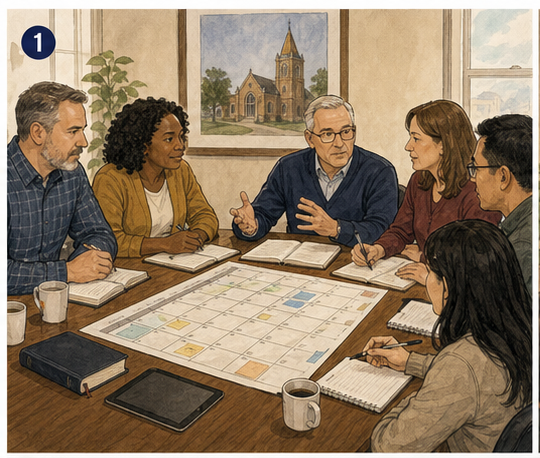
The Board Sets the Quarter in Motion
Pastor John leads a Covenanted Church that has chosen to align its congregation with the Alliance calendar. The church remains a true local church with its own pastor, its own members, its own worship life, and its own local responsibilities. But it does not move alone. It chooses to move in rhythm with the wider Alliance.
At the crossover point from the previous quarter, the Alliance leadership has already reviewed the last season, received reports, identified strengths and gaps, and announced the next focus. Now the churches are entering a season of concentrated labor. This quarter is Men's Season. That means the churches are not guessing what to emphasize. The burden has already been named. The direction is already clear.
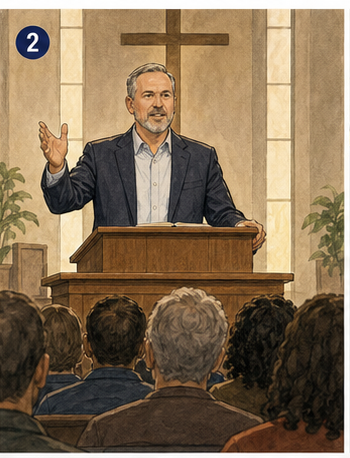
Pastor John Names the Season
On Sunday morning Pastor John stands before the church and explains it plainly. He tells the congregation, “We have entered Men's Season. This is the part of the year where we focus intentionally on reaching men—your brothers, your fathers, your sons, your uncles, your friends, your coworkers, your boss, your neighbor, the men you see every day who need God, brotherhood, truth, healing, direction, and a place to stand.”
He does not speak of it as merely another event announcement. He speaks of it as part of the life of the Alliance. The church is now entering a defined field of labor together with other churches. The quarter has a focus. Their labor has a target. Their invitation has a purpose.

The Burden Leaves the Building
Among those listening is Susie, one of the church's outreach-minded members. Later that week she gets into an Uber and begins speaking with the driver. The conversation turns personal. He shares some strain in his life, pressures at home, and the fact that he has not really been in church for a long time.
Because her church has already entered Men's Season, Susie is not left searching for what to say. She knows what the church is doing. She knows what burden they are carrying. So she warmly invites him into the church's men-focused outreach effort. At the same time, others are speaking to brothers, sons, uncles, husbands, neighbors, and coworkers. The season is no longer only on the calendar. It is now in the mouths and hearts of the people.

The Local Church Opens the Door
Before the wider Alliance gathering comes into view, Pastor John and his church prepare a local path of invitation. One common pattern may place a Friday or Saturday men-focused activity close to the general convention so that guests can move naturally from local contact into wider participation. It may be a cleanup day, a breakfast, a workshop, a family event, or some other accessible gathering that makes room for conversation and welcome before a formal service ever begins.
Then Sunday morning arrives, and the church holds its own local service with the men's burden clearly in view. This is still the church's own service. It belongs to the local church. No other church is being invited to treat it as the larger gathering. It is the congregation doing its own local work faithfully. The Uber driver comes. A brother comes. A son comes. A few men who would not normally attend show up because someone cared enough to bring them through the door.
The Wider Body Gathers in Convention
The local church service is not the end of the movement. It is the beginning of a larger step. Near the middle of the quarter, the wider Alliance holds what may be called a convention. This is more than a narrow local fellowship service. It is a larger fellowship culmination designed to include the whole body: visiting churches, fellowship churches, Covenanted Churches, Branch Churches, and Alliance Churches gathering together in one broad, shared moment.
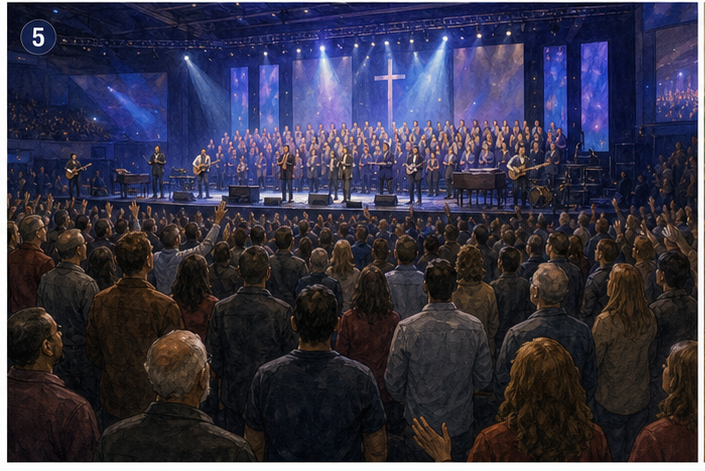
This convention is intentionally designed to carry weight, beauty, excellence, and welcome. The location should be large enough, accessible enough, and convenient enough to support the effort well. Music should be prepared at a high level. Choir and worship support should be strong. The tone should be celebratory, reverent, coordinated, and full of life. The gathering should feel like a true culmination of the quarter's labor, not an improvised meeting added to the calendar at the last minute.
Now the visitors are not only experiencing one local congregation. They are experiencing the wider Alliance in motion. They can see that what Pastor John invited them into is not a private church hobby. It is part of a living fellowship. That is why the convention belongs near the middle of the quarter. By then, churches have already begun local outreach. Momentum has already been built. Relationships have already been stirred. The convention becomes the larger harvest point of that same effort.
The Work Continues After the Gathering
The convention is not the finish line. After the gathering, Pastor John and his leaders ask the real questions. Who came? Who stayed engaged? Who needs a call? Who asked questions? Who needs prayer? Who should be visited? Who is ready for another invitation? Who must now be welcomed into the real life of the church?


Susie follows up with the Uber driver. Another member follows up with his brother. A mother continues speaking with her son. Men who were visitors are now remembered as people, not counted merely as attendance. This is the Assimilation Phase of the season. The church invites them back, checks on them, places them into relationship, and helps them move from momentary contact into actual nurture.
The Quarter Closes in Review
Then, when the season begins to wind down, the Alliance reaches the next crossover point. The Board gathers again. This meeting is not separate from ministry. It is part of the rhythm of ministry. Leadership reviews the completed season: what the churches attempted, what the convention produced, what the assimilation revealed, where the burden was strong, where it was weak, and what must be strengthened for the next cycle.
The Board then confirms the next seasonal focus and relaunches the Alliance into it. So Pastor John returns to his congregation and says, in effect, “We have completed Men's Season. Now we are entering Youth Season,” or whichever quarter comes next. And the whole pattern begins again.
What the Story Teaches
This is how the Seasonal Rhythm works in practice. The local church begins the labor. The wider fellowship culmination gathers the harvest. The local church protects the fruit through assimilation. The Board reviews, governs, and relaunches the next season.
- The Board sets the quarter in motion by naming the next seasonal burden.
- The pastor translates that burden into plain language for the congregation.
- Members carry the burden into daily life through invitations and outreach.
- The local church creates the first welcoming doorway through its own events and services.
- The convention gathers the larger harvest in a coordinated Alliance-wide culmination.
- Assimilation protects the fruit by turning visitors into remembered people and nurtured relationships.
- The crossover review turns one season into the launch point for the next.
Curriculum Map: Read From Outer to Inner
The manual is cumulative. Every later curriculum includes the understanding taught before it. A reader stops when the curriculum matching the reader's present relationship and responsibility is complete. A reader with broader responsibility continues toward the back of the book.
This means each reader begins at the front, learns the material shared by everyone, and continues only as far as the reader's actual duties require.
This is a progression of learning and accountability, not a ladder that changes church origin or spiritual worth. A Level Two church does not become Level Three by reading farther. Later readers study earlier relationships so they can understand and serve the whole Alliance without claiming authority that does not belong to them.
| Curriculum | Who completes it | Read cumulatively through | Completion point |
|---|---|---|---|
| Individual Visitor | A person exploring the Alliance organization without settled Alliance-related responsibility | Chapter 1 | Individual Visitor Orientation |
| Visiting Church | A pastor, leader, member, or participant of a church exploring the Alliance organization | Chapter 4 | Visiting Church Orientation |
| Fellowship Church | Level One pastors, representatives, leaders, and members | Chapter 5 | Fellowship Church Curriculum |
| Covenanted Church | Level Two pastors, local governing officers, and members | Chapter 6 | Covenanted Church Curriculum |
| Alliance Branch | Level Two or Level Three church carrying Branch recognition | Chapter 7 | Branch Overlay Curriculum |
| Alliance Church | Level Three pastors, leaders, and members | Chapter 8 | Alliance Church Curriculum |
| Pastor and Local Leader | Pastors and senior local leaders in any recognized relationship | Chapter 9 | Pastor and Local Leader Curriculum |
| Local or Specialized Officer | Local boards, secretaries, treasurers, events, safeguarding, restoration, records, property, and communication servants | Chapter 10 | Local or Specialized Office Curriculum |
| Alliance Board or Governing Officer | Board, Council, Chairman, President, Vice President, and other governing officers | Chapter 11 | Alliance Board and Officer Curriculum |
| Governance and Accountability | People responsible for meetings, finance, property, safeguarding, discipline, restoration, or appeal | Chapter 14 | Governance and Accountability Curriculum |
| Mission and Church Development | People responsible for fellowship, gatherings, seasons, outreach, development, or Church Mode | Chapter 16 | Mission and Development Curriculum |
| Full Manual Steward | Full Curriculum Instructors, full verifiers, amendment stewards, and final manual custodians | Chapter 17 and applicable back matter | Full Alliance Curriculum |
Doctrine teaching is a separate authorization layered onto the appropriate cumulative curriculum. A Doctrine Instructor or Doctrine Verifier also studies the current doctrinal book and doctrine records in Appendix A.
How the Stopping Points Work
Each curriculum ends with a clearly marked checkpoint. The checkpoint states what was required, what the learner must understand or demonstrate, what record is completed, and whether the reader stops or continues.
A person may read beyond the required stopping point voluntarily. Reading farther gives understanding; it does not create recognition, office, instructor authority, verifier authority, or a different church relationship.
Who Am I in Relation to an Alliance Organization?
The Preamble, Introduction, and Curriculum Map first explain the Alliance organization. These questions now help the reader identify where to stop. Checking a box does not create status. Every answer carrying authority must be confirmed by the appropriate church, covenant, charter, appointment, credential, or authorization record.
The questions help a reader find the right curriculum. They do not make the reader a member, officer, teacher, verifier, or representative.
Question 1: What Is Your Connection to a Local Church?
- If you are only visiting churches and are not settled, complete the Individual Visitor Curriculum and stop.
- If you attend a church but do not know whether you are a member, ask the church to confirm whether you are a visitor, membership candidate, or recognized member before continuing.
- If you are a recognized member, pastor, or local officer, continue to Question 2.
An Alliance organization does not provide a direct individual path that bypasses the local church. An unsettled visitor may read the manual voluntarily but may not advance into member, officer, instructor, verifier, or governing certification until local church standing is confirmed.
Question 2: What Is Your Church's Relationship?
- A church only exploring, with no recognition, covenant, or Alliance founding record, follows the Visiting Church Curriculum.
- A recognized church fellowshipping without transferred authority follows the Fellowship Church Curriculum.
- A pre-existing church with a written doctrine and oversight covenant follows the Covenanted Church Curriculum.
- A Level Two or Level Three church with Branch recognition adds the Alliance Branch Curriculum.
- A church founded by the Alliance organization from inception follows the Alliance Church Curriculum.
- If the relationship is unknown, use Chapters 4-8 and actual records to confirm it before claiming a category.
Attendance, payment, title, credential, time, or a database label cannot decide the relationship. Branch recognition is an overlay; it does not replace the underlying Level Two or Level Three origin.
Question 3: What Responsibility Do You Carry?
- Members stop at the curriculum for their church relationship unless another duty is assigned.
- Pastors and senior local leaders continue through the Pastor and Local Leader Curriculum.
- Local board members and specialized servants continue through the Local or Specialized Officer Curriculum.
- Alliance Board, Council, and governing officers continue through the Alliance Board and Officer Curriculum.
- Full instructors, verifiers, amendment stewards, and manual custodians continue through the complete manual and applicable back matter.
Question 4: What Is the Pastor's Personal Alliance Standing?
The pastor may be locally selected for Level Two service, Alliance-recognized or credentialed, Alliance-appointed for Level Three service, serving temporarily during transition, or carrying a Branch assignment. The pastor's personal status and the church's institutional relationship are separate records. Neither silently changes the other.
Question 5: Do You Teach or Verify?
Teaching a congregation, teaching the Board, teaching the full manual, teaching doctrine, teaching a specialized subject, and verifying completion are separate assignments. Complete the cumulative curriculum required for the audience and receive the matching instructor or verifier authorization. Office, experience, curriculum completion, or doctrinal knowledge alone does not create teaching authority.
Question 6: Is a Church Mode or Specialized Situation Active?
Mission, Startup, Transitional, and Restoration Modes add situation-specific guidance without changing the church relationship. Finance, property, safeguarding, discipline, appeals, events, records, and communication duties add their specialized sections and forms.
Record Your Result
The Reader Pathway Record identifies the reader, local church, confirmed church relationship, local role, pastoral standing when applicable, Alliance office, required stopping point, instructor or verifier scope, Church Mode or specialized assignment, and records proving each answer.
Common Foundation and Visitor Curricula
Everyone begins here. The Individual Visitor completes Chapter 1. A Visiting Church continues through Chapters 2-4 so its pastors, leaders, and people understand Alliance identity, doctrine boundaries, authority, and structure before deciding whether to seek a recognized relationship.
Why Churches Form an Alliance Organization
An Alliance organization exists because churches need one another. No local church possesses every gift, every skill, every resource, or every kind of experience. One pastor may be strong in teaching but need help with administration. Another church may have mature officers but struggle with outreach. One congregation may have musicians, counselors, teachers, or workers who can strengthen a neighboring church. Fellowship allows those strengths to circulate through the body instead of remaining locked inside one place.
1.1Alliance Begins as a Relationship Before It Becomes an Organization
The ordinary meaning of alliance begins with a bond or connection. That is why churches may be in alliance before they have a formal Alliance Board, treasury, office, or governing instrument. Their alliance is the relationship they have chosen to honor. Their fellowship is the shared life through which that relationship is experienced.
An organization is formed only when the relationship needs a continuing structure through which it can act. The formal Alliance comes into being through a founding and adoption process. That process identifies its purpose, jurisdiction, doctrine attachment, participating relationships, governing body, officers, records, finances, meeting order, and limits.
The organized body serves the alliance. It must never pretend that paperwork created the trust, calling, or fellowship that made the body necessary. Put simply, the documents establish how the churches will work together; they do not create the love and trust that brought the churches together.
This distinction also protects churches from accidental authority. Fellowship attendance does not place a church under an organization. Friendship does not create a covenant. A shared event does not create a governing body. Formal Alliance authority begins only through the lawful formation, covenant, founding, appointment, ratification, or other written act required for the authority being claimed.
1.2Fellowship Comes First
An Alliance organization does not create the desire to fellowship. That desire already exists when pastors pray together, visit one another's services, share pulpits, support special events, or help during a crisis. In a small circle, much of this can happen through friendship and simple conversation. Two or three churches may coordinate without building a larger governing structure because the people involved can still hold most of the relationship in direct personal contact.
An Alliance organization should never destroy this natural fellowship by making every act of kindness formal or by claiming authority over every shared event. Its purpose is to help fellowship remain healthy when the relationship grows beyond what a few personal conversations can manage.
1.3Why Growth Needs Order
As the number of churches grows, coordination becomes more difficult. Four or five churches can already feel the strain of choosing dates, rotating locations, sharing expenses, and deciding whose needs should receive attention first. By the time seven or more churches are trying to move together, the group will usually need a dependable calendar, clear meeting practices, agreed leadership, honest records, and a fair way to resolve disagreements.
These numbers are not legal thresholds. They are a practical picture of how complexity grows. The real question is whether the relationship can still be carried fairly through informal conversation. When repeated confusion, competition, overload, or resentment appears, the fellowship needs more order.
1.4Strong Churches Build Strong Fellowship
A fellowship is affected by the condition of every church in it. When one church is stable and another is continually disorganized, the stronger church may carry most of the planning, money, people, and emotional burden. Pastors may tolerate that imbalance for a time out of love, but an unaddressed imbalance can eventually produce frustration and distance.
The answer is not to shame the church that needs help. The answer is to strengthen it. An Alliance organization should provide training, honest assessment, experienced counsel, and a clear development path. A church that enters a season of restoration may need more meetings, closer support, better records, leadership training, or temporary limits on wider responsibility. Strong churches make strong fellowship, and strong fellowship makes a strong Alliance.
1.5What an Alliance Organization Adds
When churches formally constitute the Alliance organization, the organization gives their growing fellowship a shared calendar, a place for leaders to reason together, common seasons of ministry, training for pastors and officers, support for churches under strain, and guardrails for money, property, communication, conflict, and shared events. It helps the churches ask not only, “What is best for my congregation?” but also, “What will strengthen the whole fellowship?”
The practical result is shared order. Churches still care for their own people, but they also gain a dependable way to plan together, share burdens, and consider how one decision may affect everyone.
An Alliance organization does not receive the same power over every church. Some churches remain entirely self-governing while participating in fellowship. Some give the Alliance organization specific oversight through a written covenant. Alliance-founded churches begin under Alliance government. An Alliance organization is strongest when it tells the truth about these differences instead of using closeness to imply authority.
1.6What a Healthy Alliance Relationship Looks Like
A healthy Alliance does not make local churches smaller. It helps them become clearer, stronger, and more capable of serving. Strong churches share without dominating. Developing churches receive help without humiliation. Pastors can ask for counsel without losing dignity. Members understand why churches are working together. Shared events produce discipleship and lasting relationships rather than only excitement.
Most importantly, the Alliance organization protects fellowship from the very pressures that growth can create. Order serves love. Records serve trust. Accountability serves restoration. Leadership serves the churches, and the churches strengthen one another.
Discuss together:
- What is the difference between being in alliance and forming an Alliance organization?
- Which parts of fellowship exist through relationship, and which activities now need organized support?
- At what point does informal fellowship in our setting begin to feel strained?
- Which strengths could our church share with others?
- Where does our church need help so that fellowship remains balanced?
- What kind of order would protect the relationship without controlling it?
Make it real:
Ask each participating church to describe the relationship that already joins the churches, one strength it can share, one area in which it needs development, and one recurring coordination problem the wider fellowship should solve together. Use those answers to distinguish the alliance that already exists, needs that can remain informal, and needs that require a formally organized Alliance, training, planning, or governance.
You have completed the Individual Visitor Orientation when every requirement below is true. Reaching this page alone does not complete the curriculum.
Requirements
- You have read the Preamble, Introduction, Curriculum Map, Who Am I, and Chapter 1.
- You can explain in your own words why the Alliance organization exists, how fellowship differs from government, and why a person should not bypass the local church.
- An authorized teacher or verifier has reviewed the required discussion, exercise, or other completion evidence and the completion record has been made.
Completion Statement
COMPLETED: Individual Visitor Orientation
This completion means that you understand the Alliance organization at the individual visitor level. It does not settle you into a church, recognize a church, transfer authority, confer office, or authorize you to teach or verify Alliance curriculum.
What to Do Now
- Proceed to Chapter 2 if you are connected to a church that is exploring the Alliance organization.
- Return to Who Am I in Relation to the Alliance organization? if you are unsure whether you are reading only as an individual or on behalf of a church.
- You may stop here until you have chosen a local church connection or have been asked to continue as part of a Visiting Church.
Completion Record
Record the learner, manual edition, curriculum name, required sections, completion evidence, teacher, verifier, completion date, and durable record location.
Who We Are, What We Do, and What We Believe
An Alliance organization exists to strengthen churches, leaders, members, and mission through coordinated fellowship, orderly support, a common rhythm of ministry, and shared teaching. Its government and its doctrine work together, but they answer different questions.
2.1The Purpose of Identity and Doctrine Reference
Churches need both a dependable way to live together and a clear statement of what they believe. Those needs are connected, but they are not identical. An Alliance organization teaches order, fellowship, stewardship, accountability, and restoration through principles that can be recognized across church traditions and that are foundational to biblical teaching. The separate Apostolic Doctrine book identifies the specific doctrinal standard adopted by this Alliance organization.
This separation allows the government of the Alliance organization to remain understandable across denominational backgrounds without pretending that doctrine does not matter. Truthful records, fair meetings, care for people, responsible giving, protection from abuse, reconciliation, and restoration are not denominational inventions. At the same time, a church entering Level Two or Level Three is agreeing to the particular doctrine selected by this Alliance organization.
This means the Manual explains how the Alliance organization is governed, while the doctrine book explains the beliefs adopted by that Alliance. The two work together, but one must not be used as a substitute for the other.
Each governed Alliance organization therefore has one selected doctrine for its Level Two and Level Three churches. A denominational name may describe history or family, but the governing test is the actual doctrine book the church is asked to adopt. The wider Alliance Network may connect Alliance organizations that use different doctrine books because the Network shares the government and formation framework without becoming the theological adjudicator for every Alliance organization.
2.2How to Teach the Relationship
Teach the principles of Alliance life from this book and teach theological claims from the current doctrine book recorded in Appendix A. When a church is considering Level Two or Level Three standing, provide both documents and explain what each one governs. If the Alliance organization later changes its selected doctrine, update the doctrine register and teach the change without rewriting unrelated principles of government and fellowship.
2.3Who May Teach Doctrine
The Alliance Framework curriculum and the Apostolic Doctrine curriculum are related but separately authorized. Permission to teach Alliance government does not automatically authorize doctrinal teaching. Doctrinal knowledge, pastoral office, or a general instructor certificate does not by itself authorize a person to present a private interpretation as the Alliance organization's doctrinal position.
Someone may understand church government without being authorized to teach doctrine, and someone may know doctrine without being authorized to teach The Alliance Framework. The teaching record must show which subject and audience the person is approved to serve.
A person assigned to teach the selected doctrine must complete CUR-DOCTRINE, demonstrate understanding of the current doctrinal book, complete doctrine-teaching preparation, and receive INS-DOCTRINE. The authorization must identify the doctrine title and edition, the audience, the permitted scope, and any limits. A person teaching both government and doctrine must hold the appropriate manual instructor scope and INS-DOCTRINE.
Doctrine Instructor scope may distinguish member doctrine classes, congregational covenant orientation, pastor and leader instruction, Bible-study or new-member preparation, and the complete doctrinal curriculum. The teacher must use the approved doctrinal book and may not silently replace, expand, or narrow it. Before doctrine instructor or verifier credentialing is exercised, the current Doctrine Credential Authority Activation Addendum names the responsible forum, authorized people, jurisdiction, term, review, and appeal path. Appendix A preserves that addendum reference.
In daily practice, the teacher stays within the approved book and assigned audience. A personal belief may be discussed honestly as a personal belief, but it must not be presented as the Alliance organization's doctrine unless the authorized doctrine source supports it.
Watch for: Do not turn a rule about meetings, money, or organization into a theological belief that the doctrine book never teaches. Do not use the broad Christian principles in this book as an excuse to avoid the Alliance organization's selected doctrine. Administrative records and local procedures may use words such as doctrine, policy, or authority in an operational sense, but they cannot answer theological questions.
Healthy practice: Readers understand the Alliance organization's identity without confusing government with theology. They can identify the current doctrinal source, explain why Level Two and Level Three churches adopt it, and still recognize that principles such as truth, order, care, giving, accountability, and restoration are taught throughout Scripture and used across many church traditions.
2.6Records and Exercises
Record the exact title, edition, effective date, and adjudicating body of the selected doctrine in Appendix A and in every covenant or founding record that requires adoption. Record unresolved doctrinal-source questions in the ledger until they are ratified.
2.7In Everyday Church Life
An Alliance organization is more than records, procedures, and events; it is an ordered fellowship with teaching, care, and mission responsibilities. The same governance framework may be used across denominational settings while the Alliance organization still requires one named doctrinal standard for this Alliance organization. The doctrine of choice may be updated by ratification in the doctrine register or attached reference without rewriting the whole governance manual. The method used to keep records or communicate does not create theological authority, ecclesial office, or governing power.
Discuss together:
- What problems are prevented when governance rules and doctrinal attachments are kept related but separate?
- Why must administrative procedures and theological doctrine stay separate?
Make it real:
- Confirm the current Apostolic Doctrine reference is named in Appendix A and identified in the current ratification record.
- Confirm doctrinal claims are not being sourced from an administrative procedure, recordkeeping method, message, form, or local operating instruction.
- Record any future unresolved doctrine questions in the ledger until ratified.
How We Know What Governs
An Alliance organization needs a clear way to answer a basic question: “What actually governs this situation?” Without that clarity, a confident speaker, a familiar custom, or an administrative label can be mistaken for real authority.
3.1Why the Same Words Must Mean the Same Thing
Words such as must, should, and may carry different weight. “Must” means the action is required. “Should” means it is the normal and expected practice, although a lawful exception may exist. “May” means the action is allowed, not commanded. When those words are treated as interchangeable, people can turn advice into law or weaken a real duty into a suggestion.
Some statements are broad principles, while others are rules chosen specifically by the Alliance organization. A doctrinal statement receives its theological meaning from the Apostolic Doctrine book. An example may help a teacher explain the rule without becoming a new rule. A matter marked Pending Alignment is an honest notice that the Alliance organization has not completed the decision.
So a reader must notice both the words and the kind of statement being read. A helpful example may explain a requirement, but it cannot create a requirement that the governing text never established.
3.2What “Jurisdiction” Means
Jurisdiction simply means the area in which a person or body has authority to decide. A local church board may have authority over a matter that remains local. An Alliance organization may have authority over a matter expressly submitted in a Level Two covenant. An Alliance organization has founding authority in a Level Three church according to its charter. A person may have valuable knowledge about a subject without having jurisdiction to decide it.
This distinction protects everyone. Expertise can inform a decision, but expertise does not replace the lawful decision-maker. Likewise, a high office in the Alliance organization does not automatically give authority over every local matter.
3.3How to Find the Governing Answer
Begin with the subject itself. Ask whether it concerns doctrine, church origin, a written covenant, a charter, local employment, property, finance, discipline, an officer seat, records custody, or administrative access. Then find the document that lawfully governs that subject. A Level Two covenant may give more detail about powers that church chose to submit. A Level Three charter may give more detail about an Alliance organization-founded church. A legal instrument may define property control. None of those narrower documents may quietly create a different kind of relationship from the one this book recognizes.
The purpose is to ask the right document the right question. A covenant answers covenant questions. A charter answers founding and constituent questions. A property instrument answers property questions. One document must not be stretched into authority over a different subject.
3.4When Two Sources Seem to Disagree
Do not choose whichever answer is easiest for the moment. First write down the exact statements that appear to conflict. Confirm that both documents are current and that both actually apply to the church and subject. Preserve the existing facts while the question is reviewed. If the conflict cannot be resolved from already ratified authority, mark it Pending Alignment and send it to the body that has authority to ratify the answer.
Watch for: Guidance can become accidental law when it is repeated without its label. Silence can become invented permission when a leader fills a gap privately. A database field, long-standing habit, or local preference may describe practice, but none of them can manufacture authority that the shared agreement and lawful instruments do not supply.
Healthy practice: Readers reach consistent conclusions because they use the same tags, force words, and source order. Unresolved questions remain visible, narrow instruments stay within their lawful scope, and no one needs to disguise uncertainty as confidence.
3.7Records and Exercises
Cite the governing section and any narrower instrument in material decisions. When authority is missing or conflicting, append the question to the ledger as RATIFICATION_REQUIRED and identify every section or instrument affected.
3.8In Everyday Church Life
Most church members will never use the word jurisdiction in ordinary conversation, but they understand the question behind it: “Who is responsible for deciding this?” Clear answers reduce personality struggles. The pastor does not need to claim every decision. An Alliance organization does not need to control every local matter. A board does not need to guess. Each body serves within the responsibility it has actually received.
Discuss together:
- What happens when people use guidance language as if it were a binding rule?
- Why is it safer to mark a subject Pending Alignment than to improvise a final answer?
Make it real:
- Check whether major sections are tagged accurately.
- Check whether unresolved questions are routed into the ledger instead of being buried in commentary.
Visiting an Alliance Organization and Understanding Its Structure
An Alliance organization must distinguish organizational placement, relational journey, authority relationship, officer seat, records custody, and administrative access so practical convenience and church authority do not become confused.
These categories may describe the same church or person at the same time, but each category answers a different question. Keeping them separate prevents a title, assignment, or recordkeeping permission from being mistaken for governing power.
4.1The Purpose of Distinct Models
Many organizational conflicts begin when one word is asked to answer several different questions. The word Branch, for example, may describe ministry function, but it does not tell us who founded the church, what authority was submitted, who employs the pastor, or who may handle a particular record. Distinct models protect both relationship and truth by allowing the Alliance organization to describe closeness without inventing power.
4.2One Church Can Have Several True Descriptions
Imagine a church that existed before meeting the Alliance organization. It later entered a written Level Two covenant and was recognized as a branch for its region. Its pastor also serves as an Alliance organization officer and is entrusted with maintaining the shared Alliance calendar. All of those facts may be true at the same time, but they do not mean the same thing.
The covenant is the Level Two authority relationship. The Branch recognition is a ministry function. The pastor's officer seat exists because of a lawful election or appointment. Custody of the shared calendar or another record is only a practical permission. If the pastor leaves office, any related access should be reviewed, but the church does not automatically lose its covenant or Branch recognition. If the Branch assignment ends, the church remains Level Two unless the covenant itself ends.
4.3Five Questions That Must Stay Separate
The Alliance organizational hierarchy asks where an organization belongs in the operating tree: Network, Alliance, Fellowship, or Church. The relational journey asks whether a church is visiting, participating in fellowship, or carrying branch responsibility. The authority relationship asks whether the church has no submitted authority, a written Level Two covenant, or Level Three Alliance founding. The officer seat asks what governance duty a person holds. An administrative access permission asks only which records, accounts, communication channels, or protected resources that person may handle.
For example, a pastor may lead a Level Two church, hold an Alliance organization officer seat, and receive permission to maintain a calendar. The covenant, officer seat, and calendar permission are three separate sources of responsibility. None of them silently expands the others.
The Network is the outer operating layer. It allows multiple Alliance organizations in different countries, regions, or jurisdictions to connect through one overarching Network Board, shared formation method, reporting language, and coordinated calendar. Each Alliance remains responsible for the authority it has actually received. The Network coordinates what has been entrusted to it and does not become the owner of every Alliance organization, Fellowship, Branch, or church merely because they operate in one connected system.
When a disagreement arises, ask which of these five questions is really being discussed. Many apparent authority conflicts disappear when the parties realize they were using one word to answer different questions.
4.4How to Use Distinct Models
Start by identifying the question being asked. If the question is about placement in the operating tree, use the Alliance organizational hierarchy. If it is about relational participation, use the relational journey. If it is about covenant and origin, use the authority relationship and church class. If it is about present capacity, use Church Mode. If it is about governance service or administrative access, use the officer-seat or access record. Place each answer in its proper field and allow several accurate descriptions to coexist.
4.5What a Visiting Church Is
A Visiting Church is a pre-existing church exploring the Alliance organization without Level One recognition, a Level Two covenant, or Level Three origin. Visiting allows pastors and members to observe gatherings, ask questions, receive introductory teaching, and decide whether any further relationship is appropriate. It creates no transferred authority.
4.6What a Visiting Church May Do
A Visiting Church may attend open fellowship services, conventions, orientation meetings, and other gatherings to which it is invited. It may request information and participate in voluntary activities when the host and Alliance permit. Participation remains descriptive; attendance, giving, titles, or database records cannot create Fellowship, Covenanted, Branch, or Alliance Church standing.
4.7What Comes Next
A Visiting Church may remain visiting, end its exploration, or seek Level One Fellowship recognition. It must not be pressured to covenant or treated as though a pastor's private interest has committed the congregation. If it seeks a deeper relationship, the next curriculum begins with Level One Fellowship.
4.8Prior Commitment and Compatibility Review
Not every church or leader is compatible with every relationship offered by an Alliance organization. Compatibility is not determined by church size, worship style, ethnicity, wealth, age, or popularity. It is determined by whether the requested relationship can be entered truthfully without conflicting doctrine, governance, pastoral authority, discipline, financial obligations, property commitments, confidentiality, safeguarding, member relationships, or promises already made to another organization.
Compatibility therefore asks whether the new promise can be kept without breaking an earlier lawful promise. It does not ask whether one church, culture, or style is better than another.
Before church recognition, covenanting, personal credentialing, appointment, or Alliance office, the applicant must disclose current denominational, ministerial, alliance, network, credentialing, employment, property, financial, discipline, and governing commitments. The actual instruments should be reviewed rather than relying only on the applicant's memory or description.
This means leaders should review the real covenant, credential, employment agreement, charter, policy, or other controlling record. A verbal summary may miss an exclusivity clause, financial duty, discipline process, or limit on outside service.
The review produces one of three results:
- Compatible: no material conflict prevents the requested relationship.
- Conditionally Compatible: the relationship may proceed only after a named release, written consent, amendment, resignation, recusal, or other recorded condition is completed.
- Incompatible at the Requested Relationship: the applicant may remain visiting or may participate only at a relationship level that creates no conflict until the issue is lawfully resolved.
Existing affiliation is not automatically disloyal. Concealing an obligation, making contradictory promises, using one organization's office or confidential relationships to benefit another, or claiming release without authority can become a breach of trust. A written release is required only when the prior instrument is exclusive or the two commitments claim the same doctrine, governance, discipline, credential, finance, property, pastoral, or representative authority. Where the instruments are compatible, disclosure and a recorded no-conflict finding may be enough.
Put simply, belonging to more than one fellowship is not automatically wrong. The problem begins when the promises conflict, when information is hidden, or when a person uses one trusted position against another body.
A Level One church may ordinarily maintain other fellowships because Level One creates no submitted governance or doctrine. It must still satisfy Alliance ethics and safeguarding expectations for recognition and shared activity. A Level Two church may not submit the same governing power to two bodies whose instructions can conflict; it must obtain written release, consent, or amendment before covenanting where necessary. A Level Three church cannot be constituent of two Alliance organizations. A person entering Level Three service must conclude incompatible offices, assignments, or controlling obligations before the new appointment begins.
4.9The Proximity Principle
Compatibility asks whether a relationship can be entered truthfully. Proximity asks where that relationship can be carried responsibly.
A church and an Alliance organization may agree in belief and purpose, but agreement alone does not prove that the Alliance organization can care for the church well. The relationship must also work in real life.
The Proximity Principle places the strongest continuing authority in the closest workable circle of shared doctrine, national legal jurisdiction, geography and travel, time, language and communication, cultural understanding, trusted relationship, and mission capacity.
In other words, authority should remain as close to the church as reasonably possible. An Alliance organization must share its doctrine, understand its setting, and be able to provide real care and support. Leaders should consider national law, distance, travel, time zones, language, culture, trust, communication, and the ability to carry out the mission.
The nearest organization on a map is not always the closest responsible fit. A nearby Alliance may not share the church's doctrine, understand its culture, or have the ability to serve it. At the same time, a distant organization should not absorb a church merely because no local structure has been formed yet.
So proximity does not simply mean, “Who is nearest?” It means, “Who is near enough in belief, relationship, understanding, and ability to serve responsibly?”
For Level Two and Level Three, doctrinal agreement comes first: every church governed within one Alliance organization adopts that Alliance organization's current doctrine reference.
Churches that are governed together must agree on the beliefs that guide their teaching and decisions. This means every church under the same Alliance organization accepts the doctrine book chosen by that Alliance.
The same Alliance organization must also remain within one sovereign nation so its covenant, reporting, pastoral care, meetings, property questions, discipline, and emergency response are not stretched across conflicting national jurisdictions.
Put simply, one Alliance organization should not be responsible for governing churches under different national legal systems. Keeping an Alliance organization within one nation makes it easier to handle reports, meetings, pastoral care, property, discipline, and emergencies under the same laws.
A large nation may contain more than one regional Alliance organization when distance, language, time, travel, culture, or ministry scale makes separate local governance more responsible.
For example, one national Alliance organization may become too large to serve every church well. Several regional Alliance organizations may be needed so that leaders are closer to the churches, understand their communities, and can respond when help is needed.
Level One fellowship may cross doctrinal and national lines because it transfers no doctrine or government.
This allows churches to pray, learn, fellowship, and work together without giving another church or Alliance control over their beliefs or internal government.
The Alliance Network may also connect multiple national or regional Alliance organizations, including Alliance organizations with different selected doctrine books, for shared formation methods, government principles, communication, reporting, fellowship, and expressly entrusted common action.
This means Alliance organizations do not have to be exactly alike to remain connected. They may share training methods, leadership principles, communication, reporting, fellowship, and specific work they have agreed to do together.
The Network must not impose one Alliance organization's doctrine on another or use connection to erase retained jurisdiction. Connection allows cooperation, but it does not create automatic control. Each Alliance keeps the authority that properly belongs to it.
Proximity is a stewardship test, not a ranking of people.
It asks where care can be carried well. It does not ask which church, leader, nation, or group of people is more important.
Race, ethnicity, wealth, social status, accent, disability, or popularity must never be used to declare a church too distant. Language and cultural differences call for translation, learning, and appropriate local leadership.
In simple terms, human differences are not barriers to fellowship or care. When people speak differently or come from different cultures, leaders should seek understanding, provide translation, and include trusted local leadership.
When no compatible Alliance organization is near enough, the proper response is visiting or Level One fellowship, Network-supported formation of a suitable local Alliance organization, or a temporary written mentoring arrangement that does not falsely place the church under a distant Alliance organization.
The church should still receive help, but the relationship must remain honest. A distant Alliance organization may visit, offer fellowship, provide mentoring, or help form a local Alliance organization. It must not claim governing authority that it cannot responsibly carry.
Watch for: Be alert when a single label begins to carry more authority than its definition allows. Calling a church a branch must not silently create a Level Two covenant. Giving a person administrative access must not be treated as ordination or board appointment. Naming a church's present mode must not change its dignity, class, or origin. When language begins doing hidden legal or spiritual work, stop and return to the correct model.
Healthy practice: The models are working when a pastor, congregation, Alliance officer, and records custodian can describe the same church without contradiction. The organization chart, covenant, recognition instrument, mode notice, seat record, access permissions, prior commitments, compatibility result, and proximity review each answer their own question. No applicant needs secrecy, double promises, a false claim of release, or remote governing fiction to participate.
4.12Records and Exercises
Use the Role and Authority Matrix before assigning labels or permissions. Keep church recognition, covenant, officer-seat, representation, and administrative-access records separate, even when one person maintains all of them in the same record location. Separate records make it possible to change one responsibility without accidentally changing another.
For compatibility review, preserve the prior-commitment disclosure, instruments reviewed, findings, required releases or consents, recusals, completion evidence, reviewer, decision, and durable record location.
Before Level Two covenanting, Level Three founding, or placement of a church into a governed Alliance organization, preserve the Alliance Proximity and Formation Review. Level One remains free from a required application or roster.
A Level Two application, Level Three founding packet, Branch application, or Mission Mode review must include the protected current Member Register and Officer Seat and Representation Register. It must also show permanent, acting, and vacant seat status, authorized spokespersons, the Council delegate and alternate, and any temporary coverage plan. The practical purpose is to show who truly belongs, who may speak, and who currently carries each responsibility.
4.13In Everyday Church Life
A church may appear under the Alliance organization on a chart and still remain self-governing. It may be close in fellowship without having submitted authority. It may move into Transitional or Restoration Mode without changing its church class. It may also maintain another compatible fellowship without violating trust. A church in another country or doctrinal family may be a respected Network or Level One partner without being governed inside the same Alliance organization. A label or directory entry can help people find information, but it cannot create a covenant, release a prior obligation, create a pastoral office, establish ownership, or overcome a missing proximity fit. The records should describe the relationship that truly exists rather than trying to create the relationship by labeling it.
Discuss together:
- Which errors happen when hierarchy and authority relationship are treated as the same thing?
- Why is administrative access too weak to carry ecclesial meaning by itself?
- When does another affiliation remain compatible, and when does it require written release or consent?
- Why should the actual prior instrument be reviewed rather than accepting a verbal summary?
- Why is the nearest organization not always the closest responsible Alliance?
- When should a church remain in Level One fellowship while a suitable local Alliance organization is formed?
Make it real:
- Check that org charts, forms, and teaching materials keep the five concepts distinct.
- Check that no database field or UI badge is being treated as stronger than origin and covenant.
- Complete a sample Prior Commitment and Compatibility Review and identify whether the result is compatible, conditionally compatible, or incompatible at the requested relationship.
- Complete a sample Alliance Proximity and Formation Review and route the church to an existing Alliance organization, a new local Alliance organization formation path, Level One fellowship, or a temporary Network mentoring arrangement.
You have completed the Visiting Church Orientation when every requirement below is true. Reading through Chapter 4 without discussion and verification does not complete the curriculum.
Requirements
- The participating pastor, church representatives, and any assigned learners have completed everything before this point through Chapter 4.
- They can explain what the Alliance organization is, distinguish doctrine from government, identify the major structures, and describe what visiting does and does not mean.
- The required discussion, exercise, and completion record have been reviewed by an authorized teacher or verifier.
Completion Statement
COMPLETED: Visiting Church Orientation
This completion means the church can explore the Alliance organization without confusing attendance with fellowship recognition, covenant, Branch authority, or Alliance ownership. It does not create any church status or authority.
What to Do Now
- Proceed to Chapter 5 if the church wishes to seek Level One Fellowship recognition.
- Remain in visiting status if the church needs more time, more questions answered, or more observation.
- You may stop here if the church is not seeking Level One recognition or has decided not to continue.
Completion Record
Record the church, participating learners, manual edition, required sections, completion evidence, teacher, verifier, completion date, decision to continue or stop, and durable record location.
Church Relationship Curricula
These curricula move from the outer recognized relationship toward deeper institutional connection. They are cumulative learning paths, not advancement tiers. Each chapter ends with its own stopping point.
Fellowship Church: Level One Collaborative Fellowship
Level One is the Alliance organization's recognized relationship of fellowship without transferred government. It is for pre-existing churches that choose mutual honor, communication, shared gatherings, and voluntary cooperation while remaining fully responsible for their own doctrine, government, property, finances, pastoral office, and internal decisions.
This means the church is recognized as a fellowship partner, not governed as a constituent church of the Alliance organization. It joins the relationship while keeping control of its own internal life.
5.1The Purpose of Fellowship Recognition
Fellowship recognition gives a truthful name to an existing relationship. An Alliance organization confirms Level One standing through an Alliance Fellowship Recognition record. It helps churches know who is participating, how calendars and gatherings are coordinated, and how voluntary projects are communicated. It does not turn friendship into control.
5.2What Level One Does Not Require
Level One requires no contract, payment, doctrine adoption, submission, or transfer of power. No church becomes Level Two through attendance, time, giving, title, credential, directory entry, or administrative label. Any roster or relationship record is descriptive and grants no authority.
Because Level One requires no doctrine adoption or governance submission, voluntary fellowship may cross doctrinal families, regions, and national borders. That fellowship does not place the church inside the Alliance organization's doctrinal covenant body, make it constituent of the same Alliance organization, or authorize the Alliance organization to govern it.
The church may pray, worship, learn, and serve with the Alliance organization without promising to accept the Alliance organization's doctrine or government.
5.3Responsibilities of Fellowship Churches
Fellowship Churches should communicate honestly, respect gathering agreements, protect one another from gossip and faction-building, report safeguarding concerns appropriately, and contribute voluntarily where they have agreed to participate. Strong churches should share strength without humiliating churches that need development.
An Alliance Board decision does not become general local law for a Level One church. When a Level One church voluntarily joins an Alliance gathering or project convened by the organization, it follows the rules lawfully announced for that activity or declines participation. Its representatives may speak and vote in a Fellowship Session concerning voluntary shared activity, but that vote does not create doctrine submission, covenant authority, property control, financial control, or a continuing duty beyond the activity accepted.
For example, a Fellowship Session may agree on a date, host, speaker, or voluntary project. That agreement coordinates the shared activity. It does not give the Alliance organization power over the church's pastor, property, money, doctrine, or local decisions.
5.4Pastors, Members, and Representatives
The pastor remains entirely under the local church's authority. A Fellowship representative may help coordinate communication or gatherings but does not become a covenant-governance officer. Members should understand that Alliance fellowship expands relationship without surrendering the church's identity.
Watch for:
Do not imply submission because a church attends frequently, hosts events, gives support, or uses an Alliance organization title informally. Do not use Fellowship recognition to recruit members away from their local church or to carry leadership conflicts between pastors.
Healthy practice:
The churches cooperate freely, disagreements can be discussed without threats, expectations are written plainly, and every participant can explain that Level One fellowship transfers no governing power.
Discuss together:
- What benefits can our church contribute without surrendering local responsibility?
- What assumptions could cause fellowship to be mistaken for oversight?
- How will members know when a gathering is Alliance-managed and when it belongs to one local church?
Make it real:
Review the Fellowship recognition or descriptive record. Confirm that it identifies the church, relationship, communication contacts, gathering expectations, and review date without inventing doctrine, payment, submission, or transferred authority.
You have completed the Fellowship Church Curriculum when every requirement below is true. Fellowship recognition and curriculum completion must each be recorded; neither should be assumed from attendance.
Requirements
- Pastors, representatives, leaders, and assigned members have completed everything before this point through Chapter 5.
- They can explain Level One fellowship, voluntary responsibilities, gathering and financial boundaries, and the absence of transferred governance.
- An authorized teacher or verifier has reviewed the required evidence and the church's completion record.
Completion Statement
COMPLETED: Fellowship Church Curriculum
This completion means the learners understand how a Level One Fellowship Church relates to the Alliance organization. It does not create a covenant, doctrine submission, payment duty, Branch assignment, or transferred power.
What to Do Now
- Proceed to Chapter 6 only if the church is considering written doctrine adoption and expressly defined Alliance oversight.
- Continue in Level One fellowship if voluntary fellowship is the church's intended relationship.
- You may stop here while the church remains Level One or before any Level Two proposal is formally presented.
Completion Record
Record the church, learners and roles, manual edition, required sections, completion evidence, teacher, verifier, completion date, Level One recognition record if issued, and durable record location.
Covenanted Church: Level Two Covenanted Oversight
Level Two is a written oversight relationship between the Alliance organization and a church that existed before the covenant. The church adopts the Alliance organization's selected doctrine and expressly submits defined matters to Alliance governance while remaining its own organization. Every power not expressly submitted remains local.
Put simply, the covenant must say what the Alliance organization may govern. Anything the church did not clearly submit stays with the church.
6.1The Purpose of a Written Covenant
A written covenant prevents warm language from becoming hidden authority. An Alliance organization confirms Level Two standing through an Alliance Oversight Recognition record issued alongside the covenant. The covenant identifies what the church agrees to, what the Alliance organization may oversee, what remains local, how the relationship is reviewed, and how it may be changed or ended.
6.2The Required Level Two Record
The relationship record identifies the church, pastor, effective date, covenant, doctrine adoption, principal ministry location, national jurisdiction, and proximity review. It also identifies submitted and retained powers, pastoral authority, property, finances, discipline and appeal, withdrawal, and the review date.
The record should allow an ordinary member to answer two questions: “What did our church place under Alliance oversight?” and “What did our church keep?” Exact governance powers beyond already ratified doctrine and credentialing provisions remain visible as pending until lawfully decided.
The church must comply with Alliance Board and Council decisions only where the written covenant has submitted that subject to Alliance authority. A Board or Council vote cannot expand the covenant by implication. Any proposal that materially enlarges the submitted powers requires notice, renewed teaching, and separate congregational ratification before it binds the church.
A Level Two church must share the Alliance organization's selected doctrine and have its principal ministry location in the same sovereign nation as the Alliance organization. A church in another country may remain in Level One fellowship or receive Network formation support while a suitable local Alliance organization is formed; it must not be placed under a distant Alliance organization merely to avoid local formation.
6.3Teaching Before Covenanting
Before recognition, the pastor teaches the current manual and selected doctrine through the approved orientation. The congregation receives the same edition, time for questions, and a plain explanation of the relationship, authority submitted and retained, responsibilities, accountability, finances, disputes, and withdrawal.
Teaching is not consent. The pastor certifies completion, an officer or official record independently confirms it, the Alliance organization verifies the evidence, and congregational ratification occurs separately. A pastor may not privately covenant an uninformed congregation into Alliance oversight.
This means a congregation does not agree merely because a class was held. Members must first receive the teaching and an opportunity to ask questions. The congregation then makes the covenant decision through its lawful ratification process.
The Alliance Covenant of Honor, Order, and Care applies to Level Two membership only when the church's ratified covenant or other lawful local membership instrument incorporates it. Once incorporated and taught, becoming or remaining a member under that instrument carries the covenant without a separate personal signature. The absence of a signature does not permit hidden obligations: the church must provide the current edition, explain the member duties and safe reporting exceptions, allow questions, and preserve the teaching and membership record.
6.4Pastoral Office Remains Local
The Level Two church selects, employs, supervises, and removes its pastor. Alliance recognition of the church or credentialing of the pastor affects Alliance standing only. Neither action terminates local office or employment.
In daily practice, the Alliance organization may decide whether the pastor remains recognized or credentialed within the Alliance organization, but the local church decides whether that person remains its pastor. If the pastor enters Level Three service, the old pastorate ends, incompatible duties end, and the original church selects its replacement.
6.5Finance, Property, and Support
The church keeps the financial and property authority not expressly submitted. Any Alliance support amount or formula must be stated in the covenant or another ratified instrument. Payment does not create authority, and the Alliance organization may not imply full financial control from voluntary support.
6.6Material Change, Withdrawal, and Review
A material covenant change requires notice and, when substantial, renewed teaching and ratification. Ending Level Two leaves the church as its original organization; it may still fellowship at Level One. Exact withdrawal, discipline, appeal, and dissolution mechanics remain governed by current ratified instruments or pending alignment where no final rule exists.
So leaving Level Two does not erase or dissolve the pre-existing church. The written covenant ends according to the governing process, while the church continues as the organization it was before the covenant.
Watch for:
Do not hide retained powers, pressure a congregation with incomplete teaching, treat credentials as employment authority, or use a material amendment to create a different relationship without informed ratification.
Healthy practice:
Members can explain the covenant in plain language, leaders can identify every submitted and retained power, records prove teaching and ratification, and both church and Alliance know how to review concerns without pretending uncertainty is settled.
Discuss together:
- Which powers has the church actually submitted?
- Which decisions remain local even when Alliance oversight exists?
- How will a member report that the covenant was not taught accurately?
Make it real:
Complete the Level Two relationship record, orientation completion record, independent confirmation, Alliance verification, congregational ratification record, and covenant review calendar.
You have completed the Covenanted Church Curriculum when every requirement below is true. Teaching completion is not congregational consent, and neither one replaces the written covenant.
Requirements
- The assigned learners have completed everything before this point through Chapter 6, the current doctrine, the church's actual covenant and recognition records, and the Covenant of Honor, Order, and Care module when the local covenant incorporates it.
- They can explain doctrine adoption, submitted and retained powers, local pastoral authority, congregational teaching and ratification, finances, review, and withdrawal.
- The pastor has certified the teaching, an authorized independent verifier has confirmed completion, the Alliance organization has verified the record, and any required congregational ratification has been recorded separately.
Completion Statement
COMPLETED: Covenanted Church Curriculum
This completion means the learners understand the actual Level Two covenant governing their church. It does not transfer any unwritten power, terminate local office or employment, create Branch authority, or convert the church into Level Three.
What to Do Now
- Proceed to Chapter 7 if the church carries or is considering Alliance Branch recognition.
- Stop here if the church remains a Level Two Covenanted Church without Branch duties.
- Return to the covenant teaching and ratification process before acting on any material covenant change.
Completion Record
Record the church, learners and roles, manual and doctrine editions, covenant and recognition references, required sections, completion evidence, pastor certification, independent verifier, Alliance verification, congregational ratification record, completion date, and durable record location.
Alliance Branch: A Service and Fellowship Overlay
An Alliance Branch is not a fourth authority level. It is a Level Two or Level Three church that has accepted a written responsibility to help coordinate fellowship, communication, gatherings, calendars, support, or mission within a defined area or group.
The Branch title describes added service. It does not change how the church began or create a new class of church.
7.1The Purpose of Branch Recognition
Branch recognition gives shared work a dependable local center without confusing the branch function with the church's underlying origin. It helps the Alliance organization distribute care and coordination as the number of churches grows.
7.2The Underlying Relationship Still Controls
A Branch must first be identified as Level Two or Level Three. A Level Two Branch remains a pre-existing covenanted church with retained local powers. A Level Three Branch remains an Alliance organization-founded church. Branch title, activity, payment, or time cannot change that origin.
7.3Branch Responsibilities
The recognition instrument identifies the Fellowship cluster or service area and the churches permanently assigned to it. It also states the convening authority, communication duties, meeting and host rotation, speaker-coordination responsibilities, gathering types, hosting expectations, service-health reporting, financial support, multiplication responsibilities, review date, and limits of the assignment.
This record tells the Branch what it is responsible to coordinate and where its responsibility stops. Coordination is a duty to serve the Fellowship, not a right to control the churches in it.
The Branch coordinates the movement of the Fellowship rather than owning its churches. It works with the Alliance Worship Coordinator on authorized speakers, the Event Coordinator on the calendar and rotation, and the Secretary on required reports. Each host church keeps its ordinary Fellowship Service offering under the Circle of Support rules.
7.4The 5+2 Multiplication Principle
A Fellowship cluster is a stable circle of recognized churches coordinated by one Alliance Branch Church. It begins with two churches: the qualified Branch Church and at least one other recognized church. It may grow to five permanently assigned churches in total, including the Branch. Five is the maximum permanent assignment for one Fellowship cluster.
In simple terms, a Fellowship begins with two churches and grows to five. After five, new visiting churches are cared for without being permanently added to the full cluster.
After the fifth assigned church, the Branch may continue welcoming, teaching, and nurturing additional Visiting Churches through a formation circle, but those churches are not reassigned into the full Fellowship. The sixth church begins the formation circle. The seventh church completes the two-church formation circle and triggers a formal multiplication review by the Alliance Board.
Seven is a multiplication trigger, not an automatic founding act. The President may introduce the opportunity and recommend action, but only the Alliance Board may approve the new Branch designation, constitute the new Fellowship cluster, and record its assignments. Before launch, both formation-circle churches must reach the recognition appropriate to their participation, and one must qualify as a Level Two or Level Three Branch Church in Mission Mode, with its permanent officer seats filled, Branch preparation complete, and Branch Recognition approved.
Reaching seven starts a review. It does not create a new Branch by itself. The Board must confirm that the churches and leaders are ready before the new Fellowship begins.
When the new Fellowship is approved, the original five churches remain assigned to their existing Fellowship. The two formation-circle churches become the starting pair of the new Fellowship: one new Branch Church and one recognized partner church. The nurturing Branch completes a recorded handoff and retains no ownership or continuing authority over the new Fellowship beyond any separately authorized relationship.
If neither formation-circle church is ready to become a Branch, the Board records the unmet conditions and formation care continues. The number seven alone cannot create a Branch, change church class, transfer authority, or permit an unready church to lead.
An established church must not be moved from one Fellowship to another merely to populate a new Fellowship, balance numbers, or make expansion easier. Any exceptional transfer requires the church's informed written request or consent, a documented reason other than numerical convenience, review of pastoral care and existing relationships, and separate Alliance Board approval.
The repeating multiplication pattern is:
2 churches -> grow to 5 -> nurture 2 more -> Board review at 7 -> original 5 remain + new Fellowship begins with 2
7.5Branch Pastors and Members
The Branch pastor completes the curriculum for the underlying church relationship and the Branch curriculum. Members learn when their church acts locally and when it convenes an Alliance Fellowship Service, Alliance Convention, pastoral fellowship, training, or another work under Alliance authority.
7.6Branch Readiness and Church Mode
A church should not carry a Branch assignment that its present strength or Church Mode cannot sustain. Startup, transition, or restoration needs may require duties to be reduced, shared, or temporarily reassigned instead of concealed.
Watch for:
Do not use Branch recognition to claim property, pastoral employment, discipline, finance, or doctrine authority beyond the underlying relationship and written assignment. Do not let one strong church carry the whole fellowship indefinitely without review. Do not place more than five churches into permanent assignment, count formation-circle churches as though they are already assigned, treat seven as automatic Branch recognition, or move an established church merely to complete the new group.
Healthy practice:
The Branch strengthens nearby churches, gatherings remain balanced, records show who authorized each activity, and the underlying Level Two or Level Three authority remains easy to identify. The Fellowship grows from two to five without overload, the sixth and seventh churches receive patient formation care, the Board approves multiplication only when a new Branch is ready, and the original Fellowship remains intact.
Discuss together:
- Which responsibilities belong to the Branch rather than the local church?
- What evidence shows that the church is ready to carry the assignment?
- When should the Alliance organization review or reduce Branch duties?
- Why does the sixth church enter a formation circle instead of becoming a sixth permanent Fellowship assignment?
- What must be true before the seventh church can help form a new Fellowship?
- Why must the original five churches remain together during ordinary multiplication?
Make it real:
Complete the Branch Recognition, Fellowship Assignment Register, responsibility schedule, gathering and speaker rotation, support designation, service-report path, review date, Church Mode readiness review, and a sample Fellowship Capacity and Multiplication Review showing the two-to-five growth path, formation circle, Board trigger at seven, Branch readiness, and handoff.
You have completed the Alliance Branch Curriculum when every requirement below is true. Branch learning is an overlay on the church's true Level Two or Level Three origin.
Requirements
- The assigned learners have completed everything before this point through Chapter 7 and have reviewed the actual Branch Recognition.
- They can identify the underlying church class, service area, duties, limits, gathering authority, support arrangement, review date, Church Mode readiness, permanent Fellowship assignments, and formation-circle status.
- They can explain and apply the 2 -> 5 -> 7 multiplication cycle, the Board's exclusive approval role, the new Branch qualification, the original-Fellowship continuity rule, and the exceptional-transfer safeguard.
- An authorized teacher or verifier has reviewed the Branch exercise, actual recognition instrument, sample Fellowship Capacity and Multiplication Review, and completion record.
Completion Statement
COMPLETED: Alliance Branch Curriculum
This completion means the learners understand the specific Branch assignment. It does not create a new church class, change the church's origin, expand the assignment beyond the written recognition, or grant authority through a title alone.
What to Do Now
- A Level Two Branch reader may stop here after confirming the review calendar and assigned duties.
- A Level Three Branch reader proceeds to Chapter 8.
- A person with broader pastoral, officer, governance, teaching, or verification duties continues to the matching later curriculum.
Completion Record
Record the church, underlying class, learners and roles, manual edition, Branch Recognition, Fellowship assignment and capacity records, multiplication practicum evidence, teacher, verifier, completion date, review date, and durable record location.
Alliance Church: Level Three Alliance-Founded Constituent
A Level Three Alliance Church is birthed, initialized, organized, and constituted by the Alliance organization from its beginning under the Alliance organization's selected doctrine, creed, constitution, charter, and government. It is not a pre-existing institution that advanced from another level.
This means Level Three is determined by origin. An Alliance organization founded the church from the start. A church that already existed cannot later be renamed Level Three.
8.1The Purpose of Alliance Founding
Level Three allows the Alliance organization to establish a church with its identity, doctrine, pastoral appointment, accountability, and mission clear from inception. An Alliance organization confirms Level Three standing through an Alliance Church Charter. Members should learn this structure before conflict or transition makes the authority personally difficult.
8.2Founding and Constituting Records
The church requires a founding act, charter, constitution, and doctrine reference. Its records must also identify the principal ministry location and national jurisdiction, proximity and formation review, pastoral appointment, property instrument, financial structure, member-participation provisions, discipline and appeal process, and durable record location.
Together, these records answer the basic questions before the church begins: who founded it, what it believes, who appoints its pastor, how money and property are governed, how members participate, and where concerns or appeals go.
Because the church is Alliance-founded, lawful Alliance Board and Council decisions within the charter and this manual govern the church without requiring every member or pastor to attend the deciding meeting. Member participation, notice, reserved congregational actions, and appeal remain protected by the charter and this manual.
The practical result is representative government. Members do not have to attend every Alliance organization meeting for a lawful decision to apply, but leaders must still honor notice, participation, reserved congregational rights, and appeal.
A Level Three church must be founded within the sovereign nation of its Alliance. Cross-border mission support may be coordinated through the Network, but a church in another nation requires its own suitable national or regional Alliance organization formation path rather than constituent placement inside the distant founding Alliance.
8.3Pastoral Appointment
An Alliance organization appoints, transfers, supervises, and replaces Level Three pastors. The pastor remains accountable for sound teaching, member care, financial stewardship, safeguarding, truthful reporting, and duties stated in the charter and appointment.
8.4Property and Finance
Property status is established at formation and may use local title, consent-controlled title, trust or beneficial control, or Alliance title. The exact legal instrument remains subject to jurisdictional review. All Level Three tithes and offerings flow through the Alliance organization financial order, with designated gifts preserved for their lawful stated purposes.
Put simply, property control must be settled in writing at the beginning, and the legal document must fit the law where the church is located. Money given for a stated purpose must continue to be used for that purpose.
8.5Members and Participation
Members are not bystanders. They learn how pastors are appointed, how local participation works, how giving is administered, how concerns are reported, how correction and appeal operate, and how the church joins the wider Alliance mission.
Because a Level Three church is Alliance-founded, membership includes the current Alliance Covenant of Honor, Order, and Care. No separate signature is required. The membership record and covenant-teaching record identify the manual edition supplied, the teaching received, the opportunity for questions, and the effective membership date. A material covenant change requires notice and renewed teaching before it governs continuing membership.
8.6Institutions Do Not Convert Into Level Three
A pre-existing church can never become Level Three. Individuals may enter Level Three service, but the original institution remains. A Level Two pastor entering Level Three concludes the old pastorate, ends incompatible duties, receives Alliance appointment and credentialing, and begins a new Alliance organization-founded assignment.
The person may move into a new assignment, but the old church does not move with the person. The original church continues and chooses its own replacement pastor.
Watch for:
Do not call a church Alliance-founded because of attendance, payment, title, credential, time, database label, or increased cooperation. Do not defer property and appointment clarity until a dispute.
Healthy practice:
The founding record matches actual practice, members understand Alliance appointment and governance, property and finance instruments are reviewable, and no one needs to invent authority during transition.
Discuss together:
- Which records prove that the church was Alliance-founded from inception?
- How are members protected while Alliance appointment authority remains clear?
- Which property questions still require jurisdictional legal review?
Make it real:
Review the charter, constitution, doctrine record, pastoral appointment, property instrument, financial controls, member teaching record, discipline and appeal provisions, and founding minutes.
You have completed the Alliance Church Curriculum when every requirement below is true. The curriculum explains Level Three life; only a lawful founding act establishes a Level Three Alliance Church.
Requirements
- The assigned learners have completed everything before this point through Chapter 8, the Covenant of Honor, Order, and Care member module, and the current doctrine, charter, constitution, founding record, appointment, property, and finance instruments.
- They can explain Level Three origin, Alliance pastoral appointment, member participation, property and finance structure, and why a pre-existing institution cannot become Level Three.
- An authorized teacher or verifier has reviewed the required discussion, founding-record exercise, and completion record.
Completion Statement
COMPLETED: Alliance Church Curriculum
This completion means the learner understands the Level Three Alliance Church relationship and its governing instruments. It does not itself constitute a church, appoint a pastor, confer office, or authorize teaching or verification.
What to Do Now
- An Alliance Church member without additional responsibility may stop here.
- Pastors and local leaders proceed to Chapter 9.
- Officers, Board members, teachers, verifiers, and manual stewards continue to the curriculum matching their responsibility.
Completion Record
Record the church, learners and roles, manual and doctrine editions, charter and founding references, required sections, completion evidence, teacher, verifier, completion date, and durable record location.
Pastors, Leaders, and Alliance Officers
Readers entering this Part are responsible for more than personal understanding. They must care for people, explain relationships accurately, protect records and authority boundaries, and prepare others to serve.
Pastors, Leaders, Churches, and Members
People serve the Alliance organization according to the lawful relationship of their church and the duties of their calling.
9.1The Purpose of Shared Leadership Care
An Alliance organization cannot become a healthy fellowship if pastors are treated as isolated operators or if members are treated as passive recipients. Different people carry different responsibilities, yet all of them need clear teaching, truthful relationships, and dependable support. This section connects care to lawful authority so that help strengthens a church without quietly taking over the church.
9.2How to Serve in the Right Role
Begin with the church's authority relationship. In Level Two, respect the local church's employment and pastoral-placement authority while offering the oversight, recognition, and support actually written into the covenant. In Level Three, exercise Alliance appointment and supervision openly. Give members the same governing edition when their congregation is considering a covenant, and make Alliance leadership present enough that pastors can seek counsel before strain becomes crisis.
The relationship tells leaders how to help. Level Two help must respect the powers the church retained. Level Three leadership may use the appointment and supervision authority established at the church's founding.
Before a person receives Alliance credentialing, appointment, or office, review other organizational memberships, credentials, employment, governing seats, financial obligations, discipline forums, and confidentiality duties. Compatible relationships may continue when disclosed. A conditionally compatible relationship requires the recorded release, consent, resignation, limitation, or recusal before the new role begins. A person may not use an existing office, membership list, confidential relationship, or ministry assignment to recruit for the Alliance organization or weaken another church or organization.
Put simply, a new responsibility must not be built on a hidden conflict or broken promise. The person should disclose existing duties and resolve any conflict before beginning the Alliance organization role.
9.3A Server Is Event-Based
Everyone who participates does so voluntarily, but not everyone accepts the same responsibility. A server agrees to help with an event or another time-bounded activity. The assignment may be preaching at one service, helping at a convention, preparing a room, transporting people, collecting an offering, or assisting for the day. The server is responsible for doing the assigned activity faithfully. The server is not responsible for carrying the event's larger purpose to a later result after the assigned service ends.
The length of the activity does not decide the classification by itself. A person may serve for several days if the assignment remains event-based. The question is whether the person was asked to assist with an activity or to solve a stated problem.
9.4A Worker Is Result-Based
Work begins with a stated problem and a projected result. A problem may be something broken, missing, unstable, incomplete, interrupted, or not yet established. The worker accepts responsibility for labor directed toward resolving that problem. Fixing plumbing or a light is work even when it takes only one day because the assignment ends with a repaired result, not merely with the passing of time. Covering a pastor's emergency absence is work because the problem is a temporary pastoral gap and the projected result is continuity until the stated expiration.
Startup and Restoration assignments are work because they begin with an absent or damaged condition and continue toward a defined outcome. Building a manual, creating a system, teaching a complete curriculum, reorganizing records, or carrying a development project through an agreed result may also be work. A worker does not declare the assignment complete merely because an event ended. Completion comes through the projected result, an accepted handoff, automatic expiration written into the request, an explicit change or release, or the recipient's documented statement that the requested result has been fulfilled.
The simple difference is this: a server helps with an event, while a worker accepts responsibility for a stated result. Either assignment may be short or long. The expected outcome, not the number of hours, decides which kind of responsibility it is.
9.5Put the Request and Support in Writing
Every work request should identify the stated problem, projected result, requested worker, beginning date, and automatic expiration. It should also state the expected evidence, support arrangement, resources and access supplied, reviewing person or body, and the way completion or release will be confirmed.
A verbal request should be converted into a text message, written note, or other durable record as soon as practical. If an oral instruction changes the work, that change should also be recorded. This protects both sides from a later disagreement based only on different memories.
Support should be discussed before the work begins. An Alliance organization uses a recommended planning benchmark of $25 for each expected hour of labor when estimating worker support. The benchmark is guidance, not employment language, a guaranteed wage, or a statement of legal market value. Support may be more or less according to the worker's skill, complexity, urgency, expenses, available resources, expected duration, and the worker's freely recorded agreement. A worker may freely accept no financial support, but lack of support must not be presumed merely because the labor occurs in ministry.
The benchmark helps people plan and speak honestly before the work starts. It does not turn every ministry assignment into employment or prevent a worker from freely choosing a different support arrangement.
The recipient should not hold a worker responsible for a result while withholding the access, cooperation, information, materials, or authority reasonably needed to pursue it. The worker is accountable for truthful reporting, faithful labor, responsible stewardship, and matters within the worker's control. Reputation should not be damaged merely because circumstances outside the worker's authority prevented the desired result.
9.6Pastors of Covenanted Churches
The pastor of a Level Two church serves first in a local office created and controlled by that church. An Alliance organization may recognize or credential the pastor and may exercise the oversight written into the covenant, but it does not become the employer unless a separate lawful arrangement says so.
This means an Alliance organization credential decision and a local employment decision are different. An Alliance organization may decide that a pastor no longer holds Alliance standing while the local church still has to follow its own process concerning office or employment. Likewise, the local church may end the pastorate without claiming that the Alliance organization made the decision.
9.7Pastors of Alliance Churches
The pastor of a Level Three church serves by Alliance appointment. An Alliance organization may transfer, supervise, or replace that pastor according to the charter and governing process. The congregation should be taught this from the church's beginning so that appointment authority is not introduced only when a change occurs.
Alliance appointment does not make the pastor unaccountable. The pastor remains responsible for truthful leadership, member care, sound teaching, responsible stewardship, and the reporting and review required by the Alliance organization.
9.8Members Are Participants, Not Bystanders
Members do not carry every leadership duty, but they are not simply an audience. They welcome people, serve, give, learn, report concerns, participate in lawful decisions, and help create the spiritual culture of the church. When a covenant or material change affects them, they deserve the same current information leadership is using.
Members should also be protected from being drawn into leadership conflict. Pastors and officers must not use members to carry messages, spread accusations, or build factions.
9.9An Alliance Organization as a Pastoral Support System
Pastors often carry pressures they cannot discuss openly with their congregations. An Alliance organization should provide trusted counsel, prayer, training, and practical help before isolation turns into failure. Support should be accessible to both strong and struggling pastors. It should help a pastor face reality, not provide cover for avoiding responsibility.
Watch for: Support can become control when advice is treated as an order without authority. Local autonomy can become isolation when a pastor refuses healthy counsel or hides serious weakness. Members can be manipulated when they are asked to support a covenant they were never taught. Leaders should also guard against serving only the strongest or most visible churches while struggling churches carry their burdens alone. Do not describe result-based work as casual service to avoid discussing support, and do not turn a result-based assignment into unlimited responsibility by omitting its expiration, release, or acceptance path.
Healthy practice: Pastors know who employs, supervises, recognizes, and supports them. Members understand the commitments affecting their church. Alliance leaders are accessible, accountable, and willing to share wisdom and practical help, while local and Alliance duties remain clear. Servers know the event or activity they agreed to help. Workers know the problem, projected result, support, resources, expiration, review, and completion path they accepted.
9.12Records and Exercises
Keep pastoral placement, employment, credential, covenant-teaching, and support records distinct. Record significant counsel or assistance when it affects a covenant duty, restoration plan, appointment, or formal review. Preserve service requests and result-based work requests separately so the assignment, support, expiration, and accepted result can be reviewed later.
9.13In Everyday Church Life
The relationship category changes how pastoral authority is assigned and reviewed. Congregations deserve clarity before being asked to live under a covenant. An Alliance organization story of mutual support among pastors and churches can be taught without erasing local duties. An Alliance organization should function as a brotherhood and support system among pastors and leaders, not merely as an administrative shell. Practicing the words service and work helps everyone understand whether the request ends with an event or with a stated result.
Discuss together:
- What duties stay local in Level Two even when Alliance oversight exists?
- How does Level Three appointment differ from Level Two recognition?
- Is the request event-based service or problem-and-result-based work?
- What written evidence will show that a worker's projected result, expiration, or handoff has occurred?
Make it real:
- Check that pastoral placement records match the church's relationship category.
- Check that members received the same edition leadership used when covenant teaching occurred.
- Convert a sample verbal work request into a written problem, projected result, support arrangement, expiration, and acceptance record.
You have completed the Pastor and Local Leader Curriculum when every requirement below is true. The same title may carry different authority in different church classes, so the governing instrument must be part of the learning.
Requirements
- The learner has completed everything before this point through Chapter 9 and the instruments governing the pastor's actual church relationship.
- The learner can distinguish local and Alliance pastoral authority, support members, protect congregational information, develop successors, and use proper placement, temporary-service, and support records.
- An authorized teacher or verifier has reviewed the required role scenarios, records, and completion evidence.
Completion Statement
COMPLETED: Pastor and Local Leader Curriculum
This completion means the learner understands the pastoral or local-leadership scope being taught. It does not employ, appoint, credential, transfer, or remove a pastor and does not authorize the learner to teach or verify another curriculum.
What to Do Now
- A pastor or local leader without officer duties may stop here and follow the review requirements of the actual church relationship.
- Proceed to Chapter 10 if the learner holds a local or specialized officer seat.
- Proceed to Chapter 11 if the learner holds Alliance Board or governing responsibility.
Completion Record
Record the learner, church and class, role, manual edition, governing instruments, required sections, scenario or practicum evidence, teacher, verifier, completion date, and durable record location.
Roles, Officers, Boards, Records, and Access
Board seats, officer seats, record responsibilities, and access permissions must reinforce order without being mistaken for one another.
10.1The Purpose of Seats and Access
Governance, records, communication, and practical access may overlap in daily work, but they answer different questions. An officer seat says that a person has been lawfully placed into a defined responsibility. A records assignment says what information the person must preserve. An administrative access permission says which records, accounts, communication channels, or protected resources that person may handle. Keeping them separate prevents an administrative shortcut from becoming a false claim of spiritual or corporate authority.
For example, permission to enter financial records does not make someone the Treasurer. The seat carries the governing responsibility; the access permission only allows the assigned task.
10.2How to Assign Seats and Access
Create the officer-seat record through the lawful election or appointment process, define the duties of that seat, and identify the records, communication channels, accounts, keys, credentials, or other protected resources needed to perform those duties. Review access whenever a seat changes. A person who provides practical help may receive limited access without receiving ecclesial office.
10.3What an Officer Seat Means
An officer seat is a place of responsibility created by the Alliance organization's governing process. It gives the person the duties and decision rights attached to that seat, no more and no less. A respected title should not be treated as permission to act outside the written responsibility.
The lean core officer set contains eight seats: President, Vice President, Secretary, Treasurer, International Ambassador, Chairman of the Board, Worship Coordinator, and Event Coordinator. The President coordinates work and lawful representation within the recorded jurisdiction. The Vice President is the President's official assistant and continuity officer. The Secretary protects notices, minutes, reports, and official records. The Treasurer protects truthful financial administration. The International Ambassador connects Alliance organizations, regions, nations, and cultures into the wider Network. The Chairman protects orderly Board process. The Worship Coordinator develops the worship and preaching rotation. The Event Coordinator coordinates the shared calendar and event execution.
Each seat has a distinct purpose. The officers work together, but one title does not absorb the duties or vote of another seat.
The same functional set may be established at Network, Alliance-organization, and local jurisdictions. A title must name its jurisdiction when confusion is possible, such as Network President, Alliance President, or Local Fellowship Secretary. The Network level connects multiple Alliance organizations through a common Board and shared operating method. An Alliance organization may serve an entire sovereign nation or a defined region within one nation. A local set may serve a fellowship cluster, Branch, or church. Repeating the role does not transfer authority upward or downward; each officer acts only within the jurisdiction and instrument attached to that seat.
Small bodies may temporarily combine compatible administrative duties when the governing record names the combination, reporting path, review date, and handoff plan. Incompatible safeguards must remain separated: the Treasurer may not be the only authorizer, counter, custodian, recorder, and reviewer of the same funds; a safeguarding concern must have a reporting path outside an accused leader; and the person creating a material record should not be the only person verifying it.
This means a small Alliance may ask one person to carry more than one suitable task, but it must not remove the checks that protect people, money, and records. No person should control every step of a matter that requires independent review.
No additional permanent core officer is required at this stage. An Alliance organization must still assign two independent functions: a qualified safeguarding contact with a protected reporting path, and an independent financial reviewer who is not reviewing only his or her own work. Credential administration may be assigned to the Secretary or a Board-appointed committee; records and communication administration remain practical assignments; and legal, accounting, or other professional advice may be obtained as needed. These functions can be staffed without enlarging the core Board or turning every helper into an officer.
Officers do not merely occupy seats. Each seat turns through a repeating operating cycle: receive information, assess the condition, prepare the next action, act within authority, report the result, review what happened, improve the next round, and repeat. These role cycles interlock with the Circle of Support, the seasonal calendar, service-health reporting, leader development, and the annual review. A healthy Alliance therefore moves through connected cycles rather than disconnected events.
The Chairman also ensures that the approved Board curriculum is scheduled, assigned to an authorized instructor, completed, and independently verified. The Chairman may personally teach when holding INS-BOARD, INS-FULL, or the temporary INS-INIT scope during a recorded Alliance initialization period, but chairing the Board or creating the manual does not itself authorize teaching, rewriting the curriculum, or continuing personal control after handoff.
10.4The Governance Mirror Principle
An Alliance organization and its churches use the same basic pattern of government at different scales. The Alliance Council mirrors the Church Business Meeting as the wider body for reserved decisions. The Alliance Board mirrors the Church Board as the smaller body carrying ordinary administration. Officer cycles, meeting procedures, minutes, action records, calendars, financial safeguards, conflict rules, reporting, and leadership development should therefore be recognizable at both levels. This is the Governance Mirror Principle: the same pattern at a different scale, without transferring one body's authority to another.
Put simply, leaders should recognize the same habits of good government in the local church and in the Alliance organization. The pattern is shared, but each body still decides only the matters entrusted to it.
The Mirror Principle matters because the Alliance organization cannot become orderly while its churches remain unfamiliar with orderly local governance. Officers learn the pattern in the Alliance organization and practice it in their churches; local officers then bring better records, preparation, judgment, accountability, and leadership development back into the Alliance organization. Improvement therefore moves in both directions: healthy local governance strengthens Alliance governance, and healthy Alliance governance gives local churches a model they can practice.
The eight Alliance functions have these ordinary local mirrors:
| Alliance function | Local church mirror |
|---|---|
| President | Church President or Executive Coordinator; the pastor holds this seat only when the local governing instrument says so |
| Vice President | Vice President, assistant, or continuity officer |
| Secretary | Church Clerk or Secretary |
| Treasurer | Church Treasurer |
| International Ambassador | Alliance, Fellowship, or Community Ambassador |
| Chairman of the Board | Church Board Chairperson |
| Worship Coordinator | Church Worship Coordinator |
| Event Coordinator | Church Event or Outreach Coordinator |
Local titles may be adapted for language and custom, but all eight functions must remain identifiable. Mirroring government does not merge pastoral office with corporate office, make the Alliance President the pastor of every church, or give a local officer authority outside the church's covenant, charter, bylaws, or seat.
10.4.1How to Mirror an Alliance Organization in Your Church
The Governance Mirror is established through the church's own lawful authority. A pre-existing church adopts the pattern through the body and process authorized by its charter, bylaws, covenant, or other governing instrument. An Alliance Church establishes the pattern through its founding and constituting records. An Alliance organization may teach, review, and assist, but it may not pretend that a training session alone amended a church's law.
The work should move in the following order:
- Identify the church's lawful authority. Find the charter, bylaws, covenant, founding record, or established congregational process that says who may create offices, assign duties, and approve the local governance pattern. If the source is missing or unclear, record the uncertainty and resolve it before claiming that the Mirror has been adopted.
- Map the eight functions. Compare the church's present offices with the eight Alliance functions. Record which local office already carries each function, which functions are combined, and which are missing. A familiar title is helpful, but the actual duties matter more than the title.
- Choose clear local titles. The church may use titles that fit its language and custom. Each title should still make the function easy for members, officers, and Alliance reviewers to identify. One person may temporarily carry compatible duties, but safeguards that require independent people must remain separate.
- Write the authority and limits of each seat. State how the officer is selected, what the officer may decide, what must go to the Church Board or Church Business Meeting, what records must be kept, and what the officer may not do. The local Role Card may add church-specific detail, but it must remain consistent with the governing instrument and the corresponding function in this chapter.
- Name the present condition of every seat. Mark each function as permanent, acting, or vacant in the Officer Seat and Representation Register. An acting holder needs a Temporary Seat Coverage and Development Plan. A vacancy must not be hidden by allowing an unappointed person to perform the work indefinitely.
- Teach the officers before expecting performance. Each officer studies the common governance teaching, the matching Role Card, the local governing instrument, and the records used by that seat. The officer must understand both the work and its boundaries. A title without teaching leaves the church vulnerable to confusion, neglect, and concentrated power.
- Establish the relationship between the Church Board and the Church Business Meeting. The Church Board carries ordinary administration within delegated authority. The Church Business Meeting decides matters reserved to the wider membership by local law. Chapter 12 supplies the shared meeting method, but the church's own governing instrument identifies which body holds each local decision.
- Begin the monthly operating cycle. The Church Board or service-planning body receives reports from all eight functions, assesses present conditions, plans the next work, assigns responsibility, records decisions, reviews results, and prepares the next cycle. Meetings should produce action and accountability, not merely conversation.
- Adopt the supporting controls. The church must identify how it will keep minutes and registers, protect people and private records, handle money with independent safeguards, disclose conflicts, receive protected reports, maintain the calendar, and develop replacements. Mirroring titles without mirroring these protective practices is incomplete.
- Practice before declaring readiness. Conduct a Church Board simulation using Chapter 12. Officers prepare an agenda, submit reports, disclose conflicts, process a motion, assign follow-up, record minutes, and explain what belongs to the Board, the Church Business Meeting, the pastor, or another lawful authority.
- Record representation. Identify who may give factual reports, who may speak for the church, who serves as the Alliance Council delegate and alternate when eligible, and what each representative may not bind. Local office does not automatically create an Alliance Board seat or a Council vote.
- Verify implementation and determine the Church Mode. An authorized instructor teaches the required curriculum, and an independent verifier reviews the governing action, seat map, Role Cards, records, simulation, safeguards, vacancies, and monthly cycle. The result is preserved in the Church Governance Mirror Implementation and Completion Record and considered with the full Church Mode test in Chapter 16.
The practical result is a church in which members can tell who is responsible, officers know how to perform and report their work, meetings produce durable decisions, and temporary help develops permanent local capacity. Governance Mirror completion supports a Mission Mode review, but it does not by itself grant Mission Mode, create an office, change a church's relationship class, or transfer authority to the Alliance organization.
10.5Permanent Seats, Temporary Coverage, and Representation
A church may be recognized as operating in Mission Mode only while all eight mirrored local seats are filled by qualified permanent officers of that church. A permanent local officer is lawfully elected or appointed, is a member of that church in good standing, has accepted the seat's duties and term, and appears in the current Officer Seat and Representation Register. Mission Mode also requires a monthly Church Board or service-planning meeting in which the eight functions report, plan, receive assignments, and review results.
An empty seat does not justify leaving the function unattended. A newly forming church with incomplete permanent seats remains in Startup Mode. An established church experiencing a recent vacancy enters Transitional Mode. Chronic vacancies, repeated failure to develop officers, refusal to fill required functions, or governance breakdown may require Restoration Mode. The church returns to Mission Mode only after every permanent local seat is filled and each temporary holder has completed a recorded handoff.
The mode tells the truth about the church's present condition. It also tells leaders what kind of help is needed until permanent local officers are ready.
During Startup, Transitional, or Restoration Mode, a qualified person from the church, the Alliance organization, or a supporting church may serve as an Acting Seat Holder through a written temporary coverage and development plan. The acting holder attends the monthly planning meeting, performs the stated function within limited authority, keeps the required records, trains a local replacement, and serves only until the recorded expiration or handoff. Temporary coverage must solve the vacancy; it must not normalize permanent dependence.
An Acting Seat Holder is there to keep the work moving and prepare a replacement. The temporary helper should leave the church stronger and able to carry the function locally.
Every Level Two application, Level Three founding packet, Branch application, and Mission Mode review must include a protected current Member Register and an Officer Seat and Representation Register. The records identify members, all eight seats, permanent, acting, or vacant status, terms, authority sources, required access, official spokespersons, Council delegates, alternates, and people authorized to speak within each office. An Alliance organization protects the roster and does not publish unnecessary personal information.
A permanent local Board officer listed in the current register is automatically recognized as a church representative for factual reports and matters within that officer's recorded scope. Automatic recognition does not permit the officer to bind the church outside that scope or cast the church's Council vote unless designated as the voting delegate. An acting or temporary seat holder is not an automatic church representative or Council voter; that person may report on the temporary function when invited but may not claim permanent local authority.
10.6The Officer Support Principle
Alliance work should develop people and should not force one officer to carry every practical detail alone. Under the Officer Support Principle, work may be delegated while accountability and seat authority remain with the officer. Assistance is encouraged when it improves accuracy, learning, continuity, and timely execution, but it is not required for every seat.
Each Alliance officer may register one Officer Support Assistant from the officer's church. The normal preferred candidate is a qualified member in good standing who already performs the matching local function: a church secretary or clerk may assist the Alliance Secretary, a church treasurer may assist the Alliance Treasurer, and local worship, event, ambassador, records, or other officers may support the corresponding Alliance work. The assignment should also develop the assistant's capacity for future service.
The assistant may attend ordinary or open Alliance Board portions to support the named officer, sit near the officer, listen without interrupting, take notes, organize information, prepare drafts, track action items, help complete forms, and confer quietly with the officer when clarification is needed. The assistant may answer a factual question or offer counsel only when the Chair recognizes the assistant, ordinarily at the supported officer's request.
An Officer Support Assistant is not an additional Board member. The assistant may not make or second motions, vote, count toward quorum, bind the officer or church, independently receive the seat's authority, or vote for an absent officer. Alliance Board votes belong to the seated officers, and the existing no-proxy rule remains unchanged. If an assistant independently holds another lawfully seated Board office, that separate seat carries its own vote.
In simple terms, the assistant helps the officer do the work but does not become the officer. Help may be delegated; the seat and vote may not.
The seated officer remains responsible for understanding the role, completing required training, reviewing and approving work, making authorized decisions, submitting final reports, protecting confidential information, and correcting errors. For example, a support assistant may draft minutes, but the Alliance Secretary remains accountable for the official minutes and record process. Assistance must not become a permanent disguise for an officer who refuses to learn or perform the seat.
A registered assistant pastor of a represented church may attend ordinary or open Alliance Board and Alliance Council portions as a nonvoting pastoral adviser without a separate invitation for each meeting. The assistant pastor may listen, confer with the lead pastor, and offer counsel or perspective when recognized by the Chair. Automatic ordinary-session attendance does not replace the church's lay representative, create Board membership, or authorize the assistant pastor to bind the church.
At the Alliance Council, the church still has one vote. The pastor, assistant pastor, and lay representative may confer, but only the locally designated voting delegate casts the vote. An assistant pastor may vote in place of the primary delegate only when previously recorded as the church's alternate and the primary delegate is absent, recused, or otherwise not casting the vote. The primary and alternate may not cast separate ballots or combine two ballots; one church decision produces one recorded vote.
That means the church may send several people to listen and advise, but the church still speaks through one recorded vote.
The Board or lawful chair may restrict attendance during safeguarding, discipline, personnel, legal, property, finance, credential, or other confidential or executive portions. A support person may remain only when the body determines that the assistance is necessary, appropriate, conflict-free, and covered by the required confidentiality and safeguarding duties.
Every assistant relationship must use an Officer Support Assignment stating the supported officer, assistant, church and local role, tasks, meetings permitted, records and information accessible, confidentiality duties, speaking limits, account or communication access if any, beginning date, review or ending date, and handoff. Administrative access remains separate and must be limited to what the support work actually requires.
10.7How to Read the Role Cards
Each role below has a purpose, a practical checklist, required records, a reporting path, and limits. The role card is the canonical duty summary. Later subject chapters may identify who acts in a particular situation, but they should point back here rather than silently creating a second version of the office.
A title never supplies unnamed power. The person performs the checklist only within the church relationship, governing instrument, appointment, curriculum, and administrative access actually recorded. A person may hold more than one role, but each role remains separately authorized and reviewable.
Whenever a major subject requires several people to act in sequence, that subject should include a short Who Does What table or subsection. The subject-specific assignment explains the situation; the Role Card remains the canonical source for the office itself.
10.8Alliance Officer and Board Role Cards
President
Purpose: Coordinate the Alliance organization's lawful work and public representation.
Required actions:
- Keep activity within the President's jurisdiction aligned with the manual, current doctrine, Board decisions, and lawful governing instruments.
- Reach out to pastors, leaders, churches, and prospective leaders and maintain a current relationship map.
- Introduce qualified prospects, needs, conflicts, and opportunities to the Board or proper deciding body.
- Present Fellowship capacity, formation-circle, Branch-readiness, and multiplication recommendations to the Board without treating presidential recommendation as approval.
- Coordinate lawful assignments, including fellowship preachers and ministry leaders, with the Worship Coordinator, Event Coordinator, pastors, and the body holding appointment authority.
- Support officers and pastors without privately replacing their assigned authority.
- Represent the jurisdiction only within approved positions and recorded authority.
- Ensure major plans identify a responsible person, resources, review point, and durable record.
Operating cycle: Reach out -> build relationship -> discern readiness or need -> present to the Board -> receive the lawful decision -> coordinate assignment -> review fruit and support -> develop the next leaders -> repeat.
Records and reports: Presidential reports, authorized correspondence, assigned-action follow-up, and representation records go to the Board and Secretary.
Limits and handoff: The President does not act as the whole Board, approve a Branch or Fellowship multiplication alone, rewrite doctrine or the manual alone, control every local church, or create private financial authority. All open matters and official records transfer at succession.
Vice President
Purpose: Assist the President and preserve continuity when lawfully called to act.
Required actions:
- Meet with the President regularly and maintain a current delegated-priority list.
- Track responsibilities delegated in writing and the officers or churches affected.
- Support coordination across officers and churches.
- Act for the President only during an authorized absence, vacancy, or delegation.
- Report decisions, obstacles, and unfinished work promptly.
- Prepare to receive and return responsibility without creating a competing center of authority.
Operating cycle: Receive delegated priorities -> clarify authority -> assist or act -> monitor progress -> report to the President and Board -> hand back or renew the assignment -> repeat.
Records and reports: Delegations, interim actions, and handoff records go to the President, Board, and Secretary.
Limits and handoff: The Vice President does not assume presidential authority merely because the President is unavailable for a conversation. Acting authority must be traceable to the governing record.
Secretary
Purpose: Preserve the Alliance organization's official memory.
Required actions:
- Issue or preserve notices, agendas, attendance, minutes, decisions, and official correspondence.
- Receive and archive final reports from officers, churches, every Alliance organization-listed Fellowship Service, every Alliance organization convention or Alliance-convened service, curricula, collections, meetings, and assigned work.
- Maintain the authoritative record location, edition references, decision dates, and responsible follow-up persons.
- Distinguish draft discussion from ratified action.
- Protect confidential records and provide lawful access without altering their meaning.
Operating cycle: Collect notices, reports, and decisions -> check completeness -> record and index -> circulate to authorized recipients -> archive -> follow up on missing records and action items -> report gaps -> repeat.
Records and reports: The Secretary maintains the official record index and reports missing or incomplete records to the Chairman, President, or Board.
Limits and handoff: The Secretary records decisions but does not create them, certify financial accuracy alone, or change minutes after approval without a recorded correction. All files, indexes, credentials, and access transfer at succession.
Treasurer
Purpose: Protect truthful Alliance financial custody, recording, deposit, reconciliation, reporting, and review.
Required actions:
- Maintain the Alliance organization treasury, approved accounts, electronic giving channels, ledgers, budgets, and designated funds.
- For Alliance conventions and Alliance-convened services, ensure at least two authorized people document the collection and identify cash, checks, electronic receipts, and designations.
- Receive the documented collection, reconcile it to deposit and electronic records, and preserve the collection confirmation.
- Prepare financial reports showing Alliance resources received, held, designated, distributed, and available, and review reported Fellowship Service collection amounts as informational distribution data without claiming custody of the host church's funds.
- Support audits, independent reviews, budgets, worker-support records, and Board planning.
Operating cycle: Receive authorized financial records -> reconcile custody and deposits -> update ledgers -> report resources and obligations -> carry out authorized support or budget actions -> prepare independent review -> correct variances -> repeat.
Records and reports: Collection confirmations and financial reports go to the Secretary for the official archive and to the Board or authorized finance body for review.
Limits and handoff: The Treasurer does not supervise a host church's fellowship-service collection, decide personal support alone, redirect designated gifts, or act as the only counter, approver, custodian, and reviewer. Accounts, reconciliations, pending obligations, and access transfer at succession.
International Ambassador
Purpose: Connect multiple Alliance organizations, regions, nations, and cultures into the wider Alliance Network using the prescribed formation and governance method.
Required actions:
- Maintain a current map of existing Alliance organizations, prospective Alliance leaders, regions, nations, and communication paths.
- Reach out to leaders, explain the organizational model taught in The Alliance Framework, and identify readiness to form or connect an Alliance organization.
- Apply the Proximity Principle by comparing doctrine, national jurisdiction, geography and travel, time, language and communication, culture, trusted relationship, and mission capacity before recommending an existing Alliance organization, new Alliance organization formation, Level One fellowship, or temporary Network mentoring.
- Help a new Alliance organization begin through the prescribed manual, doctrine, teaching, application, recognition, and governing process rather than through an improvised structure.
- Connect recognized Alliance organizations to the Network Board, shared calendar, reporting system, and appropriate peer relationships.
- Identify language, legal, cultural, scheduling, travel, and resource differences that require a jurisdictional addendum or proper review.
- Coordinate reports and proposals across Alliance organizations without overriding their retained authority.
- Bring global patterns, risks, needs, and opportunities to the proper Network or Alliance body.
Operating cycle: Map regions and leaders -> make contact -> explain and teach the model -> assess readiness -> support lawful Alliance formation or connection -> connect the Alliance organization to the Network -> receive reports -> bring shared needs to the Board -> repeat.
Records and reports: Alliance and regional contact maps, Alliance Proximity and Formation Reviews, formation records, connection reports, translations, jurisdictional needs, risks, and recommendations go to the President, Network or Alliance Board, and Secretary.
Limits and handoff: Ambassadorship does not create unilateral international jurisdiction, authority to charter an Alliance organization alone, or permission to change doctrine, covenants, property control, or local law.
Chairman of the Board
Purpose: Protect orderly Board governance, collective decision-making, and Board curriculum.
Required actions:
- Establish the recorded monthly or quarterly Board-meeting rhythm required by the jurisdiction.
- Prepare the meeting path with the Secretary and ensure lawful notice, agenda, quorum, motions, votes, minutes, and follow-up.
- Keep discussion tied to the authority and question before the Board.
- Require conflicts to be disclosed and recusals to be recorded.
- Ensure motions, amendments, rules, regulations, protocols, and addenda are acted upon by the proper body rather than by the Chair alone.
- Ensure the Board curriculum is assigned, taught, completed, and independently verified, including the first-officer formation curriculum when the Alliance organization is being initialized.
- Track action items, officer accountability, succession, manual maintenance, addendum review, and required updates to leaders.
Operating cycle: Schedule -> prepare with the Secretary -> convene -> guide motions and amendments -> confirm decisions and owners -> monitor action -> update governing records through the authorized process -> communicate to leaders -> review at the next meeting -> repeat.
Records and reports: Board agendas, meeting records, curriculum status, conflicts, and follow-up assignments are preserved through the Secretary.
Limits and handoff: The Chairman facilitates the Board but is not the Board. The seat does not independently authorize doctrine teaching, curriculum rewriting, financial custody, or unilateral decisions.
Worship Coordinator
Purpose: Preserve a prepared, balanced, and developing cycle of worship leadership, preaching, prayer, music, and ministry participation.
Required actions:
- Receive the annual seasons, themes, Fellowship Service rotation, and Alliance-event calendar.
- Maintain a current list of qualified preachers, worship leaders, musicians, prayer leaders, moderators, and developing backups.
- Coordinate proposed preaching and worship assignments with the President, pastors, Event Coordinator, and the authority responsible for the gathering.
- Confirm assignments, preparation material, service order, doctrine or theme boundaries, arrival expectations, and backup coverage.
- Review service-health reports for missing roles, repeated overuse of the same people, quality gaps, and development opportunities.
- Train and rotate emerging leaders so the Alliance organization develops capacity rather than depending on one preacher, musician, or church.
Operating cycle: Receive season and theme -> identify and prepare people -> coordinate assignments -> confirm the service team -> support execution -> review the health report -> coach and develop backups -> improve the next rotation -> repeat.
Records and reports: Worship rosters, preaching rotations, assignment confirmations, preparation records, development plans, and role-coverage reviews go to the President, Event Coordinator, participating pastors, and Secretary.
Limits and handoff: The Worship Coordinator does not appoint pastors, license preachers, change doctrine, promise financial support, or override the convening authority. The role administers authorized worship assignments.
Event Coordinator
Purpose: Coordinate the Alliance organization calendar and orderly execution of Alliance gatherings.
Required actions:
- Classify each gathering before announcement as a Church Service, Fellowship Service, or Alliance convention or service.
- Identify the convening authority, host, purpose, schedule, participating roles, and collection path before the event.
- Coordinate communications, facilities, accessibility, safety, program flow, and post-event review.
- For Alliance events, confirm that collection officers and the Treasurer know their responsibilities.
- Ensure the assigned reporting person completes the service-health report and preserve attendance, role coverage, representation, collection-routing, outcome, and follow-up records through the Secretary.
Operating cycle: Build the calendar -> classify the gathering -> confirm authority, host, theme, and budget -> assign logistics and service roles -> execute -> collect reports -> review gaps and outcomes -> update the next event plan -> repeat.
Records and reports: Event plans and final reports go to the Secretary; financial portions go through the Treasurer.
Limits and handoff: The Event Coordinator does not take custody of host-church fellowship offerings, change a gathering's collection purpose after giving begins, or create financial authority through event coordination.
Alliance Board Member
Purpose: Participate in collective governance for the good of the whole Alliance.
Required actions:
- Prepare for meetings and study the governing material.
- Disclose conflicts and recuse when required.
- Deliberate, vote, and follow through on assigned actions.
- Protect confidential matters while reporting authorized decisions truthfully.
- Complete the required curriculum and help preserve succession.
Records and reports: Conflicts, votes, assignments, and completion records are preserved in Board records.
Limits and handoff: Board membership does not create individual executive power. A Board member performing separate result-based work needs a separate written work and support record and may not decide personal support.
10.8.1Teaching and Practicing the Eight Officer Seats
The Role Cards state the governing duties of each seat. This teaching section explains why the seats exist, how their cycles cooperate, what usually causes the work to fail, and what a learner must demonstrate before the seat curriculum is complete. The eight officers do not operate as eight private ministries. They form one accountable system in which leadership, continuity, records, money, relationships, meetings, worship, and events support one another.
Learning the President's Seat
The President keeps the Alliance organization moving toward its shared mission without replacing the Board or taking over the work of every officer. The office exists because relationships, opportunities, needs, and assignments require a responsible point of coordination. The President listens across the Alliance organization, brings matters to the proper body, communicates lawful decisions, and follows the work until it reaches review.
In practice, the President should be able to move a matter through a complete cycle: receive a need, determine who has authority, consult the affected leaders, prepare a recommendation, receive a lawful decision, coordinate the assigned people, and report the result. The President works closely with the Chairman on lawful decision-making, with the Secretary on durable records, and with the Worship and Event Coordinators on assignments and gatherings.
The danger is personal government. A President who decides privately, promises what the Board has not approved, or becomes the only person who knows the relationships makes the Alliance organization dependent on personality instead of order. For the practicum, the learner must prepare a relationship or mission recommendation, identify the proper deciding body, coordinate a recorded assignment, and give a follow-up report that clearly separates recommendation from approval.
Learning the Vice President's Seat
The Vice President protects continuity. Assistance and succession are not signs of weak leadership. They keep one person's absence, overload, or transition from stopping the work of the whole Alliance. The Vice President remains informed, receives specific delegated responsibilities, and is prepared to act only when the governing record authorizes it.
Good practice requires regular coordination with the President, a written list of delegated priorities, and a clear beginning and ending for any acting authority. The Vice President should strengthen the President's work without building a rival circle, bypassing another officer, or treating private knowledge as a permanent claim to power.
For the practicum, the learner must receive a sample delegation, explain its limits, carry the assignment through reporting, and complete a handback record. The learner must also show how an authorized temporary presidential absence differs from a vacancy, an informal request for help, and permanent succession.
Learning the Secretary's Seat
The Secretary preserves the Alliance organization's official memory. Without reliable records, people may remember the same meeting differently, unfinished actions disappear, later leaders cannot trace authority, and private notes may be mistaken for ratified decisions. The Secretary protects truth by showing what was proposed, what was decided, who was responsible, and what remains open.
The Secretary's cycle begins before the meeting through notice and agenda preparation. It continues through attendance, minutes, decisions, reports, action tracking, correction, approval, indexing, and protected storage. The Secretary coordinates with every officer because each seat produces information that belongs in the official record. Chapter 12 governs the meeting and minutes process; the Secretary's Role Card governs the continuing custody of those records.
The common failure is either under-recording or overreaching. Missing records create uncertainty, while a Secretary who edits the meaning of a decision begins to govern through the record. For the practicum, the learner must prepare a notice and agenda, record a simulated meeting, distinguish discussion from action, issue an action list, process a lawful correction, and place the approved record in the authoritative location.
Learning the Treasurer's Seat
The Treasurer protects the truthful movement of Alliance money. The office does not own the treasury and does not decide alone how resources should be used. Its purpose is to make every receipt, designation, custody transfer, deposit, authorization, distribution, balance, and review traceable.
The Treasurer works with collection officers, the Secretary, the Board, budget owners, workers receiving authorized support, and an independent reviewer. A complete cycle moves from documented receipt to reconciliation, ledger entry, report, authorized action, and independent review. Fellowship Service reports may inform the Alliance organization about how support is moving among churches, but host-church money remains under the host church's own officers.
The greatest danger is concentrated custody. One person must not be the only counter, approver, custodian, recorder, and reviewer of the same funds. For the practicum, the learner must reconcile a sample cash and electronic collection, preserve designations, prepare a clear report, identify a variance, and demonstrate the independent review and correction path.
Learning the International Ambassador's Seat
The International Ambassador helps Alliance organizations and prospective Alliance leaders connect across regions, nations, languages, and cultures without creating remote control. The seat exists because expansion needs relationship, translation, formation, and careful placement. Growth that ignores doctrine, national jurisdiction, distance, culture, or local capacity may create a connection that cannot be responsibly served.
The Ambassador applies the Proximity Principle, teaches the Alliance organization formation method, identifies what belongs at the Alliance organization or Network level, and brings recommendations to the proper Board. The Ambassador may open doors and support formation, but does not charter an Alliance organization alone or impose one Alliance organization's doctrine and government on another.
For the practicum, the learner must complete a sample Alliance Proximity and Formation Review, identify language or jurisdictional needs, recommend the correct relationship or formation path, and prepare a Board referral. The explanation must show why connection is valuable and why connection does not create automatic authority.
Learning the Chairman's Seat
The Chairman protects the Board's ability to govern together. The Chairman is not an extra executive and does not receive an additional vote merely by presiding. The office exists to prepare the decision process, keep it fair and within jurisdiction, protect participation, state the question clearly, announce the result, and ensure that decisions move into records and assigned action.
The Chairman works closely with the Secretary before, during, and after meetings and with the President on the difference between coordination and Board authorization. The Chairman also watches the Board's curriculum, conflicts, vacancies, review calendar, and maintenance of governing documents. Chapter 12 is the controlling teaching for calling, conducting, recording, and following through on meetings.
The common failure is using procedure to control outcomes. A Chairman must not silence lawful disagreement, hide a conflict, invent a ruling to favor one side, or treat informal agreement as a ratified decision. For the practicum, the learner must chair a simulated meeting from notice through adjournment, process motions and discussion fairly, identify a matter outside jurisdiction, state a vote result, and confirm the minutes and action path.
Learning the Worship Coordinator's Seat
The Worship Coordinator develops the people and preparation that support shared worship. This seat is not merely responsible for filling a program. It helps pastors, speakers, worship leaders, musicians, and participating churches prepare in time, understand the gathering, and serve within the approved theme, doctrine, and authority.
The cycle moves from the seasonal and service calendar to leader development, assignment, preparation, confirmation, service, report, and improvement. The Worship Coordinator works with the President on lawful assignments, the Event Coordinator on the gathering plan, host leaders on local responsibilities, and the Secretary on the final service-health record.
The danger is last-minute dependence on a small group of familiar people. That pattern exhausts leaders and prevents new workers from developing. For the practicum, the learner must prepare a worship and speaker rotation, show how participants are trained and confirmed, respond to a late absence without overriding the convening authority, and use the service report to improve the next gathering.
Learning the Event Coordinator's Seat
The Event Coordinator turns an approved purpose into an orderly gathering. Every event needs a clear category, authority, host, schedule, place, access plan, safety plan, responsible roles, financial path, reporting person, and follow-up. Coordination helps people arrive prepared and helps the Alliance organization learn from what occurred.
The Event Coordinator works with the Worship Coordinator on service flow, with the Treasurer on Alliance-event collections, with the Secretary on reports, and with host leaders on local facilities and responsibilities. The coordinator manages the plan but does not take over the authority of the body that convened the event or the custody of money assigned to another officer.
For the practicum, the learner must classify a proposed gathering, prepare its planning record, assign the required functions, show the correct collection and reporting path, respond to one realistic disruption, and complete the after-action review. A successful event is not only one that occurred. It is one that served its purpose, protected people, preserved truthful records, and improved the next cycle.
Completing the Officer Teaching
Officer teaching is complete only when the learner can explain the seat in ordinary language, perform its operating cycle, create its required records, report to the correct recipients, identify its limits, cooperate with the other seats, and complete a lawful handoff. The instructor records the teaching and practicum. An independent verifier confirms the evidence against the current manual edition and the applicable governing instrument.
The Board must also practice as one body. Individual seat competence does not replace collective governance. The final shared exercise uses Chapter 12 to conduct a lawful meeting in which reports from the eight functions become clear decisions, assignments, records, review dates, and coordinated action.
10.9Church-Relationship Pastor Role Cards
Visiting Church Pastor
- Learn and explain what the Alliance organization is before presenting a relationship decision.
- Identify the church as visiting and avoid implying recognition, covenant, Branch authority, or doctrine adoption.
- Bring questions from leaders and members to the assigned Alliance contact.
- Preserve the church's own authority while exploration continues.
- Record whether the church stops, continues visiting, or seeks Level One recognition.
Fellowship Church Pastor
- Preserve the church's Level One independence and mutual-honor relationship.
- Coordinate voluntary fellowship, communication, calendars, gatherings, and projects.
- Teach that fellowship creates no payment duty, doctrine submission, or transferred governance.
- Ensure the host church handles its own fellowship-service offering without Alliance custody.
- Bring any proposal for deeper written oversight through the full Level Two teaching and ratification path.
Covenanted Church Pastor
- Teach the current manual, doctrine, covenant, submitted powers, and retained powers to the congregation.
- Preserve the local church's pastoral-placement, employment, and unsubmitted authority.
- Perform the reporting, review, and oversight duties expressly written in the covenant.
- Keep teaching completion separate from congregational ratification.
- Give notice and renewed teaching when a material covenant change is proposed.
Branch Pastor
- Perform the duties of the church's underlying Level Two or Level Three class.
- Coordinate only the service area, gatherings, communication, support, and functions named in the Branch Recognition.
- Coordinate the Fellowship meeting and host rotation, work through the authorized speaker process, and ensure required service-health reports reach the Alliance Secretary.
- Protect neighboring churches from hidden control, unequal scheduling, unsupported burdens, and involuntary reassignment.
- Maintain the Branch calendar, Fellowship Assignment Register, capacity count, formation-circle record, review record, support designation, and Church Mode readiness.
- Notify the President and Board when the sixth church begins a formation circle and submit the Fellowship Capacity and Multiplication Review when the seventh church triggers Board review.
- Nurture the formation circle without claiming that its churches are permanently assigned or that the Branch owns the future Fellowship.
- Complete the Board-approved handoff when a new Branch and Fellowship are constituted.
- Stop using Branch authority when the recognition expires, is suspended, or is withdrawn.
Alliance Church Pastor
- Serve under Alliance appointment and the Level Three charter and founding record.
- Teach the manual and current doctrine to leaders and members.
- Follow the Alliance organization financial order, property model, reporting, and worker-support rules.
- Develop officers, successors, members, and ministries rather than building dependence on one personality.
- Cooperate with Alliance supervision, transfer, review, or replacement through the lawful process.
10.10Ministry Support Role Cards
Host-Church Offering Officers
At a Fellowship Service, the host church's deacons, treasurer, counters, or other locally authorized people receive, count, record, deposit, and report the offering according to that church's own order. There is no fellowship treasury and no Alliance collection role. An Alliance organization does not decide which local officer holds the funds or require access to the host church's internal collection records merely because the gathering appeared on the Alliance organization calendar. The host church does report the gross amount collected on the Fellowship Service Health Report so the Alliance organization can understand how support is circulating without taking custody.
Fellowship Service Reporting Officer
- Confirm the service date, host church, gathering type, and churches represented.
- Record total attendance, host-church members, members or representatives from other churches, visitors, and any useful youth or children count without collecting unnecessary personal information.
- Mark whether each assigned service role was filled, absent, combined with another role, or changed.
- Record the gross offering amount reported by the host church without taking custody or requesting donor identities, bank details, or the host church's internal ledger.
- Record the speaker, theme, key outcomes, follow-up needs, incidents, and any format weakness.
- Submit the completed report promptly to the Alliance Secretary.
Alliance-Event Collection Officer
- Confirm that the gathering is an Alliance organization convention or Alliance-convened service before handling the collection.
- Work with at least one other authorized Alliance officer to document cash, checks, electronic gifts, and designations.
- Record the gross collection before authorized expenses or distributions.
- Turn the physical collection and signed documentation over to the Alliance Treasurer.
- Preserve electronic report references and report any difference immediately.
- Do not use a personal electronic account, redirect a designated gift, or take custody of a host church's Fellowship Service offering.
Server
- Confirm the event or activity being supported.
- Perform the assigned task faithfully and safely.
- Report any incident, expense, or unfinished event duty.
- Return property, information, or access received for the event.
- End the assignment when the event or stated activity ends.
Worker
- Confirm the written problem, projected result, resources, support, reviewer, and automatic expiration.
- Perform result-based labor and report material progress or obstacles truthfully.
- Use support and entrusted resources for the agreed purpose.
- Seek written clarification when the requested result or scope changes.
- Close through verified result, accepted handoff, automatic expiration, explicit release, or documented recipient acceptance.
Specialist or Restoration Overseer
- Confirm the specific Startup, Restoration, Transitional, or other problem being addressed.
- Build local capacity while solving the stated problem.
- Train the people who will carry the responsibility afterward.
- Report progress, risks, support use, and exit readiness.
- Complete the handoff or record why renewal, changed scope, or release is required.
Instructor
- Teach only the curriculum, audience, edition, and scope authorized.
- Use the governing manual or doctrine rather than a private substitute.
- Provide questions, exercises, and practical application.
- Record what was taught and certify the teaching record.
- Refer unresolved authority and avoid acting as sole verifier.
Verifier
- Confirm the learner, edition, assigned scope, required evidence, and completion gate.
- Review understanding and practice rather than attendance alone.
- Identify missing or conflicting authority instead of inventing a standard.
- Record the verification decision and its limits.
- Refuse self-verification and disclose conflicts.
Founding Convenor and Initial Instructor
Purpose: Help a newly forming Alliance move from a founding vision and written manual into a trained, verified, commissioned, and functioning first Board.
- Serve only through the Alliance organization founding instrument and the temporary INS-INIT scope recorded there.
- Give every first officer the complete current manual, decision ledger, selected doctrine reference, founding instrument, and applicable Role Card.
- Teach or lawfully coordinate the Alliance Initialization and First-Officer Formation Curriculum without treating authorship as permanent governing authority.
- Ensure every officer completes the Full Alliance Curriculum, Board curriculum, Covenant of Honor, Order, and Care teaching, Protected Covenant of Service, and seat-specific practicum required for the role.
- Arrange independent verification, the public officer charge or commissioning, and the first lawful Board meeting.
- Transfer the manual, ledger, registers, minutes, calendar, open actions, property and financial records, and authorized access to the seated officers and official custodians.
- Record that the temporary founding assignment and INS-INIT scope expire when the first Board receives custody and the initialization completion requirements are met.
Limits and handoff: Creating the manual, proposing the Alliance organization, convening the founding group, or teaching the first officers does not create a permanent office, additional Board vote, ownership of the Alliance organization, or authority beyond the founding instrument. If the Founding Convenor also serves as the first Chairman or another officer, the temporary founding assignment and the continuing officer seat must be recorded separately.
10.11Who May Hold Alliance Office
Presiding spiritual and governing officers, including the President and Chairman of the Board, must be recognized pastors serving Level Two or Level Three churches in good standing. They must also complete the Board and office curricula assigned to their seats. Fellowship alone does not transfer covenant-governance authority, so a Level One pastor may serve as a Fellowship representative or adviser but does not qualify for a covenant-governance office merely because the pastor attends Alliance gatherings.
Administrative and specialized offices do not all require pastoral ordination or pastoral appointment. A qualified member of a Level Two or Level Three church in good standing may serve in secretarial, financial, events, safeguarding, restoration, records, property, or communication work after completing the applicable curriculum and being lawfully placed. Branch recognition does not independently qualify a person for office; the underlying Level Two or Level Three relationship controls.
10.12What Administrative Access Means
Administrative access is a practical permission. It may allow a person to view member information, maintain a calendar, approve a process, send official communication, handle keys or credentials, or manage records. The permission should match the task and expose no more information or control than the task requires.
For example, a server may update an event record without becoming the Event Coordinator. A bookkeeper may enter transactions without becoming the Treasurer. A records custodian may correct an account entry without gaining authority over doctrine, employment, or church property. The assigned task does not change who lawfully holds the responsibility.
10.13When a Person Changes Roles
Access to records, accounts, communication channels, keys, credentials, and other protected resources should be reviewed immediately when a person leaves office, changes duties, begins a leave, or enters a conflict that requires restricted access. An Alliance organization should not wait for a security or confidentiality problem to discover that former officers still hold permissions.
Watch for: Never use possession of a record book, account, password, key, credential, or communication channel as proof that someone is a pastor, officer, overseer, or doctrinal decision-maker. Do not leave former officers with unnecessary access merely because a file, shared account, or communication list is not updated automatically. Do not let an Officer Support Assistant become an unrecorded extra Board member, proxy voter, independent spokesperson, unnecessary recipient of confidential material, or permanent substitute for an officer who will not learn the role. Do not confuse the Vice President's defined office, an Acting Seat Holder, an assistant pastor, and an Officer Support Assistant. Do not hide an empty local seat by omitting the function, list an acting outside helper as a permanent local officer, or claim Mission Mode while the church still depends on temporary seat coverage.
Healthy practice: Every Alliance function has a recognizable local mirror, every permanent seat can be traced to a lawful governing action, every support assignment strengthens rather than replaces the officer, every permission can be traced to an operational need, and changes in one record trigger review of the others without making them identical. Current registers identify the members, permanent officers, acting holders, support assistants, vacancies, spokespersons, and delegates truthfully. Assistants help work move faster while officers remain accountable. Temporary holders develop replacements and leave through a verified handoff.
10.16Records and Exercises
Maintain the protected Member Register, Officer Seat and Representation Register, Officer Support Assignments, Assistant Pastor Meeting Registrations, Temporary Seat Coverage and Development Plans, monthly meeting records, and a separate access register whenever records, accounts, communication channels, keys, credentials, or other protected resources are shared. Show the source, effective date, permanent, support, acting, or vacant status, scope, representative authority, meeting access, speaking limit, voting status, reviewer, expiration, and handoff of each assignment. Record access changes during succession, support changes, and vacancy handling.
10.17In Everyday Church Life
A person may hold a seat without possessing every file, account, communication channel, key, credential, or administrative permission. A records custodian or calendar editor does not become a pastor, elder, or board chair through access alone. An officer may receive skilled help without sharing the seat's vote, and an assistant pastor may contribute counsel without creating a second church vote. The church learns Alliance governance by using the same officer, support, meeting, reporting, calendar, and review pattern locally. Seat, support, and representation records should describe permanent, temporary, and assisting responsibility truthfully without overstating any of them.
Discuss together:
- What problems appear when records custody or administrative access is treated like spiritual office?
- Why should seat records and permission records be kept separately?
- Which local seat mirrors each Alliance organization function?
- Why can an acting holder perform a temporary function without automatically representing the church?
- Which tasks may an officer delegate to a support assistant, and which authority must remain with the seat?
- Why may an assistant pastor counsel a delegation without creating a second church vote?
- When may an assistant pastor cast the church's Council vote, and why can the same person never vote for an absent Board officer?
Make it real:
- Check that seat assignments and administrative-access permissions are recorded separately.
- Check that no seat title is being used as automatic proof of covenant level or doctrinal jurisdiction.
- Complete a Church Governance and Representation Application showing every member, permanent officer, acting holder, vacancy, spokesperson, delegate, and alternate.
- Verify that every temporary seat has a development plan, monthly responsibility, expiration, and permanent local replacement path.
- Complete an Officer Support Assignment for an Alliance Secretary assisted by a local church secretary, including meeting access, minute-drafting duties, confidentiality, no-vote limits, final officer review, and ending date.
- Practice one Council vote in which the pastor and assistant pastor confer, the recorded alternate acts because the primary delegate is not voting, and exactly one church vote is counted.
You have completed the Local or Specialized Officer Curriculum when every requirement below is true. Curriculum completion prepares a person for a scope; it does not place the person into the seat.
Requirements
- The learner has completed everything before this point through Chapter 10 and the procedures and forms governing the assigned seat.
- The learner can use the applicable Role Card, explain the Governance Mirror and Officer Support Principles, distinguish permanent office, support assistance, acting coverage, representation, administrative access, expertise, teaching authority, and governing authority, and perform the named local or specialized duty.
- An authorized teacher or verifier has reviewed the applicable Role Card, required office scenario, form, practicum, or record and confirmed the completion record.
Completion Statement
COMPLETED: Local or Specialized Officer Curriculum
This completion means the learner has finished the teaching required for the named scope. It does not elect, appoint, seat, credential, employ, or grant access to records, accounts, communication channels, keys, credentials, or other protected resources.
What to Do Now
- Stop here if the person's only responsibility is the completed local or specialized scope.
- Proceed to Chapter 11 if the person also holds Alliance Board or governing responsibility.
- Continue through the assigned later sections if the person will teach, verify, steward amendments, or maintain the manual.
Completion Record
Record the learner, church or Alliance body, named scope, manual edition, governing procedures, required sections, practicum evidence, teacher, verifier, completion date, and durable record location.
Alliance Board, Governing Officers, Certification, and Leadership Transition
Placement into office must match the lawful source of authority for that office.
11.1The Purpose of Lawful Placement and Succession
A ministry can lose stability even when its people are sincere if no one knows who may place a leader, what term the leader accepted, how responsibility may lawfully end, or how a successor receives the work. Clear placement rules protect the legitimacy of office. A protected covenant of service protects the officer from political or arbitrary displacement, while clear succession rules protect the records and responsibilities that outlive any one person.
11.2How to Place and Transition Leaders
Identify the source of the office before beginning an election or appointment. Use the local church's authority for Level Two pastoral office and the Alliance organization's authority for Level Three pastoral office. For an Alliance organization seat, provide the candidate with the current Protected Covenant of Service before the final vote or appointment. The person must voluntarily accept its duties, term, eligibility conditions, resignation path, defined causes for early vacancy, protective-suspension process, review protections, and handoff duties before the seat begins. During every transition, transfer minutes, covenant records, property records, financial records, credentials, and necessary access through a documented handoff.
11.3The Eight-Seat Board and the Alliance Council of Churches
The eight core officers form the ordinary Alliance Board. Each seated officer has one Board vote. The Chairman has the same single vote as every other member and receives no extra tie-breaking vote. With all eight seats filled, quorum is five under the default more-than-half rule. A tied vote fails and may be reconsidered later after further work; it is not converted into approval by the Chair.
So the Board has eight possible votes, not nine. The Chair guides the meeting but does not receive an extra vote to break a tie.
The Board manages the Alliance organization between wider representative meetings. It may coordinate calendars, preaching and worship assignments, events, training, reports, workers, authorized support, approved-budget activity, record maintenance, and Activation Addenda already delegated to it. The Board also approves official Fellowship formation, Branch Recognition, the multiplication review triggered at seven churches, new Fellowship assignments, handoff, and any exceptional transfer between Fellowships. Branch Recognition follows the current two-thirds threshold. The President may present a recommendation but may not approve the expansion alone. Officers serve the whole Alliance within their jurisdiction; no church owns a Board seat merely because one of its members holds office.
The Alliance Council of Churches provides church representation without turning every pastor into a permanent Board member. Each Level Two and Level Three church may send its pastor and one lay representative. A registered assistant pastor may also attend ordinary Council portions as a nonvoting pastoral adviser without replacing the lay representative. The church has one vote, cast by the voting delegate designated in its local record. The assistant pastor may cast that one vote only when previously designated as the alternate and the primary delegate is not voting. The representatives may confer, but they may not cast or combine separate ballots. If the delegation cannot state the church's position, it may abstain or return the matter for local consideration rather than cast conflicting votes.
The Board represents the eight Alliance offices. The Council represents the governed churches. A person may participate in one or both bodies only through the seat or church designation that lawfully places that person there.
A pastor who does not hold one of the eight Board seats does not vote in ordinary Board meetings. The pastor may submit reports, present proposals, answer questions, advise the Board, and carry the church's vote when designated for an Alliance Council meeting.
Level One churches may participate in the Council's Fellowship Session for calendars, shared gatherings, voluntary projects, and other fellowship matters. Each participating Level One church may cast one participation vote in that session. Such a vote coordinates voluntary activity only and does not create Alliance governance over the church.
The Fellowship Session can decide how a shared activity will be carried. It cannot decide the internal doctrine, pastor, property, money, or government of a Level One church.
The Alliance Council elects or ratifies the eight core officers after qualification review. Each Level Two and Level Three church receives one church vote. Elections use the current majority and runoff rules. The Council should meet at least annually, ordinarily at a seasonal crossover, and whenever a reserved matter cannot lawfully wait.
Reserved Council matters include:
- election or for-cause removal of core Alliance officers under their accepted Protected Covenant of Service;
- adoption or material change of the Alliance organization doctrine or creed reference;
- formal adoption of a new master-manual edition or a material local supplement affecting church rights, authority, duties, or protections;
- Network affiliation, withdrawal, or material transfer of authority to the Network;
- Alliance-wide support policy and the annual budget envelope;
- creation, merger, or dissolution of an Alliance organization governing body;
- Level Three founding acts and other matters already assigned a higher threshold;
- any proposed expansion of Level Two submitted powers; and
- another matter expressly reserved by this manual, a covenant, charter, or ratified governing instrument.
Council approval does not replace local congregational ratification where the action changes a Level Two covenant, local property right, local financial obligation, or another matter reserved to that congregation. The Board may implement what has been lawfully approved, but neither the Board nor Council may manufacture consent that the proper church body has not given.
Put simply, the Council cannot vote on behalf of a congregation when the congregation itself holds the decision right.
11.4Board Guests, Other Pastors, and Officer Absence
The eight seated Alliance officers are the voting members of an ordinary Alliance Board meeting. Pastors and permanent local church officers may attend open or invited portions, submit reports, present proposals, answer questions, and speak when recognized by the chair. Their presence strengthens communication but does not make them Alliance Board members. Unless separately seated, they may not make or second a Board motion, cast a Board vote, or count toward Board quorum. Confidential or executive portions may be limited to seated officers and the people whose facts or professional help are necessary.
Each seated officer may bring one registered Officer Support Assistant into ordinary or open Board portions to help carry that officer's work. The assistant listens without interrupting, takes notes, organizes records, tracks actions, prepares permitted drafts, and confers quietly with the officer. The assistant speaks only when recognized by the Chair and does not move, second, vote, count toward quorum, bind the officer or church, or receive the absent officer's vote.
A registered assistant pastor may attend ordinary or open Board and Council portions as a nonvoting pastoral adviser, confer with the lead pastor, and offer counsel when recognized. Automatic ordinary-session attendance does not extend to confidential or executive portions, replace the lay representative, create a second church vote, or create Board membership.
A permanent local officer listed in the church's current Officer Seat and Representation Register is recognized to report within that local seat's scope. The church's official position and Council vote still follow its authorized spokesperson and designated voting delegate. An acting or temporary local seat holder may report on the covered function when invited but does not automatically represent or bind the church.
An Alliance officer who expects to be absent must notify the Chairman and Secretary as early as practical, submit the required report, identify urgent duties, and request written temporary coverage where continuity requires it. Authenticated virtual participation counts as attendance when the meeting method allows it. An absent officer does not vote by proxy, does not count toward quorum, and does not transfer the seat's vote to the person covering operational tasks.
Temporary meeting coverage follows the function. During an authorized absence, the Vice President may carry the President's delegated executive work. If the Chairman is absent, the seated Board members present select a temporary presiding member for that meeting. If the Secretary is absent, the Board selects a recording secretary for the meeting. Treasurer absence does not transfer custody, approval, account access, or review authority without a separate lawful financial delegation. Worship, event, ambassador, and other urgent duties may receive a written limited assignment that expires when the officer returns or the stated task ends.
A single absence does not vacate the seat. Repeated unexplained absence, failure to report, or refusal to arrange continuity triggers support and accountability review under the officer's Protected Covenant of Service. It becomes abandonment or another vacancy cause only when the pre-agreed covenant standard and due-process requirements are actually met.
11.5Qualification Comes Before Selection
An election or appointment answers who will serve; it should not be the first time anyone asks whether the person is ready. Spiritual and moral qualifications come from the Apostolic Doctrine and any properly adopted leadership standard. Practical readiness includes the character, knowledge, time, and skill needed for the actual duty.
A person may be gifted and still need training before taking a particular office. It is kinder to identify the gap before placement than to discover it publicly after failure.
11.6Certification Shows What a Person Has Learned
Certification should answer a clear question: “What has this person been taught and shown that he or she can do?” It should not be a general badge of importance. A certificate must name the curriculum, chapter and section ranges, source edition, teacher, verifier, completion date, and scope.
The certificate should make the person's preparation easy to understand. It proves a named course of learning; it does not make the person important in every area of Alliance life.
An Alliance organization recognizes several kinds of certification. A Full Alliance Certificate covers the entire shared curriculum and is required for Board members, Alliance Council members, presiding Alliance leaders, and people seeking authority to teach the full curriculum. A Relationship-Track Certificate covers the material for a particular church relationship, such as Alliance Church, Covenanted Church, Branch, Fellowship, or Visiting. An Office Certificate covers a defined seat or specialized duty. A Module Certificate covers one limited subject or lesson group.
These certificates are complete within their stated scope. A Relationship-Track or Office Certificate should not be called “partial” in a way that makes it sound defective; it is limited by design. The certificate should make the limit easy to see.
Credentialing follows three connected stages. The first stage establishes that the person may properly enter the process. The second establishes that the person has completed the required preparation and has received the named license or authorization. The third prayerfully and publicly charges the person to carry that responsibility. A stage should not be skipped merely because the candidate is known, gifted, already active, or urgently needed.
In simple terms, the church first endorses the person, the required education and authorization come next, and the public commissioning follows after the decision is complete.
Stage One: Church Application and Local Endorsement. The applicant begins through his or her local church rather than applying privately to the Alliance organization. The pastor and the locally authorized church body verify identity, membership standing, character and conduct, required experience, prerequisites, references, and the completeness of the application. The local church's endorsement means, “We have examined this person and believe the application is ready to be considered.” It does not guarantee licensing.
The local church receives the application and the required published application fee, issues a receipt, and records how the packet and any required remittance are handled. The fee supports application processing, record preparation, credential documents, and related administration. Paying the fee does not purchase approval, excuse missing qualifications, or create a credential. Before applications are accepted or money is collected, the current Credential Application, Fee, and Commissioning Activation Addendum must publish the fee amount, recipient, remittance path, waiver or hardship treatment, refund rule, document-replacement charges, training level, ceremony level, officiants, and activation point.
After local validation, the pastor forwards the endorsed application and supporting records to the Alliance organization. An Alliance organization receives the pastor-forwarded packet; it does not replace the church's first-stage application process or treat an unendorsed direct submission as complete.
Stage Two: Education, Verification, and Licensing. The credential sought determines the required curriculum and who may teach it. Church-level preparation may be taught through the local church by an instructor authorized for that curriculum. Alliance-level office, Board, doctrine, full-curriculum, or other Alliance-wide credentials require the Alliance organization-level preparation and instructor or verifier scopes assigned to them. Training may therefore occur locally, through the Alliance organization, or through a coordinated combination, but the record must show which authorized person taught and verified each requirement.
After the educational requirements and practical evidence are complete, the authorized verifier confirms completion and the lawful Alliance credentialing body reviews the endorsed application and evidence. A certificate records what the candidate learned and demonstrated. A license or credential records the ministry, teaching, office, or other Alliance-recognized scope the person is authorized to carry. These records may be issued together, but they answer different questions and must state their scope and limits.
Stage Three: Public Commissioning Ceremony. After the licensing decision is recorded, the candidate is presented in an appropriate church-level or Alliance-level gathering according to the credential being received. The ceremony identifies the person, credential, scope, responsibilities, limits, and supporting church; gives a public charge; allows the candidate to accept the responsibility; and surrounds the person with prayer. The issuing body presents or confirms the credential, and the secretary preserves the ceremony record and witnesses.
The ceremony does not repair an incomplete application, replace education, or create authority broader than the written credential. The three-stage credentialing process is complete only when the endorsed application, educational and licensing record, and public commissioning record are all preserved.
11.7Completing a Curriculum Does Not Automatically Authorize Teaching
Knowing a subject and teaching it are different responsibilities. A Board member who has completed the full curriculum understands the Alliance organization, but that completion alone does not prove that the person can explain the material clearly, manage questions, distinguish teaching from personal opinion, or evaluate another learner.
An Instructor Authorization is therefore separate from learner certification. It states exactly which curriculum the person may teach and to which audience. A person may hold more than one instructor scope. A Verifier Authorization is also separate; it permits the person to review evidence and sign completion for named curricula.
11.8Who May Teach the Full Curriculum
The Alliance Board or Alliance Council should ensure that at least one person holds Full Curriculum Instructor authorization. That instructor may teach the complete curriculum to the Board, Alliance officers, Alliance Church pastors and leaders, Covenanted Church pastors and leaders, and Branch pastors and leaders.
A Board member may become that instructor after completing the Full Alliance Certificate and the required instructor preparation. Board membership by itself does not create teaching authority. The Board may appoint more than one full instructor so the Alliance organization does not depend on one person's availability or viewpoint.
11.9Who May Teach Church-Relationship Curricula
An Alliance Church pastor may teach the Alliance Church member curriculum after completing the Alliance Church Pastor track and receiving the corresponding instructor authorization. A Covenanted Church pastor may teach the Level Two congregation curriculum after completing the Covenanted Church Pastor track and receiving that instructor scope.
A Branch pastor may teach the Branch Church curriculum to the congregation only after completing both the pastor track for the church's underlying class and the Branch Pastor overlay, then receiving Branch Curriculum Instructor authorization. If a Level Two church carries branch recognition, the pastor teaches the Covenanted Church curriculum and the Branch overlay. If a Level Three church carries branch recognition, the pastor teaches the Alliance Church curriculum and the Branch overlay.
A Fellowship Church pastor may teach the Fellowship curriculum after completing the Fellowship Pastor track and instructor preparation. Visiting churches should be taught by a Full Curriculum Instructor, an authorized Visiting/Fellowship Instructor, or another person assigned in writing by the Alliance organization.
11.10Who May Teach Office and Specialized Curricula
An office or specialized module may be taught by a Full Curriculum Instructor or by a person specifically authorized for that module. For example, an experienced and certified Treasurer may teach the Treasurer curriculum, and an authorized safeguarding instructor may teach safeguarding lessons. Expertise alone is not enough; the Alliance organization should record the instructor scope so learners know the person is teaching the Alliance organization's agreed curriculum rather than a private version.
Doctrine is a separate teaching scope. INS-FULL, INS-BOARD, or a church-relationship instructor authorization does not include authority to teach the Apostolic Doctrine unless INS-DOCTRINE is also recorded. Likewise, INS-DOCTRINE does not authorize the holder to teach Alliance government, Board curriculum, or church-relationship curricula without the corresponding manual instructor scope.
11.11Who Confirms Completion
The teacher records what was taught and certifies the teaching record. A separately authorized verifier confirms that the required lessons, exercises, questions, and practical evidence were completed. The teacher should not be the sole verifier of his or her own certification or instructor authorization.
For congregational orientation, the pastor may be the teacher, while the clerk, secretary, or another designated local officer independently confirms attendance and completion. An Alliance organization verifier then confirms that the required process and records are present before recognition or covenant action.
11.12Certification Belongs to an Edition
A certificate should identify the edition taught. When a later amendment materially changes the duties covered by a certificate, the Alliance organization may require a focused update module instead of repeating the entire curriculum. The update record should be attached to the original certificate so the person's current scope remains clear.
Before a certification scope is exercised, its Certification Mechanics Activation Addendum supplies the current instructional hours or modules, passing evidence, renewal period, continuing education, expiration, and review. Individual teachers may not invent or silently change those requirements.
11.13Election and Appointment Are Different
An election allows the authorized voters to choose. An appointment allows an authorized person or body to place someone into service. Neither method is automatically more spiritual. The correct method depends on where the authority for that office comes from.
Level Two churches choose their own pastors. An Alliance organization appoints pastors to Level Three churches. Alliance officer seats follow the Alliance organization's governing process. Using the wrong method can make a good candidate's placement unstable because the proper body never acted.
11.14The Protected Covenant of Service
Alliance office is voluntary covenant service, not employment merely because the person was elected, appointed, commissioned, supported, or given responsibilities. An Alliance officer is therefore not an at-will employee who may be fired whenever a majority becomes dissatisfied. An Alliance organization commits itself to honor the person for the term and protections accepted before service, and the officer commits to carry the duties of the seat faithfully for that same term while remaining free to resign.
This means the Alliance organization cannot treat a voluntary officer like an employee who may be dismissed at any moment. The officer serves under the term, duties, protections, and ending conditions accepted before service began.
Accepting an Alliance organization office also places the officer under the current Alliance Covenant of Honor, Order, and Care. The covenant is incorporated into the office and Protected Covenant of Service records; it does not require a separate ethics signature. The officer must receive the current edition, complete the assigned covenant teaching, and have the applicable edition and effective date recorded before exercising the seat.
During the accepted term, disagreement, unpopularity, a change in political support, personal preference, or an ordinary vote of no confidence does not end the seat. The Board or Council must not empty the office by permanently transferring its essential duties, withholding necessary access, or naming another person to exercise the same authority as an indirect removal.
The seat ends only through an event stated in the accepted covenant: the officer's voluntary resignation; the agreed term's expiration or lawful nonrenewal; death or incapacity; documented abandonment or refusal to perform after notice and opportunity to respond; loss of an eligibility condition the officer accepted before service; or a proven serious breach already defined as cause in the covenant. No new cause may be invented and applied backward after the officer begins.
Put simply, the ending rule must already exist. Leaders may not create a new reason for removal after a conflict begins and then apply it to the officer.
For-cause removal is an office-governance decision, not employment termination. It requires a written issue statement, notice of the evidence, a meaningful opportunity to respond, conflict-free and independent review, a written determination, and the required two-thirds Council vote. The minutes must identify the accepted covenant provision and evidence supporting the decision.
Where credible facts show an immediate risk to people, funds, records, property, confidential information, or essential systems, the lawful body may impose a temporary protective suspension. The suspension must state the immediate risk, restricted duties or access, responsible reviewer, review path, and expected review point. It protects the work while facts are examined; it does not permanently end the seat, prove wrongdoing, or authorize public condemnation.
A protective suspension is a temporary safety measure. It creates space for a fair review without treating an allegation as a final judgment.
A resignation ends the seat, its decision rights, and the access needed only for that seat. It does not automatically cancel the person's Alliance relationship, church membership, credential, fellowship, or another lawfully held responsibility. Any separate employment relationship must be governed and ended through its own instrument rather than being confused with Alliance office.
11.15Presence, Participation, and Provision: The Three Service Benchmarks
An office, appointment, Branch assignment, covenant duty, worker assignment, or other recorded responsibility should be reviewed by more than title, personality, visibility, or popularity. Faithful service is shown through a dependable pattern of Presence, Participation, and Provision. These are the Three Service Benchmarks.
Success does not require perfection. It requires an honest and observable pattern of carrying the responsibility, communicating when help is needed, receiving correction, and returning to faithful operation. Failure is not established by a single disappointment or by another leader's private opinion. A concern must be tied to a known duty, supported by facts, considered in light of reasonable barriers, and handled through the governing instrument that created the responsibility.
| Benchmark | Evidence of faithful service | Concern or failure signals |
|---|---|---|
| Presence | The person attends required meetings and assignments, remains reasonably reachable, submits required reports, gives timely notice of absence, and helps arrange lawful continuity when unable to attend. | Repeated unexplained absence, chronic unavailability during assigned responsibility, missing reports, or failure to notify and arrange continuity. One absence, a reported emergency, approved leave, illness, disability, or another documented hardship is not abandonment. |
| Participation | The person carries the core duties of the role, completes or advances assigned actions, preserves required records, reports outcomes, develops needed skill, asks for help when blocked, contributes appropriate time, labor, skills, practical help, and nonfinancial resources, and produces fruit that can reasonably be connected to the assignment. | Repeated duty neglect, unfinished actions without explanation, missing records, refusal to participate, refusal of reasonable training or correction, withholding the practical help accepted with the role, or no observable progress over a reasonable period. Fruit must be measured against the stated duty, available resources, and conditions the person could responsibly influence. |
| Provision | The minister, officer, church, or other responsible body puts money into the Circle of Support. An individual gives financially to local and Fellowship Churches. Churches give financially into the shared work of fellowship. The Fellowship, acting through its participating churches and the Alliance organization's lawful financial path, gives to workers who solve stated problems, restore churches, and strengthen the common work. Any stated amount, cadence, or purpose in the governing instrument is honored according to ability. | An able person or church repeatedly receives the benefits of the Circle while giving no money back into it, persistently avoids financial giving, or refuses an accepted financial commitment without explanation. This receiving-only pattern breaches continuity and interrupts the Circle of Support. Poverty, job loss, disability, family emergency, or another genuine hardship is not misconduct and should lead to care or an adjusted plan rather than shame. |
Provision is money. It is the actual financial giving that keeps the Circle of Support moving. It includes gifts, donations, offerings, and accepted financial support commitments. Showing up, remaining available, giving time, performing labor, sharing skills, supplying practical help, and contributing nonfinancial resources are valuable, but they do not satisfy Provision. They belong under Presence or Participation.
A minister is not exempt from giving because the minister also serves, preaches, leads, or receives support. Every minister who has means is expected to give money faithfully into the churches and fellowship relationships from which ministry life is received. An able minister who continually receives from the Circle while refusing to put financial giving back into it is not honoring the Circle of Support.
The same principle applies to churches. A Fellowship Church receives the love, attendance, ministry, shared gatherings, and labor of others. It honors that relationship through financial giving to workers who carry result-based assignments and through financial giving to the Alliance organization that coordinates, trains, restores, starts, and strengthens the common work. Freedom from an imposed fee does not mean freedom from the responsibility to be a giver. Level One still carries no fixed payment, assessment, or transferred financial authority; its giving remains voluntary in amount and designation unless a separate voluntary project is accepted.
When a person or church is willing to receive but, while able, is unwilling to give money, continuity is broken. Financial support reaches the receiver but stops there instead of continuing toward the next church, worker, restoration, or mission need. That is a breach of continuity and an interruption in the Circle of Support. Restoration begins by naming the break, hearing any hardship, and establishing a faithful giving pattern that allows the Circle to move again.
Provision does not purchase office, influence, recognition, voting power, or protection from accountability. It also does not create a financial obligation where none was accepted. Level One fellowship remains free from required payment, and no benchmark may be used to invent a giving amount or support formula outside a covenant, charter, appointment, work request, budget, or other lawful record.
The benchmarks create a graduated response:
- Support trigger. A documented concern in any one benchmark calls for direct conversation. The responsible leader asks what happened, identifies any barrier, restates the duty, and offers reasonable support, training, accommodation, or temporary coverage.
- Corrective trigger. When the same concern continues after support, or concerns appear in two or more benchmarks during the same review period, the lawful supervisor or body opens a written Service Improvement and Restoration Plan. The plan states the unmet duty, expected result, support provided, evidence required, reviewer, and a definite review date.
- Covenant trigger. When the person persistently refuses the duty or the documented facts may satisfy abandonment, loss of eligibility, or a serious cause defined before service, the matter enters the Protected Covenant review. This trigger begins due process; it does not itself end the seat.
- Immediate-protection trigger. Credible risk to people, funds, records, property, confidential information, or essential systems follows the protective-suspension and safeguarding process without waiting for the ordinary improvement period.
Each seated officer should receive a Three Service Benchmark review at the ordinary monthly or quarterly operating review and before renewal or reappointment. The review may be brief when all three benchmarks are being met. When a concern exists, the record must distinguish the fact observed, the explanation received, the support offered, the result expected, and the next review date.
For a church, Fellowship coordination assignment, or Branch responsibility, the same benchmarks test the recorded duty of the body rather than the worth of its people. Sustained concern in two or more benchmarks requires a Church Strength Review, Church Mode Self-Check, or Branch review as applicable. It does not automatically change the church's class, covenant, ownership, doctrine, or dignity.
11.16Vacancies and Interim Service
A vacancy should not force the ministry to stop. The lawful deciding body may place an interim servant until the normal election or appointment can occur. Interim service should have a written scope and review point. It should not quietly become permanent simply because everyone became accustomed to it.
11.17A Good Handoff
Succession is more than announcing a new name. The incoming leader needs the current agreements, minutes, financial condition, property records, pending decisions, passwords or access, calendar, commitments, and known risks. The outgoing leader should not keep the ministry's memory in a private device, account, or filing cabinet.
Watch for: Popularity does not cure a defective appointment process. A direct application should not bypass the candidate's local church, an application fee should not be mistaken for purchased approval, and a public ceremony should not be used to cover missing qualifications, training, verification, or licensing. A support assistant must not become an unseated voter, proxy, hidden decision-maker, or substitute for the officer's required competence. A protected covenant must not become involuntary lifetime service or a shield for serious misconduct, and a resignation must not be punished by falsely treating it as disloyalty. Conversely, ordinary disagreement must not be renamed misconduct, temporary suspension must not become hidden permanent removal, and essential duties must not be transferred away merely to force an officer out.
Healthy practice: The right body places the right person through a process everyone can identify. Candidates enter through a truthful local endorsement, receive preparation matched to the credential, and knowingly accept the term and protections of their office before service begins. Officers may receive qualified practical help while retaining responsibility and vote. Assistant pastors strengthen counsel without displacing lay representation or creating another vote. A forming Alliance openly identifies its temporary Founding Convenor, trains and verifies the first officers, commissions them, holds a lawful first meeting, and transfers custody instead of leaving permanent authority in the person who wrote or introduced the manual. Officers can disagree without fearing political displacement, serious concerns can still receive a fair and protective review, and nobody is forced to remain in voluntary service. Vacancies do not paralyze the work, successors receive the records they need, and outgoing leaders leave without taking the institution's memory with them.
11.20Records and Exercises
Preserve founding instruments, temporary Founding Convenor and INS-INIT authorizations, Alliance Initialization and First-Officer Formation Records, Manual and Governance Custody Handoff Records, nominations, qualification reviews, Council church delegations, voting-delegate and alternate designations, Board and Council voter rolls, Fellowship Session participation rolls, permanent local officer registers, Officer Support Assignments, Assistant Pastor Meeting Registrations, assistant attendance and confidential-session restrictions, guest and adviser attendance, elections, reserved-matter decisions, local ratifications, credential applications, local endorsements, application-fee receipts and remittance records, curriculum assignments, lesson completions, certificates, licenses, instructor and verifier scopes, commissioning records, accepted Protected Covenants of Service, Three Service Benchmark Reviews, Service Improvement and Restoration Plans, absence notices, advance reports, temporary presiding and recording assignments, limited operational coverage, proxy-vote prevention, term dates, resignations, term expirations, eligibility findings, abandonment notices and responses, protective suspensions, independent reviews, for-cause determinations, vote records, vacancy actions, access changes, and succession checklists. Cite any narrower instrument that lawfully replaces the default mechanics.
11.21In Everyday Church Life
The authority relationship with an Alliance organization determines who can place pastors in Level Two and Level Three. An Alliance officer serves under a voluntarily accepted protected covenant rather than at the pleasure of a changing majority. The covenant determines the term and lawful ways the seat may end, while record preservation remains part of every resignation, expiration, vacancy, or succession. At the beginning of a newly formed Alliance organization, the founding teacher helps the first officers learn and receive the work; after the recorded handoff, those officers carry it together under their ordinary seats.
11.22Initializing the First Alliance Board
Why initialization is necessary
A new Alliance organization cannot behave as though an experienced Board, instructor registry, record office, meeting rhythm, and working calendar already exist. Someone must gather the first officers, explain the Alliance organization, teach the governing principles, train each seat, and transfer the records. If that beginning is left informal, the founder's personal knowledge can quietly become the real constitution, officers may accept titles without understanding their duties, and the Alliance organization may remain dependent on one person.
Initialization solves that problem without giving the creator permanent personal governance authority. The founding instrument names a temporary Founding Convenor and Initial Instructor, identifies the source and limits of the assignment, records the temporary INS-INIT scope, names an independent verifier, and states when the assignment ends. The creator or first Chairman may carry this assignment. Authorship may carry separate intellectual-property rights under the front matter and Chapter 17, but authorship, spiritual influence, or possession of the files does not create an additional Board seat, vote, governance ownership, or continuing ecclesial authority after handoff.
The founder may begin the teaching and formation work because someone must start it. That temporary assignment ends when the trained officers receive governance custody. Creating the Manual and governing the Alliance organization are different responsibilities.
How the first officers are formed
Every first officer receives access to the same complete current licensed manual edition. The manual is the one primary book from which the common formation and seat-specific curricula are taught. Giving everyone the complete manual is not confusing when the curriculum path is clear. It allows every officer to see the duties and limits of the Chairman, President, Treasurer, Secretary, and every other seat without requiring an overwhelming physical package at the beginning.
The master decision ledger, adoption record, selected doctrine reference, founding instrument, Role Cards, forms, check-ins, and other supporting records are supplied progressively as the formation sequence reaches them. Official blank supplements may be distributed through the Author/Publisher's current resource library when available. By the custody handoff, every required record must be present and accessible, but the officers do not have to receive every possible form on the first day. Receiving the manual and records gives governance custody only; it does not transfer the Author/Publisher's intellectual-property rights.
The first-officer formation sequence is:
- Introduce Alliance identity, mission, universal governing principles, doctrine attachment, relationship classes, jurisdiction, and source order.
- Teach the complete manual and the Board curriculum required of first officers.
- Teach the Alliance Covenant of Honor, Order, and Care and receive each officer's Protected Covenant of Service.
- Train each officer through the applicable Role Card, operating cycle, records, limits, administrative access, support-assistant relationship, and seat-specific practicum.
- Practice a Board meeting, reports, minutes, financial controls, safeguarding, the yearly rhythm, Church Modes, Fellowship coordination, and manual maintenance.
- Obtain independent verification of the common curriculum and each seat practicum.
- Complete the lawful placement record and public officer charge or commissioning.
- Hold the first lawful Board meeting and transfer governance custody.
Choosing the training schedule
The Alliance Initialization and First-Officer Formation Curriculum has three recognized delivery formats:
- A One-Day Alliance Seminar provides six instructional hours introducing Alliance identity, relationships, governance, doctrine attachment, and the officer structure. It is an orientation, recruitment, or refresher event and does not independently complete or certify first-officer formation.
- A Four-Day Officer Formation Intensive provides twenty-four instructional hours through four six-hour training days. It is the approved accelerated path for covering the complete initialization curriculum, provided the required reading, exercises, role practicums, independent verification, commissioning, first meeting, and custody handoff are also completed.
- An Eight-Week Officer Formation Series provides twenty-four instructional hours through eight weekly three-hour sessions. It covers the same governing curriculum and is the recommended default because officers have time between sessions to read, practice, ask questions, prepare records, and apply each lesson.
The weekly series ordinarily moves through Alliance identity and authority; church relationships and structure; honor, order, care, ethics, and safeguarding; Board seats, Role Cards, officer support, and the Mirror Principle; meetings, motions, votes, minutes, and records; the Circle of Support, finance, property, servers, and workers; seasons, Church Modes, Fellowship multiplication, and mission; and final seat practicums, Board simulation, verification, and custody handoff.
The intensive and weekly paths are equivalent only when they teach the same required material and preserve the same evidence. Attendance and instructional hours do not create completion by themselves. The learner must still demonstrate understanding, perform the role practicum, complete the required records, receive independent verification, participate in the public charge or commissioning, and complete the first lawful Board meeting and handoff.
The exact dates, schedule, delivery method, venue, instructors, verifier, breaks, assignments, and local logistics belong in an Alliance Initialization Activation Addendum. The addendum may choose the four-day, eight-week, or a documented hybrid format with at least twenty-four instructional hours, but it may not treat the one-day seminar as full certification, shorten the governing curriculum, create secret rules, or expand the Founding Convenor's authority.
What the first handoff means
Initialization is complete only when the first Board is lawfully seated, trained, independently verified, publicly charged or commissioned, able to perform its roles, and has formally received the manual, ledger, doctrine register, founding instrument, minutes, registers, calendar, open actions, financial and property records, and authorized access. The first meeting records the transfer, the temporary founding assignment's expiration, and the ordinary officers who now hold each continuing responsibility.
In simple terms, initialization ends when the Board can govern lawfully without depending on the founder's private memory or continuing personal control.
After handoff, the Chairman ensures that Board education remains scheduled and verified; the officers carry their own cycles and develop assistants or successors; pastors teach the church curricula for which they are authorized; and instructors teach only within their recorded scopes. The first officers are charged to reproduce understanding and orderly handoff, not to reproduce one person's private authority.
Under the Governance Mirror Principle, a church may use the same pattern to initialize or restore its local Board: identify the temporary trainer, give officers the governing materials, teach the shared principles, practice each role, verify readiness, hold a lawful meeting, and transfer custody to the permanent local officers. This is important because Alliance governance improves when leaders practice the same habits at both the local-church and Alliance levels. Mirroring the formation method does not give a local trainer Alliance authority or change the church's relationship class.
An edition-bound Alliance Initialization Workbook or facilitator guide may later collect schedules, exercises, checklists, and handouts. The same items may be supplied progressively through the official supplemental resource library so officers receive only what the current lesson, role, meeting, or formation stage requires. Every workbook, form, or handout remains a derivative teaching or implementation aid. It must cite the governing manual edition and cannot add, remove, or override a governing standard.
Discuss together:
- Which offices can already be placed clearly from this draft?
- Why must the term, eligibility conditions, and causes for early vacancy be known before a person accepts office?
- How do Presence, Participation, and Provision show whether an accepted responsibility is being carried faithfully?
- Why does a concern trigger support or review rather than automatic removal?
- What separates a temporary protective suspension from permanent for-cause removal?
- Why does resignation from a seat not automatically end every other Alliance relationship?
- Why should Board membership and teaching authorization remain separate?
- Which curriculum and instructor scope should be required before a pastor teaches the congregation?
- What must the local church verify before a pastor forwards a credential application?
- Why are educational certification, licensing, and public commissioning separate records?
- Why is an eight-seat Board enough for ordinary management but not enough to replace church representation on reserved matters?
- Which decisions bind Level One, Level Two, and Level Three churches differently?
- What may a visiting pastor or permanent local officer do at an Alliance Board meeting without becoming a Board member?
- What operational coverage is needed when each Alliance organization officer is absent, and which powers must not transfer?
- How may an Officer Support Assistant help without becoming a Board member or proxy voter?
- When may an assistant pastor attend automatically, speak, or cast the church's Council vote?
- Why does creating or teaching the manual not create permanent governing authority?
- What must be trained, verified, commissioned, transferred, and recorded before initialization ends?
- How does the first Board reproduce orderly teaching without giving every officer authority to teach every curriculum?
- Why can a one-day seminar introduce the Alliance organization but not independently certify its first officers?
- How does practicing the same governance habits locally improve the wider Alliance?
Make it real:
- Check whether appointments and successions preserve the right records.
- Check that every officer received and voluntarily accepted the current Protected Covenant of Service before the seat began.
- Complete a Three Service Benchmark Review that separates facts, barriers, support, expected fruit, and the next review date.
- Practice moving one repeated concern from direct support to a written Service Improvement and Restoration Plan without declaring an automatic vacancy.
- Check whether every resignation, expiration, suspension, early-vacancy claim, and handoff follows the accepted covenant and preserves the correct records.
- Check that every teacher and verifier is acting inside a recorded scope.
- Check that each certificate identifies its edition, lessons, teacher, verifier, and limits.
- Trace one sample candidate through local application, endorsed forwarding, scope-matched training, independent verification, licensing, and public commissioning.
- Conduct one sample Alliance Council vote using twenty churches, one vote per governed church, designated delegates, abstentions, and a separate Level One Fellowship Session.
- Conduct one practice Board meeting with an absent Chairman, an absent Secretary, visiting pastors, permanent local officers, an acting local officer, registered Officer Support Assistants, registered assistant pastors, no proxy votes, and documented support and temporary-coverage records.
- Conduct one Council practice in which the pastor, assistant pastor, and lay representative confer, the recorded alternate votes because the primary delegate is not voting, and exactly one church vote is counted.
- Build one complete first-officer formation record set by beginning with the complete manual and then supplying the founding authority, doctrine reference, curriculum assignments, eight Role Cards, Protected Covenants of Service, verification records, commissioning plan, first-meeting notice, and custody-handoff record at the point each item is taught or used. Verify that the full set exists by handoff without requiring an overwhelming physical package at the beginning.
- Practice the moment when the Founding Convenor reports completion, the first Board receives custody, and the temporary INS-INIT scope expires without changing any continuing officer seat.
- Draft one Initialization Activation Addendum using the eight-week default, then convert it into an equivalent four-day intensive without removing any lesson, exercise, practicum, verification, or handoff requirement.
You have completed the Alliance Board and Governing Officer Curriculum when every requirement below is true. Governing knowledge must be joined to the actual seat instrument and the limits of collective authority.
Requirements
- The learner has completed everything before this point through Chapter 11, CUR-COV-HOC, the Board curriculum, the role instrument, and the current doctrine and governing records applicable to the seat.
- The learner can govern across relationship types, steward Board training, apply election or appointment authority, supervise Officer Support Assignments, preserve one-seat and one-church voting rules, initialize and receive a first Board without creating permanent founder authority, protect voluntarily accepted terms of service, distinguish resignation, expiration, suspension, vacancy, and for-cause removal, supervise certification, preserve succession, and refuse personal expansion of collective power.
- An authorized teacher or verifier has reviewed the Board scenarios, role practicum, required records, and completion evidence.
Completion Statement
COMPLETED: Alliance Board and Governing Officer Curriculum
This completion means the learner has finished the governing-officer teaching for the named scope. It does not elect, appoint, seat, credential, or independently authorize a person to act for the Board.
What to Do Now
- Continue through Chapters 12-14 if the seat carries governance, finance, safeguarding, discipline, or accountability duties.
- Continue through Chapters 15-16 if the seat carries mission, fellowship, seasonal, Branch, or church-development duties.
- Full instructors, verifiers, amendment stewards, and manual custodians continue through Chapter 17 and the required back matter.
Completion Record
Record the learner, Alliance body, seat, manual and doctrine editions, governing instruments, required sections, Board and role practicum evidence, teacher, verifier, completion date, and durable record location.
Governance and Accountability
This Part gives the procedures that protect decisions, money, property, people, correction, and appeal. Readers responsible for any of these subjects complete the chapters that follow, while full Alliance leaders complete all of them.
How to Run Alliance Board, Church Board, and Church Business Meetings
Healthy meetings turn shared concern into clear, lawful, and reviewable action. They allow people to hear the same information, understand who has authority to decide, speak to the real question, and leave with an agreed record of what happens next. This chapter supplies one understandable meeting pattern that can be used throughout the Alliance organization while preserving the different authority of each body.
12.1The Purpose of a Successful Governing Meeting
A governing meeting is more than a discussion. It is a gathering of a recognized body to receive reports, discern what is needed, make decisions within its authority, assign responsibility, and preserve the result. Good procedure does not replace spiritual judgment, trust, or leadership. It gives them an orderly path and protects the church from surprise, confusion, forgotten promises, and decisions later reshaped by competing memories.
Put simply, a governing meeting must show who met, what that body was allowed to decide, what it decided, who will carry the work, and where the decision is recorded.
The same basic discipline serves a small church and the full Alliance: identify who is meeting, confirm who may decide, hear reliable reports, state proposals clearly, allow fair discussion, record the result, and follow the action until it is complete.
12.2Know Which Meeting Is Being Held
The meeting name tells participants which body is gathered and what that body may do.
- An Alliance Board meeting gathers the eight seated officers to administer ordinary Alliance work and decide matters delegated to the Board.
- An Alliance Council of Churches meeting gathers recorded church delegations to elect officers and decide reserved representative matters. The meeting may include a separate Fellowship Session for Level One voluntary coordination.
- A local Church Board meeting oversees the church's administration, ministry coordination, stewardship, member care, and recommendations within the authority reserved to that board.
- A Church Business Meeting gathers the locally authorized voting members to decide matters reserved to the congregation or membership by the church's bylaws, covenant, charter, or other lawful instrument.
- An advisory, planning, ministry, or committee meeting studies, coordinates, or recommends. It does not become a governing body merely because officers attend.
All four may use the procedure in this chapter. They do not receive the same authority by using the same procedure. The notice, agenda, minutes, and decision record must name the body that actually met.
12.3Prepare Before People Arrive
The chair and secretary should prepare together. They identify the meeting type, the authority under which it is called, the people entitled to notice, the voting seats, the quorum rule, the proposed agenda, and the records needed for informed decisions. Reports should be requested early enough for their presenters to prepare useful facts rather than hurried impressions.
The meeting packet should include the prior minutes, unfinished actions, officer and ministry reports, financial information appropriate to the body, proposals requiring action, and any instrument that controls a material decision. If the exact rule or authority is still unresolved, the packet and minutes should mark it Pending Alignment rather than allowing the meeting to invent a permanent rule.
12.4The Standard Order of a Meeting
Unless a narrower lawful instrument requires another order, a governing meeting should normally proceed as follows:
- call the meeting to order;
- open with prayer, Scripture, or spiritual reflection;
- take roll and record attendance;
- confirm voting standing and quorum;
- adopt or adjust the agenda;
- review and approve or correct the prior minutes;
- disclose conflicts of interest and record recusals;
- receive officer, ministry, financial, service-health, Church Mode, and other required reports;
- address unfinished business;
- address new business;
- receive motions, seconds, discussion, amendments, and votes;
- assign every approved action to a responsible person or body;
- summarize decisions, action items, referrals, and unresolved matters;
- confirm announcements and the next meeting, when known;
- adjourn and close appropriately.
The chair may adjust the order for good reason, but should not use an adjustment to hide a material issue, surprise voters, or prevent a required report.
12.5Call, Attendance, Voting Standing, and Quorum
At the beginning, the chair states the meeting name, date, place or electronic channel, and calling authority. The secretary records every person present and identifies voting members, nonvoting officers, Officer Support Assistants, assistant pastors, presenters, advisers, guests, and people who arrive or leave during the meeting.
A quorum is the minimum number of currently seated voting members who must be present before the body may act. A room may be full and still lack quorum if too few authorized voters are present. The chair announces whether quorum exists, and the secretary records the count and the rule used. Without quorum, the gathering may receive information or plan another meeting, but it must not act in the name of the body except where a lawful instrument expressly permits a limited emergency action.
This means attendance and voting standing are different. Many people may be present, but the body cannot make decisions unless enough authorized voters are participating.
For the fully seated eight-member Alliance Board, quorum is five. At an Alliance Council meeting, the secretary records one eligible church vote for each represented Level Two or Level Three church and identifies the designated voting delegate and alternate. A registered assistant pastor may act as the alternate only when the local church record names that person and the primary delegate is not voting. A Level One Fellowship Session uses a separate participation roll so voluntary coordination is never recorded as covenant governance.
Only the eight seated Alliance officers vote, make motions, or second motions in an ordinary Board meeting. Invited pastors and permanent local church officers may report, advise, and speak when recognized but do not become Board members or count toward quorum. Acting local officers may report on their temporary function when invited but are not automatic representatives. Registered Officer Support Assistants may attend ordinary or open portions, listen, take notes, prepare permitted drafts, track actions, and confer quietly with the supported officer. Registered assistant pastors may attend ordinary or open portions and advise when recognized. Neither support role votes, moves, seconds, or counts toward quorum.
In simple terms, speaking in a meeting does not make a person a voter. Board voting belongs to the eight seated Alliance officers.
An absent officer casts no proxy vote. Authenticated virtual participation may count as attendance, but written reports, delegated operational work, or a temporary meeting assignment do not transfer the absent seat's vote. The minutes identify the absent officer, notice received, report supplied, operational coverage, temporary presiding or recording assignment, and the fact that no proxy vote was cast.
12.6Reports Come Before Decisions
Reports help the body decide from truth rather than assumption. A report should identify the reporting period, the work or activity reviewed, what happened, what changed, what requires attention, and any requested action. Depending on the meeting, the agenda may include:
- president, pastor, chair, or ministry-lead reports;
- secretary, correspondence, attendance, and record reports;
- treasurer, stewardship, reconciliation, and audit reports;
- Fellowship Service Health Reports and Alliance Service and Convention Reports;
- seasonal, conference, outreach, discipleship, and member-care reports;
- Church Mode, restoration, transition, startup, or mission progress reports;
- result-based work, worker-support, project, and action-item reports;
- safeguarding, privacy, ethics, conflict, or risk reports handled at the proper level of confidentiality.
Receiving a report does not automatically approve every statement or recommendation in it. Any action requested by a report should be placed before the proper body as a clear motion.
12.7How a Motion Becomes a Decision
A motion is a proposal asking the body to do something within its authority. The chair recognizes a member, and the member states the proposal plainly, preferably beginning, “I move that ...” The motion should identify the action, responsible person or body, expected result, effective date or review point, needed resources, and important limits.
The purpose is to give the body one clear question to decide. If members cannot state what action is being proposed, who will carry it, or when it should be reviewed, the motion is not ready for a vote.
Another voting member seconds the motion when a second is required. A second means the proposal deserves consideration; it does not mean the seconder promises to vote for it. The chair then restates the motion so everyone is considering the same words, and the secretary records it.
The normal sequence is:
- recognition by the chair;
- motion stated;
- second received, when required;
- motion restated and recorded;
- discussion;
- amendment, referral, postponement, or withdrawal, if properly made;
- final wording restated;
- vote taken;
- result announced and recorded;
- responsibility, timing, and reporting path confirmed.
12.8Keep Discussion on the Question
Discussion should explain benefits, risks, costs, authority, timing, and likely consequences. The chair protects each speaker from interruption and keeps the conversation on the pending question. Personal attacks, gossip, repeated speeches, hidden accusations, and attempts to recruit factions are not valid meeting procedure.
Leaders should make room for relevant disagreement without treating disagreement as disloyalty. Confidential matters should be discussed only by the proper body and recorded with enough clarity to preserve the decision without exposing protected details unnecessarily.
12.9Amend, Refer, Postpone, or Withdraw Carefully
An amendment changes the motion being considered. The proposed change must be stated clearly, discussed, and decided before the body returns to the final motion. The minutes should preserve both the amendment result and the final wording that was actually voted upon.
The body may refer a matter to another officer, committee, board, congregation, or qualified adviser when more work is needed or the present body lacks authority. It may postpone a matter to a stated time when preparation is incomplete. A mover may request withdrawal before a final vote, subject to the body's applicable procedure. None of these actions should be used to make a difficult issue disappear without an owner, record, or return date.
12.10Vote and Announce the Result Clearly
The chair states the final motion and the required threshold before the vote. The method may be voice vote, raised hand, roll call, written ballot, or authenticated electronic vote, depending on the sensitivity of the matter and the governing instrument. The secretary records yes votes, no votes, abstentions, recusals, and the announced result with enough detail to prove whether the threshold was met.
An abstention means the person did not vote yes or no. A recusal means the person did not participate because of a conflict, disqualification, or other proper reason. Neither should be quietly counted as approval. The chair announces whether the motion passed or failed and, when it passed, when it takes effect.
Each Board member has one vote. The Chairman receives no additional tie-breaking vote. A tie does not meet a majority and therefore fails. At the Alliance Council, each eligible church has one vote regardless of congregation size or whether both its pastor and lay representative attend.
So votes are counted by the lawful seat or church delegation, not by personal rank, church size, or the number of representatives in the room.
12.11Board Authority and Congregational Authority
A board generally administers, oversees, coordinates, and recommends within its assigned authority. A Church Business Meeting decides matters reserved to the congregation or voting membership. The board must not call its own vote a congregational ratification, and the congregation should not be asked to decide a matter without receiving the teaching, notice, and information required for an informed decision.
A Level One church remains locally governed. A Level Two church remains locally governed except for the powers it expressly submits in its written covenant. A Level Three Alliance Church follows its charter, this manual, and other Alliance instruments from inception. The same meeting procedure therefore produces different lawful results according to the church class and the body that actually holds the decision.
An Alliance Board decision binds a Level One church only for the voluntary gathering or project the church chooses to join. It binds a Level Two church only within expressly submitted covenant powers. It binds a Level Three church within the charter, manual, and Alliance authority. An Alliance Council decision cannot enlarge a Level Two covenant or replace a local congregational vote where that church's consent is separately required.
The same vote can therefore have a different reach for different churches. The church's actual relationship and governing records determine what the decision may lawfully control.
12.12Virtual, Hybrid, and Guided Meetings
A meeting held by video, telephone, authenticated messaging, or another approved remote method must preserve the same essentials as an in-person meeting. The record must confirm participant identity, attendance, voting standing, quorum, motions, seconds, discussion opportunity, authenticated votes, action assignments, and minutes.
A facilitator, checklist, or meeting aid may help the chair and secretary follow these steps and prepare a draft record. It does not create meeting authority, change a vote, or replace the body responsible for approving the minutes.
12.13What the Minutes Must Show
Minutes are the official memory of the meeting, not a word-for-word transcript. They should allow a person who did not attend to determine:
- which body met, when, where, and under what authority;
- who attended, who could vote, and whether quorum existed;
- who chaired and who recorded the meeting;
- which prior minutes were approved or corrected;
- which reports were received and where their attachments are preserved;
- each material motion, second, amendment, referral, postponement, withdrawal, and final wording;
- the vote method, count or recorded result, abstentions, recusals, and threshold used;
- each approved action, responsible person, expected result, due date or expiration, and reporting recipient;
- unresolved matters and where they return;
- adjournment time, draft date, correction history, approval date, and durable record location.
Sensitive details may be preserved in a protected attachment when the main minutes should not expose them. The main record must still identify that a protected record exists and who lawfully controls it.
The minutes should tell the truth without exposing private details unnecessarily. A protected attachment keeps sensitive facts available to authorized reviewers while the main minutes remain suitable for the proper audience.
12.14Turn Decisions Into Action
A meeting is incomplete when it votes but does not assign the work. Each approved action should state what must be done, who owns it, what authority and resources are supplied, what result will show completion, when it is due or expires, who receives the report, and what happens if the work cannot be completed.
Put simply, every decision needs an owner, a result, a time, and a reporting path.
At later meetings, the secretary or chair should bring unfinished actions forward until they are completed, lawfully changed, referred, or closed. This keeps minutes from becoming a list of forgotten intentions.
12.15Close, Draft, Correct, and Approve
Before adjournment, the chair summarizes the decisions, action owners, deadlines, referrals, and unresolved matters. After adjournment, the secretary prepares draft minutes and marks them as unapproved. Participants may submit factual corrections through the stated correction path. The lawful body approves the final minutes at the next meeting or through another authorized method.
Once approved, the minutes become the durable meeting record. Later corrections should be made by an identified amendment or corrected-version record, not by silently rewriting the approved snapshot.
12.16Who Does What
| Role | Meeting responsibility |
|---|---|
| Chair or presiding officer | Calls the meeting under lawful authority, protects fair order, confirms quorum, states motions and thresholds, announces results, and ensures every action has an owner. |
| Secretary or recording officer | Prepares the record framework, takes attendance, records motions and votes, preserves reports and attachments, issues draft minutes, receives corrections, and preserves the approved record. |
| Treasurer or financial presenter | Supplies accurate financial reports, explains variances and controls, and identifies any decision requiring budget or custody authority. |
| Voting member | Reviews the material, discloses conflicts, participates honestly, votes according to conscience and duty, and carries assigned actions. |
| Pastor or spiritual leader | Supplies pastoral and spiritual context without claiming a vote or power not granted by the body's instrument. |
| Invited pastor or permanent local officer | Reports or advises within the recognized local role, speaks when recognized, and does not vote, move, second, bind the church beyond recorded authority, or count toward Alliance Board quorum. |
| Acting local seat holder | Reports on the temporary function only when invited and does not claim automatic church representation or Council voting authority. |
| Officer Support Assistant | Supports one registered officer through listening, notes, drafts, forms, action tracking, and quiet conference; speaks only when recognized and never receives the officer's seat, Board vote, motion rights, or quorum standing. |
| Assistant pastor | Attends ordinary or open Board and Council portions as a nonvoting pastoral adviser, may confer and speak when recognized, does not replace the lay representative, and may cast the church's one Council vote only when recorded as the alternate and the primary is not voting. |
| Temporary meeting-role holder | Carries the recorded presiding, recording, or operational task for the meeting without receiving the absent officer's seat or proxy vote. |
| Presenter or adviser | Gives requested facts or counsel but does not vote unless separately entitled to a voting seat. |
| Meeting access facilitator | Maintains the authorized meeting channel, identity checks, access, and vote integrity without controlling the decision. |
Chapter 10 contains the canonical Role Cards. This table explains meeting work and does not silently add authority to an office.
Watch for:
Watch for surprise agenda items, meetings with no lawful body named, attendance lists that do not distinguish voters, one person moving and seconding a proposal, vague motions, discussion before the motion is understood, vote counts that hide abstentions or recusals, decisions outside the body's authority, confidential matters exposed carelessly, and minutes that say only “approved” without preserving what was approved.
Also watch for a chair who does all the speaking, a secretary expected to remember everything without preparation, reports that contain opinion but no facts, and action items with no owner or completion test. These are early signs that the meeting may appear active while producing little trustworthy progress.
Support fails when assistants are treated as extra Board members, receive unnecessary confidential material, speak without recognition, or quietly cast authority the officer still owns. Church representation also fails when a pastor and assistant pastor each cast a ballot or when an unrecorded alternate votes.
Healthy practice:
A healthy meeting begins prepared, moves at a pace people can follow, and ends with shared clarity. Participants know which body is meeting, which decisions belong there, what facts support the discussion, what words were adopted, who must act, and when the matter returns. A person who was absent can review the record without depending on rumor. People who disagreed can still affirm that the process was fair and the result was honestly recorded.
Participants also know which people vote and which people support. Assistants reduce burden without expanding authority, and a church delegation may confer without creating more than one vote.
12.19Records and Exercises
Use the Meeting Notice and Agenda, Board and Business Meeting Record, Motion and Vote Record, Action Item Register, Officer Support Assignment, Assistant Pastor Meeting Registration, and Officer Absence and Meeting Coverage Record in Appendix H. Preserve the notice, agenda, packet, attendance, permanent, support, acting, assistant-pastor, guest, and adviser status, confidential-session restrictions, voting delegate and alternate, absence notices, reports, temporary coverage, proxy-vote exclusions, conflict declarations, motions, amendments, vote results, minutes, cited authority, attachments, effective dates, action reports, corrections, approval, and durable final snapshot.
Discuss together:
- Which matters belong to the board, and which must go to the Church Business Meeting?
- Can every voter explain the exact motion before voting?
- Can the final record show why the body had authority to act?
- Does every approved action have an owner, result, and return path?
- Can a person who disagreed still verify that the process was fair?
- Can the attendance record distinguish seated voters, permanent local representatives, acting seat holders, invited pastors, and temporary meeting-role holders?
- When an officer is absent, can the record prove that operational coverage did not become a proxy vote?
- Can every assistant explain what help is permitted and which vote or authority remains unavailable?
- If an assistant pastor cast the church's vote, can the record prove that the person was the designated alternate and that the primary did not also vote?
Make it real:
- Prepare and conduct one practice meeting using the standard order.
- Write one complete motion with an owner, expected result, resources, and review date.
- Record a sample amendment, vote, abstention, and recusal correctly.
- Record a sample officer absence, advance report, temporary coverage assignment, remote attendance decision, and no-proxy-vote result.
- Record one Officer Support Assistant performing permitted note and action-tracking work without speaking or voting.
- Record one Council vote cast by an assistant pastor serving as the designated alternate while the primary delegate does not vote.
- Produce draft minutes, receive a correction, approve the record, and preserve the approved snapshot.
- Confirm that every procedure claim uses either the defaults in Appendix I or a cited narrower lawful instrument.
12.22The First Lawful Board Meeting
The first Board meeting is the point where a trained founding group begins operating as the Alliance organization's ordinary governing body. It must not be treated as a private gathering between the founder and selected helpers. The notice cites the founding instrument, identifies the proposed seated officers and voting standing, includes the agenda and required records, and names the person authorized to call the meeting.
Before ordinary business begins, the Secretary or temporary recording officer confirms the officer roll, accepted Protected Covenants of Service, curriculum and independent-verification records, commissioning record, quorum, conflicts, and any temporary meeting roles. The Founding Convenor then presents the manual, decision ledger, doctrine register, founding instrument, officer and member registers, calendar, pending actions, financial and property records, and authorized access for formal receipt.
The first Board should:
- receive and record governance custody;
- acknowledge the authority and limits of each seated officer;
- confirm the official Secretary, Treasurer, record locations, accounts, and access controls;
- establish the first meeting, reporting, teaching, seasonal, and review calendar;
- assign unfinished startup actions with owners, expected results, resources, and return dates;
- confirm which instructors may teach which curricula;
- record the expiration of the temporary Founding Convenor assignment and INS-INIT scope; and
- approve the minutes through the ordinary correction and approval process.
If a completion requirement is missing, the meeting records the gap and the limited action still permitted under the founding instrument. It must not falsely record initialization as complete or silently extend temporary founding authority. When the completion and custody-handoff records are accepted, the continuing authority belongs to the lawfully seated officers and governing bodies, not to the author or prior holder of the files.
The Circle of Support: Giving, Workers, Property, and Accountability
Money and property must follow written authority, truthful records, and the church's actual relationship to the Alliance organization.
13.1The Purpose of the Circle of Support
The Circle of Support is a financial cycle. Saints give money to their local churches. Churches give money into the shared work of fellowship. The Fellowship gives through its participating churches and the Alliance organization's lawful financial path to workers who fix stated problems, restore churches, and strengthen the common work. Restored and strengthened churches then receive giving from their saints and give into fellowship again.
The financial circle can be summarized as:
Saints give money to churches -> churches give money into fellowship -> the Fellowship gives through its lawful church and Alliance channels to workers who fix problems and restore churches -> restored churches and their saints give money into the Circle again.
The circle does not mean that every gift passes through every body or that a separate fellowship treasury is created. An ordinary Fellowship Service offering still belongs to the host church. Churches give into the shared work through the lawful path that fits the gift, including a direct gift to a church or worker, a voluntary project, an accepted Level Two or Branch designation, or an Alliance treasury channel. The circle closes when money received for ministry produces stronger churches and those strengthened churches, ministers, and members become givers in return.
When a person or church has means but chooses only to receive, the money stops moving at that point. The receiver benefits from the giving of others while refusing to help carry the next need. This is not merely weak participation. It is a financial breach of continuity that interrupts the Circle and requires direct restoration.
Presence and Participation show who is present and who is carrying the work. Provision answers a different question: Who is putting money into the Circle? Service, labor, encouragement, food, supplies, and other practical help cannot be counted as financial giving. The correct path for the money depends on who received it, why it was given, and what record controls it.
13.2How to Practice Financial Order
Begin by identifying the gathering, gift, receiving body, designation, and responsible officers. For Level Two, write down which financial powers are submitted and which remain local. For Level Three, follow the charter and founding record, including the all-tithe-and-offering Alliance flow, the applicable registers and ledgers, and the chosen property-control model. In every setting, separate authorization, custody, and recordkeeping as far as practical; document exceptions; and review the records on a dependable cadence.
This means leaders should know whose money it is, what it was given for, who may approve its use, who holds it, and who records it. When possible, the same person should not control every step.
13.3Giving Does Not Transfer Authority
Giving is an act of worship, generosity, and shared responsibility. It should never become a hidden contract. A church may give toward a conference, help another church, support a mission project, or contribute to fellowship expenses without placing its government under the Alliance organization.
This is especially important for Level One churches. Their fellowship requires no financial obligation. If they join a voluntary project, the project record should say what the gift is for and who is responsible for it, but the gift itself gives the Alliance organization no new power over the church.
Giving support says, “We choose to help.” It does not say, “We give you control of our church.”
13.4A Fellowship Service Creates No Fellowship Money
There is no fellowship treasury merely because churches meet in fellowship. When churches gather in rotation, the ordinary offering belongs to the host church. The financial path is:
People give at the Fellowship Service -> the host church receives and records the offering -> the host church retains the ordinary proceeds and provides authorized support for its ministry, expenses, and workers.
The host church's own deacons, treasurer, counters, or other locally authorized people receive, count, record, hold, deposit, and report the offering under that church's own order. An Alliance organization does not decide which local officer receives the offering, take custody, inspect donor identities, bank details, or the host church's internal ledger, or take a percentage merely because it coordinated the calendar, announced the gathering, or helped the churches fellowship.
The host church keeps both the offering and the duty to handle it honestly. An Alliance organization receives the required service report, not the money or the host church's private donor information.
The host church or assigned reporting officer must still submit a Fellowship Service Health Report to the Alliance Secretary. The report records the gross amount collected as part of the service's overall health picture, but it does not transfer the money or financial authority. It also records attendance, church representation, assigned service roles, missing or combined roles, speaker, theme, outcomes, follow-up needs, and material incidents. Consistent reporting allows the Alliance organization to see whether gatherings are balanced, roles are being developed, support is circulating, and supplementation or correction may be needed.
The report helps the Alliance organization understand the health of the gathering. It does not turn the offering into Alliance funds.
Churches or members may choose to give support directly to another church or worker during fellowship, but that support belongs to the named recipient. It does not become fellowship money. Any different purpose should be announced clearly before giving begins and handled under the recipient's or designated custodian's lawful order.
13.5Alliance Conventions and Alliance-Convened Services
The ordinary offering received at an Alliance organization convention or another Alliance organization-convened service belongs to the Alliance organization and enters the Alliance organization treasury. The Event Coordinator identifies the gathering and collection path before announcement. At least two authorized Alliance officers document cash, checks, electronic gifts, and designations. The documented collection is turned over to the Alliance Treasurer, who reconciles it to the deposit and approved electronic channels. The Alliance Secretary preserves the final collection report in the official record.
Electronic gifts must go through an approved Alliance electronic treasury channel rather than a personal account. A host venue may assist with collection but does not become the owner of an Alliance organization-event offering. Authorized event expenses or host support follow the approved Alliance event plan and should not be silently deducted before the gross collection is documented.
An Alliance organization may direct unrestricted Alliance-event giving through its lawful, Board-approved mission budget for church expansion, new churches, pastoral support, worker support, training, restoration, administration, conferences, and extending the Alliance organization's reach. A designated gift remains restricted to the purpose announced before collection.
The Treasurer's confirmation that a collection and deposit agree is a financial reconciliation, not a Board ratification vote. The Treasurer reports what was received and distributed; the Secretary preserves the report; the Board uses the records to plan support, identify imbalance, and adjust future action.
In daily practice, the Treasurer confirms the numbers, the Secretary protects the record, and the Board decides future action within its authority.
13.6Supporting Servers and Workers
Scripture teaches that a worker is worthy of support. The manual therefore uses the language of giving, sustaining support, worker support, ministry support, support commitments, and support arrangements. That language describes the Alliance organization's spiritual Circle of Support and does not by itself create an employment or contract relationship. The actual arrangement must still obey any legal duty created by the facts and applicable law.
The word support avoids claiming that every ministry assignment is employment. It also does not allow leaders to ignore employment law when the real facts create a legal employment relationship.
A server is event-based. A church or Alliance body may give a one-time gift, honorarium, expense support, meal, lodging, transportation, or other assistance to a server. The support recognizes the activity without turning the server into the person responsible for the event's later fruit.
A worker is result-based. Work begins with a stated problem and a projected result. Before labor begins, the receiving church or Alliance body should record the problem, result, worker, support, resources, automatic expiration, reviewer, and completion path. A worker's support should protect the worker from unreasonable loss of ordinary income, personal absorption of assignment expenses, or harm to household stability.
A server helps with an event. A worker stays responsible for a stated problem until the agreed result, release, expiration, or handoff occurs. The support arrangement should match that greater responsibility.
For a non-Level-Three church, the church receiving the work carries the first responsibility for arranging support. When the church cannot carry that responsibility alone, it may request Alliance supplementation, seek a designated support gift, reduce the assignment, or delay the work. Alliance recognition of the church or credentialing of its pastor alone does not make the Alliance organization the supporting body.
The recommended Alliance planning benchmark is $25 for each expected hour of labor. It is a reference for discussing reasonable support and may be adjusted upward or downward according to skill, complexity, urgency, expenses, resources, duration, and the worker's freely recorded agreement. It is not called a wage, is not automatic employment, and does not replace any legal requirement that applies to the actual arrangement. The benchmark should be reviewed during the annual manual review.
A minister or worker also stands on the giving side of the Circle. Ministry status never exempts a person from financial giving. According to ability, the minister or worker gives money to local and Fellowship Churches as a faithful participant in the same body that provides support. This giving is not a hidden repayment, kickback, or price for receiving worker support. The amount remains free unless a lawful instrument states an accepted commitment, but an able minister who persistently receives and refuses to give financially is not meeting the Provision benchmark.
13.7Book Acquisition, Training, and Implementation Are Different
The Alliance Framework may be used in several different transactions, and each one must be named honestly. Blending them under the word donation hides what is actually being received and makes fair review difficult.
- The book price covers a lawfully supplied copy and carries a standing right to use, teach from, reproduce, and locally adapt the content for that church's or Alliance organization's own internal governance and teaching purposes, as stated in the Copyright notice.
- A training or certification fee covers authorized instruction, verification, records, documents, and administration within the certification system.
- A startup or restoration implementation engagement covers result-based work that helps an Alliance organization or church initialize, repair, install, teach, or carry the system to a stated outcome.
- Expenses reimburse or supply authorized travel, printing, lodging, venues, materials, filing costs, or other documented resources.
These are prices, fees, implementation arrangements, or expenses rather than donations. One transaction does not silently purchase another. Receiving training does not transfer copyright. Hiring the Author/Publisher or another authorized worker to initialize the system does not transfer ownership of the manual. Lawful acquisition of the book grants the Standing Use License, but it does not buy office, credential approval, doctrinal authority, resale or external republication rights, permission to issue an altered work as an official Framework edition, use of protected Framework publication or certification marks, or a guaranteed result.
Manual creation and implementation may be result-based startup work embodied in a durable deliverable. The work record should identify the problem, edition, deliverables, projected result, support or fee, expenses, acceptance path, and ending condition. The ownership of the resulting master work remains separate from the support owed for completing the engagement.
When the Author/Publisher also serves as Chairman, another officer, instructor, verifier, or implementation worker, the Alliance organization must receive written disclosure of ownership, prices, fees, scope, and expected benefit before deciding. The interested person must not control the Alliance organization's approval of the transaction. An unconflicted body or reviewer must consider the terms, record the decision, and keep Author/Publisher revenue separate from Alliance offerings, treasury receipts, and donations.
A publication may invite voluntary support for the continued development and distribution of this work. The invitation must identify the recipient and purpose clearly, and it must remain separate from the price of a book, training, certification, implementation, separately authorized publication or certification-brand rights, or any other required charge. A suggested amount is an invitation, not a condition of access, office, fellowship, recognition, or service.
In simple terms, a reader may choose to support the work, but the gift must never be disguised as a fee or used to buy authority.
13.8Who Does What in the Circle of Support
| Role | Required financial action |
|---|---|
| Member or supporter | Give voluntarily through the local church, host church, Alliance event, or clearly designated recipient. |
| Minister or worker | Give money according to ability to local and Fellowship Churches, honor any accepted financial commitment, and never treat ministry labor as an exemption from giving. |
| Fellowship Church | Give money to workers who carry result-based assignments and to the Alliance organization that carries common work, while preserving the voluntary Level One boundary and any written Level Two or Branch support designation. |
| Author/Publisher | Publish the edition and transaction terms honestly, distinguish book, training, implementation, expense, and separately authorized publication or certification-brand charges, provide the promised copy or rights, and preserve separate records. |
| Adopting Alliance organization | Review the Standing Use License and prices independently, approve any related-party transaction through an unconflicted process, keep local and Author/Publisher funds separate, and use the lawfully acquired edition only within the standing rights or another express written permission. |
| Host-church offering officers | Handle a Fellowship Service offering entirely under the host church's local order. |
| Fellowship Service reporting officer | Record attendance, representation, role coverage, gross amount collected, outcomes, gaps, and follow-up without taking custody of the host church's funds. |
| Alliance event collection officers | Document Alliance-event cash, checks, electronic gifts, and designations with at least two authorized people. |
| Alliance Treasurer | Receive the documented Alliance collection, reconcile it to deposits and electronic channels, maintain the treasury and ledgers, and report distribution. |
| Alliance Secretary | Preserve the final Alliance collection report and its supporting record location. |
| Event Coordinator | Classify the gathering and announce the collection path before giving begins. |
| Alliance Board or authorized finance body | Approve the mission budget, worker-support decisions, distributions, and adjustments within lawful authority. |
| Receiving church | State the problem and result, arrange worker support, supply needed resources, and confirm completion or release. |
| Worker | Use support and entrusted resources faithfully, report progress, pursue the projected result, and close through result, handoff, expiration, change, or release. |
13.9Money in a Level Two Covenanted Church
A Level Two church keeps control of every financial matter it did not submit in writing. The covenant may require a stated Alliance support designation or may submit a particular kind of budget, debt, or property decision for approval. Those duties must be named plainly. An Alliance organization cannot treat general oversight as permission to inspect or control every local account.
Put simply, the covenant must name any financial authority the Alliance organization receives. Silence leaves the financial power with the local church.
The support owed to the Alliance organization should be separate from the church's ordinary local funds. The amount, giving cadence, purpose, and review date belong in the covenant or branch recognition. This allows the church to plan honestly and prevents future leaders from inventing a new formula from memory.
13.10Money in a Level Three Alliance Church
A Level Three church begins inside the Alliance organization's financial order. All tithes and offerings received by or for the church flow into the Alliance organization treasury through the approved collection and deposit path. Tithe is recorded in the Alliance Tithe Register, and offerings are recorded in the Alliance organization's offering, designated-fund, or other applicable financial ledger. A gift designated for a lawful purpose remains restricted to that purpose even though the Alliance organization holds and administers it.
An Alliance organization provides sustaining support to Level Three pastors, specialists, and other authorized workers under the approved appointment, work request, support arrangement, and budget. During Startup Mode, the appointed pastor may also carry a time-limited worker function. The record should say whether that work is part of the pastoral appointment or is an additional assignment, what problem and result are stated, who is being developed, and when the work expires or will be reviewed.
This does not excuse careless local records. The church still needs a budget, receipts, reconciliations, responsible officers, and reports members can understand. Central flow and local stewardship should strengthen one another.
The money flows through the Alliance organization order, but the local church must still know what it received, what was spent, and how the funds served the church's mission.
13.11Understanding Property Control
The name on a deed is important, but it is not always the whole story. Property control may also be shaped by a trust, a consent agreement, a charter restriction, beneficial ownership, or another legal instrument. For a Level Two church, property remains local unless the church expressly submits a property power. For a Level Three church, the property model must be chosen and recorded at formation.
Because property law changes from one jurisdiction to another, the Alliance organization should obtain legal review before a Level Three church buys, transfers, mortgages, enters a long lease, or sells property. The purpose is not to make ministry difficult. It is to prevent a future dispute from discovering that the church and Alliance understood the ownership differently.
In simple terms, property promises must be written in a legally suitable instrument before money is committed or control is transferred.
13.12What an Audit Really Does
An audit or independent financial review is not an accusation. It is a way to confirm that the records tell the truth. The reviewer should be able to follow money from receipt to deposit, from approval to distribution, and from the bank record to the report. Where a small church cannot fully separate the person approving, holding, and recording funds, another officer or review body should check the work every month.
Watch for: Giving does not prove governance submission, and oversight recognition does not automatically open every local account to Alliance control. Avoid inventing fellowship money, collecting an Alliance-event offering through a personal electronic account, hiding the gross collection before expenses, oral property arrangements, unsupported expenses, one-person control of approval and records, language that mixes a support designation with ownership of the church's finances, undisclosed diversion of a designated offering, casual service language used to avoid worker support, result-based work without a written problem, expiration, and acceptance path, calling a book price or separately authorized rights fee a donation, bundling unspecified rights into one charge, or allowing an interested Author/Publisher or officer to approve a related transaction without disclosure and independent review. Legal instruments for Level Three property must receive the required jurisdictional review before material transactions become final.
Healthy practice: The church or Alliance organization can show where funds came from, who authorized their use, who held them, where they went, and which instrument granted the authority. A Fellowship Service offering remains entirely under the host church's order. An Alliance-event collection can be traced from counters and electronic channels through the Treasurer's reconciliation and the Secretary's archive. A worker can explain the problem, projected result, support, expiration, and ending path. A Framework transaction identifies whether it concerns a copy, training, certification, implementation, expenses, or separately authorized publication or brand rights, and an interested author or officer does not approve personal benefit. Property control is known before a dispute arises, and independent review can test the records without relying on personal trust alone.
13.15Records and Exercises
Preserve Fellowship Service Health Reports, Alliance service and convention reports, counter confirmations, electronic-channel reports, deposits, budgets, approvals, receipts, account reconciliations, designated-offering records, server-support records, work and support records, support designations, book invoices or authorized-distribution receipts, local adoption records, separate written permissions where applicable, training and certification charges, implementation engagements, expense records, author-officer disclosures, independent approvals, tithe and offering register records, property instruments, conflict disclosures, second-officer reviews, and audit or independent-review outcomes. Connect each Alliance organization record to the correct gathering, church class, Church Mode, supporting body, purpose, recipient, and governing instrument. Host churches preserve their detailed Fellowship Service offering records under local order while reporting the gross amount to the Alliance Secretary as service-health information.
13.16In Everyday Church Life
Financial participation alone never proves submission. Written covenants keep local and Alliance authority from bleeding into one another. There is no fellowship treasury: the host church keeps and handles its Fellowship Service offering, while the Alliance Secretary receives a service-health report containing the gross collection amount. Alliance-event offerings enter the Alliance organization treasury and are documented by Alliance officers. A non-Level-Three church normally arranges support for a worker solving its problem; a Level Three church's tithes and offerings flow through the Alliance organization, and the Alliance organization arranges support for its authorized workers. Property form is too important to leave assumed or oral. Reporting, custody, and authority must not be blended together.
Discuss together:
- Why should voluntary giving never be treated as proof of governance submission?
- Why is there no category called fellowship money?
- How can the Alliance organization record a Fellowship Service collection amount without taking custody or financial authority?
- Is the requested participation event-based service or problem-and-result-based work?
- Why must worker support, expiration, and acceptance be discussed before labor begins?
- Why should Level Three direct tithe-and-offering flow and non-Level-Three support designations stay distinct?
- Why must a book price, training fee, implementation engagement, expense reimbursement, and any separately authorized publication or brand permission be recorded separately?
- What independent approval is needed when the Author/Publisher also holds Alliance office?
- Which property questions can already be answered, and which still need legal and ratified clarity?
Make it real:
- Check whether submitted and retained financial powers are written in Level Two records.
- Classify a sample gathering and identify whether its offering belongs to the host church or Alliance treasury.
- Trace a sample Alliance-event collection from two-officer documentation through electronic and physical receipts, Treasurer reconciliation, deposit, and Secretary archive.
- Review one work request for stated problem, projected result, supporting body, benchmark discussion, resources, automatic expiration, and completion path.
- Classify every manual-related charge as book, license, training or certification, implementation, or expense, and confirm that none is described as a donation.
- Review any Author/Publisher transaction for written disclosure, recusal, independent approval, separate accounting, and a clear statement of which rights are and are not transferred.
- Check whether branch-recognized non-Level-Three churches have an explicit support designation or formula on record.
- Check whether Level Three founding records route all tithes and offerings through the Alliance organization financial order and preserve designated purposes.
- Check whether Level Three founding records identify property status and record pending legal review where needed.
Honorable Conduct, Safety, Correction, Restoration, and Appeal
Truthful speech, direct reconciliation, protected reporting, and lawful correction are necessary for holy order.
14.1The Alliance Covenant of Honor, Order, and Care
The Alliance Covenant of Honor, Order, and Care explains how people agree to live and serve together. It is not a doctrinal creed and does not replace the selected Apostolic Doctrine. Honor means telling the truth, respecting human dignity, and refusing gossip, humiliation, manipulation, and factions. Order means using lawful roles, records, meetings, lines of care, and appeals rather than private power. Care means protecting people, receiving serious reports, supporting restoration where safe, and refusing to sacrifice a person merely to protect an institution's image.
Put simply, people agree to tell the truth, follow fair processes, protect one another, and seek restoration without hiding serious wrongdoing.
No separate ethics signature is required. For a Level Three church, the covenant is inherent in membership after the current edition is provided and taught. For a Level Two church, it becomes a membership obligation only when the church's ratified covenant or lawful membership instrument incorporates it. Level One fellowship does not create a membership covenant, although every participant must follow the announced conduct and safety rules of a shared Alliance gathering. Accepting Alliance office, a worker assignment, or instructor or verifier authorization carries the covenant within that scope.
Implicit acceptance must never mean secret acceptance. Before the covenant applies, the responsible church or Alliance body provides the current edition, explains the duties and protected-reporting exceptions, allows questions, and records the membership, office, or assignment through which it applies. A material change requires notice and renewed teaching. The record proves notice and application; it is not a substitute signature.
14.2Member Ethics and the Line of Care
A member promises through membership to speak truthfully, protect the dignity of others, refuse gossip and faction-building, respect lawful leadership, participate honestly in reconciliation and correction, protect confidential information, and report serious wrongdoing through a safe path. Honor for a pastor or officer is not blind obedience, personal allegiance, or permission for that leader to act outside lawful authority.
For ordinary questions, misunderstandings, and requests, the member should use the closest appropriate line of care: the responsible local ministry leader, then the pastor, then the local board or business process, and then the Alliance organization review or appeal path where the Alliance organization has jurisdiction. A member should not bypass the pastor merely to obtain a preferred answer, avoid local accountability, create a private alliance with a higher officer, or build support against local leadership. An Alliance officer who receives such a routine approach should help return it to the proper level rather than collecting influence through the conflict.
The line of care begins close to the problem so the people responsible can respond. It is not a command to stay silent or to keep returning to a leader who is unsafe or involved in the concern.
The line of care is not a barrier to safety. A person may bypass any leader who is accused, implicated, unsafe, conflicted, retaliatory, unavailable, or reasonably likely to destroy evidence or expose a vulnerable person to harm. The person may go directly to the next safe church authority, the Alliance organization safeguarding path, emergency services, or the appropriate civil authority. Following proper order never requires reporting abuse to the alleged abuser.
14.3Officer Ethics and Higher Trust
An officer remains under every member ethic and accepts additional responsibility because the office carries influence, information, access, and public trust. Officers must serve the whole jurisdiction rather than only their church, friends, family, supporters, or voters. They must act only through the authority of their seat, follow collective decisions within lawful jurisdiction, preserve records, disclose conflicts, recuse when required, protect confidential information, receive protected reports without retaliation, and complete an orderly handoff.
An officer must not demand personal loyalty, make private promises that bind the Alliance organization, use members to carry leadership disputes, use contact lists or confidential information to build a following, punish a member for using a safe reporting path, or bypass a pastor to control the pastor's congregation. The office exists to strengthen truthful order and care, not to create a superior class of people.
14.4How to Respond to Conflict or Wrongdoing
Receive the concern without deciding its truth prematurely. First separate an ordinary relational conflict from abuse, crime, financial misconduct, a safeguarding concern, or another serious report. Take immediate protective action when needed.
Use direct reconciliation where it is safe and appropriate. Otherwise, route the matter to the lawful reviewing body. Give proper notice, preserve confidentiality according to role, document the determination, and make the appeal path known.
The practical rule is to match the response to the seriousness and safety of the concern. A misunderstanding may need conversation. A danger or serious allegation needs protection and formal review.
14.5Honorable Speech Among Leaders and Members
Pastors and leaders will sometimes disagree strongly. They must not answer disagreement with gossip, public character attacks, faction-building, or private campaigns among members. A leader should not use members as messengers in a conflict or recruit them to choose sides before the matter has been heard properly.
Honorable speech does not require pretending that nothing is wrong. It requires truth told to the right people, for the right purpose, in a manner that seeks correction rather than humiliation. Leaders should speak directly where direct conversation is safe, protect appropriate confidentiality, and correct false statements they have spread.
14.6Member Freedom, Pastoral Courtesy, and Improper Recruitment
Members are people to be shepherded, not property to be controlled. A member may seek counsel, attend a public gathering, ask questions about another church, or request a transfer without being treated as disloyal. At the same time, pastors and Alliance leaders must not use another pastor's members as an audience for a private campaign or as a shortcut for growing another ministry.
Improper recruitment includes cold-calling another pastor's members to invite their departure, using a private directory or ministry contact list for recruitment, criticizing their pastor privately to gain their loyalty, offering a title, credential, payment, ministry position, or special access to induce a move, or organizing members into a faction during a leadership dispute. These practices damage trust even when the person making contact believes the new church would be better for the member.
The problem is not that members have freedom to choose a church. The problem is using pressure, private information, promises, or another pastor's conflict to pull people away dishonorably.
Proper contact remains possible. A leader may respond when a member initiates contact, publish a general invitation to a public gathering, participate in agreed cross-church ministry, give emergency pastoral care, receive a protected report, or help with a member-requested transfer. The difference is not simply who spoke first. The leader's purpose, use of private information, promises made, and respect for the member's freedom and existing pastoral relationship must all be honorable.
An ordinary transfer should preserve the member's informed choice, honest communication, and freedom from pressure or retaliation. Where the member permits it and safety is not at risk, the receiving pastor should communicate with the sending pastor, clarify any unfinished responsibilities, and preserve a simple transfer record. Pastoral courtesy never requires notifying an alleged abuser, an unsafe leader, or a person who could destroy evidence. Safeguarding, crime, abuse, and serious wrongdoing must follow the protected reporting path instead.
14.7Conflicts of Interest and Recusal
A conflict of interest exists when a person's personal interest, close relationship, existing organizational duty, financial interest, or role in the facts could reasonably interfere with impartial judgment. A conflict is not automatically proof of wrongdoing. It is a condition that must be disclosed and managed so that the decision can be trusted.
Common conflicts include deciding one's own appointment, support, credential, discipline, or work request; deciding a matter that specially benefits one's family, close associate, church, business, or another organization one serves; acting for both sides of a property or financial transaction; serving as complainant, respondent, investigator, and decision-maker in the same matter; or using confidential member information for another purpose.
For example, a Board member whose family may receive money from a proposed arrangement must disclose that connection before discussion or voting. Disclosure allows the body to decide whether recusal or an independent reviewer is needed.
The person must disclose the conflict before discussion or as soon as it becomes known. The chair or lawful body determines the necessary recusal. Unless the body requests limited factual information, the conflicted person leaves the discussion, does not vote, and does not privately pressure the decision-makers. The minutes preserve the disclosure, the recusal decision, any alternate or independent reviewer, the person's departure and return, and the final action. Organizational conflicts and competing commitments also follow the compatibility review in Chapter 4.
14.8Protected Reporting Is Not Gossip
A person who reports suspected abuse, crime, financial misconduct, safeguarding danger, or serious wrongdoing in good faith is not creating division merely by making the report. An Alliance organization must protect a safe reporting path. Retaliation, threats, pulpit attacks, or pressure to withdraw a truthful report are themselves serious concerns.
Protection does not mean every allegation is automatically proven. It means the concern will be received, safety will be considered, and the facts will be reviewed by the proper body without punishing the reporter simply for speaking.
In simple terms, the reporter is protected for raising the concern honestly, while the accused person is protected from being declared guilty without a fair review.
14.9When Direct Reconciliation Is Appropriate
Ordinary misunderstandings, hurtful words, and many personal conflicts should begin with direct conversation. The goal is not to win an argument but to understand what happened, acknowledge harm, and repair the relationship. A neutral helper may join when the parties need assistance.
Direct reconciliation is not the first step when approaching the person could create danger, destroy evidence, expose a vulnerable person, or interfere with a serious investigation. Abuse, crime, safeguarding danger, and significant financial misconduct should be reported through the protective process.
So “go directly to the person” is not a rule for unsafe situations. Safety and proper reporting come first.
14.10Correction, Discipline, and Restoration
Correction teaches and redirects. Discipline places formal limits or consequences when conduct, office, or safety requires them. Restoration is the careful work of rebuilding truth, trust, and responsible participation after wrongdoing. These are related, but they are not identical.
Restoration should never be rushed to protect an institution's image. It may require confession, restitution, counseling, training, supervision, changed access, a period away from office, or proof of stable conduct. Forgiveness does not automatically restore a person to the same position, especially where trust, safety, or legal duties are involved.
Forgiveness and restored office are different decisions. A person may be forgiven while still needing limits, supervision, or permanent removal from a position of trust.
When the concern is neglect, withdrawal from an accepted responsibility, or another condition that may be restored safely, the restoration path ordinarily moves through three human steps and one governing decision:
- Go directly. The responsible leader meets privately with the person, explains the observed concern, listens to the person's explanation, identifies needed support, and asks the person to return to faithful operation. The request should name the duty to be resumed, the help available, and a reasonable time for response.
- Return with witnesses and support. If the person does not resume the responsibility or declines the first invitation, the leader returns with one or two neutral and trustworthy people. They witness the concern, the support offered, the person's response, and the effort made toward restoration. Their role is to establish truth and help reconciliation, not to surround, shame, pressure, or outvote the person.
- Bring the matter to the lawful body. If restoration still does not occur, the facts, prior invitations, witness record, governing instrument, and any safety concern are submitted to the Board or other body that lawfully supervises the responsibility. The person receives notice and a meaningful opportunity to respond.
- Make a definite decision. The lawful body must not leave the matter unresolved indefinitely. It records either immediate restoration to operation, additional time under a written restoration plan, continued protective limits with a review date, lawful release from the assignment, or referral to the body that holds final removal authority.
In this process, severance means lawful separation from the particular office, appointment, assignment, or responsibility. It does not automatically mean severance pay, employment termination, loss of church membership, loss of credential, expulsion from fellowship, or public condemnation. Those separate relationships change only through the instrument and authority that govern them.
The Board may decide matters entrusted to the Board. If the matter concerns for-cause removal of a core Alliance officer, the Board investigates, supports restoration, and makes a recommendation, but the Alliance Council makes the reserved removal decision through the Protected Covenant process and required vote. A Level Two pastor remains under the local church's lawful pastoral-office process. A Level Three pastor remains under the Alliance appointment and charter process.
Direct approach and witnessed approach are not required when they would endanger a person, expose a vulnerable person, invite retaliation, destroy evidence, or interfere with a safeguarding, criminal, financial-misconduct, or other serious investigation. In those cases, protection and formal reporting come first.
14.11Why Appeal Matters
An appeal gives a person a lawful way to ask whether the correct standard, process, and evidence were used. It is not a public campaign for supporters and not an excuse to ignore protective measures. The written decision should explain the result and identify the appeal path, deadline, and reviewing body.
The appeal asks whether the decision was reached fairly and lawfully. It does not simply repeat the same argument to the same conflicted decision-maker.
Watch for: Unity language must never be used to conceal harm. Protected reporting must not be mislabeled as gossip, and confidentiality must not become a shield for misconduct. At the same time, accusation is not proof, public humiliation is not due process, and recruiting members to take sides can injure both the people involved and the wider church. Member freedom must not become an excuse for pastoral poaching, and pastoral courtesy must not become an excuse to expose a vulnerable person to danger. Implicit acceptance must not become a claim that members or officers agreed to rules they were never given or taught.
Healthy practice: Members and officers understand that the covenant came with their membership or office, know the ordinary line of care, and know when a safe bypass is necessary. People can report serious concerns without retaliation, accused persons receive a truthful and orderly review, leaders resist faction-building, and decisions can be examined on appeal. Members can ask questions or request a transfer without coercion, pastors communicate honorably, and conflicted decision-makers disclose and step aside. Where responsibility is established and safety permits, restoration includes real accountability, repair, changed conduct, and a wise path back into relationship or service.
14.14Records and Exercises
Preserve the covenant teaching and application record, applicable membership or office record, manual edition, notice of material changes, and any safe-bypass routing record. Preserve the original report, intake classification, immediate protective actions, reviewing authority, notice, response, evidence record, determination, corrective or restoration plan, confidentiality decisions, appeal, and final closure record. Keep protected reports separate from ordinary gossip or speech-correction records. Where applicable, also preserve the member's contact request or consent, transfer record, conflict disclosure, recusal decision, alternate reviewer, and outcome.
14.15In Everyday Church Life
Membership and office carry a shared way of life without requiring a separate ethics signature. Members should not bypass ordinary care merely to build a preferred private alliance, and officers should not use their position to gather personal loyalty.
Alliance order protects both honest reporting and truthful reconciliation. Leaders may not hide behind “unity” to suppress serious wrongdoing. Discipline must not be invented informally outside the governing record.
Discuss together:
- Why is this a covenant of conduct rather than a doctrinal creed?
- What makes implicit acceptance truthful even without a signature?
- When should a member follow the ordinary line of care, and when is bypassing it necessary for safety?
- What higher duties come with Alliance office?
- When does confidentiality serve truth, and when can it become concealment?
- Why must reporting serious wrongdoing be protected from gossip language?
- What separates a proper response to a member's request from improper recruitment?
- Why does disclosure and recusal protect both the decision and the person with the conflict?
- Why should restoration ordinarily move from direct invitation, to witnessed support, to a definite decision by the lawful body?
- What does severance end, and which separate relationships remain unchanged unless separately reviewed?
Make it real:
- Check that the applicable membership, covenant, office, worker, instructor, or verifier record identifies the current Covenant of Honor, Order, and Care edition without requiring a separate signature.
- Practice routing an ordinary member concern through the line of care and a safeguarding concern through a safe bypass.
- Check whether leader covenants, policies, and teaching materials include the member and officer ethics and speech and reporting protections above.
- Check whether the minimum notice, review, and appeal steps are recorded and taught.
- Practice a safe restoration case through direct invitation, a witnessed second effort, Board review, and a recorded decision to restore, allow more time, or lawfully release or refer the responsibility.
- Practice the same case with a safeguarding risk and identify why direct contact must be bypassed.
- Practice a member-transfer scenario that preserves free choice, pastoral courtesy, and the safeguarding exception.
- Practice recording a conflict disclosure, recusal, alternate reviewer, and final decision without shaming the person who disclosed.
You have completed the Governance and Accountability Curriculum when every requirement below is true. Completion must show that the learner can apply the rules, not merely repeat their headings.
Requirements
- The learner has completed everything before this point through Chapter 14 and the applicable meeting, finance, property, safeguarding, discipline, restoration, and appeal procedures.
- The learner can conduct and record material decisions, trace money through its lawful custody, protect property, respond to wrongdoing, preserve protected reporting, and distinguish correction from concealment or retaliation.
- An authorized teacher or verifier has reviewed the assigned cases, forms, practicum, or records and confirmed the completion evidence.
Completion Statement
COMPLETED: Governance and Accountability Curriculum
This completion means the learner has finished the assigned governance or accountability scope. It does not grant jurisdiction, account access, disciplinary authority, or authority beyond the person's actual office or written assignment.
What to Do Now
- A specialist may stop here when the assigned governance scope and practicum are complete.
- Proceed to Chapter 15 if the learner also carries fellowship, mission, seasonal, Branch, or development responsibility.
- Continue through Chapter 17 if the learner will teach or verify the full manual or steward amendments and editions.
Completion Record
Record the learner, assigned scope, church or Alliance body, manual edition, applicable instruments and procedures, required sections, case or practicum evidence, teacher, verifier, completion date, and durable record location.
Mission and Church Development
Governance exists to protect fellowship and mission, not replace them. This Part explains shared gatherings, seasonal rhythm, outreach, assimilation, leadership development, and operating modes that help churches respond wisely to their present condition.
An Alliance organization advances through shared mission, local fellowship, and recurring convergence points that keep churches moving together.
15.1The Purpose of Fellowship Order and Seasonal Rhythm
Fellowship is natural when a few churches know one another well, but coordination becomes harder as the circle grows. Calendars compete, travel burdens become uneven, strong churches carry more than their share, and hosting opportunities can become a source of contention. An Alliance organization does not replace fellowship; it gives larger fellowship a fair rhythm, a place for discussion, and guardrails that help churches remain a blessing to one another.
In simple terms, fellowship supplies the relationship, and the Alliance organization supplies the shared order needed when many churches are trying to move together.
15.2How to Coordinate the Fellowship
Let local churches maintain their own worship and local relationships while the Alliance organization coordinates shared calendars, recognized gatherings, branch clusters, and seasonal convergence. Plan each named season through outreach, harvest and conference, then assimilation and transition. Use the crossover meeting to review what happened, correct imbalance, confirm the next emphasis, and give churches enough notice to plan locally.
15.3Three Kinds of Gatherings
A church service belongs to a local church. A fellowship service brings people from more than one church or ministry together for shared worship and relationship. A convention is a larger gathering designed to bring a broad part of the fellowship together.
The name depends on who is convening the gathering, not merely on who attends. A non-Alliance church may hold its own fellowship or convention. Alliance people attending do not turn that event into an Alliance organization event. An Alliance Church Service belongs to a Level Three Alliance Church. An Alliance Fellowship Service or Alliance Convention must be convened under Alliance authority by a body recognized to do so.
The practical question is, “Who called and governs this gathering?” The answer determines the records, offering path, officers, and reporting duties that apply.
15.3.1Service Length and Session Boundaries
An Alliance organization uses three service architectures so churches and leaders can understand the expected purpose, scale, and normal length of a gathering before they begin planning it. A Standard Church Service should normally conclude within one hour and a half. An Extended Fellowship Service should normally conclude within two hours. An Alliance Convention session should normally conclude within three hours.
These limits apply to the formal program from its recognized opening until dismissal. They are maximum normal lengths, not goals that leaders must fill. Arrival, registration, a separately announced meal, and informal fellowship before or after dismissal do not become part of the formal service merely because they occur at the same location. A convention may contain more than one session, but each session must have its own stated purpose, opening, closing, and time boundary.
Genuine pastoral need or an unforeseen ministry response may require a gathering to continue beyond its expected ending. That possibility does not permit planners to schedule an ordinary program beyond the standard. When a material extension occurs, the presiding leader should explain the reason and ensure it is noted in the applicable service report.
In simple terms, leaders should plan enough time to serve people well without allowing the program to become needlessly long. More people and more participating churches may require a larger format, but every gathering still needs a clear ending.
| Feature | Standard Church Service | Extended Fellowship Service | Alliance Convention |
|---|---|---|---|
| Primary purpose | Regular worship, teaching, prayer, ministry, and congregational care | Shared worship, relationship, encouragement, and participation among churches | Broad Alliance unity, instruction, celebration, commissioning, and major seasonal emphasis |
| Normal maximum | One hour and a half | Two hours | Three hours for each convention session |
| Convening authority | The local Church | A recognized Branch, authorized Fellowship host, or other body entrusted to convene the gathering | The Alliance Board or officers acting within an approved Alliance event assignment |
| Primary audience | The local congregation and its visitors | Participating Fellowship churches, ministries, members, and guests | Churches, pastors, officers, workers, members, and invited guests from the wider Alliance |
| Leadership scale | Local pastor and local service team | Host-church team supported by assigned Fellowship leaders | Coordinated Alliance team with clearly divided responsibilities |
| Program complexity | Simple, repeatable, and centered on the life of one congregation | Broader participation without allowing contributions to overcrowd the service | Multiple authorized contributors, presentations, recognition, and ministry components organized around one stated purpose |
| Preaching and teaching | Ordinarily one principal message | Ordinarily one principal message with limited supporting contributions | A principal convention message with carefully timed teaching, reporting, or ministry presentations |
| Worship participation | Mainly the local Church's worship leadership | Shared participation from Fellowship churches according to the approved assignment | Selected representation from participating churches, regions, or ministries according to the convention plan |
| Offering custody | The local Church receives and handles its offering under local order | The host church keeps and handles the ordinary Fellowship Service offering | An Alliance organization receives and records the ordinary Convention offering through the Alliance organization treasury path |
| Required reporting | Local records required by the Church's own order | Fellowship Service Health Report | Alliance Service and Convention Report |
| Intended result | The congregation understands the message, receives ministry, and knows its next faithful step | Participating churches leave more connected and prepared for continued fellowship | An Alliance organization leaves with shared understanding, renewed unity, and defined follow-up |
15.3.2Standard Church Service Format
A Standard Church Service is the ordinary gathering of one local Church. Its purpose is not to display every gift or satisfy every possible ministry interest in one meeting. It should provide a dependable setting for worship, prayer, Scripture, teaching or preaching, congregational response, giving, necessary communication, and pastoral care according to the Church's doctrine and local order.
For a Visiting Church, Fellowship Church, or Covenanted Church, this service architecture is guidance unless a lawful local instrument adopts it as a governing standard. An Alliance organization may teach and recommend the model, but fellowship or covenant relationship alone does not give the Alliance organization authority to rewrite a pre-existing Church's ordinary service order.
For an Alliance organization-founded Church, the Standard Church Service is the normal required architecture. The pastor and local officers may adapt the arrangement to the congregation, doctrine, Church Mode, and immediate ministry need, but they remain accountable for the time standard, assigned roles, financial path, required records, and the stated purpose of the gathering.
The normal Standard Church Service order is:
- Gathering and welcome, about five minutes. The presiding leader identifies the Church, welcomes worshipers, states the purpose, and begins on time.
- Opening prayer and Scripture, about ten minutes. An assigned leader turns the congregation toward God through prayer and the reading selected under the Church's doctrine and local order.
- Worship and praise, about twenty minutes. The Worship Coordinator or assigned worship leader guides a focused congregational response rather than an open-ended performance program.
- Church life and giving, about ten minutes. Authorized officers receive the local offering, give only necessary announcements, and identify immediate congregational care or participation needs.
- Principal message, about thirty minutes. One principal preacher or teacher delivers the prepared message without competing presentations.
- Congregational response and pastoral ministry, about ten minutes. The pastor or assigned ministry team leads prayer, response, counsel, or another doctrine-consistent ministry action.
- Closing direction and dismissal, about five minutes. The presiding leader names the next faithful step, gives final directions, and clearly dismisses the service.
These times total one hour and a half. The pastor may move time between elements when the congregation or ministry need requires it, but the ordinary plan should not omit a required function, add unnecessary appearances, or schedule beyond the normal maximum.
15.3.3Extended Fellowship Service Format
An Extended Fellowship Service gathers more than one church or ministry for shared worship and relationship. It is longer than a Standard Church Service because it must receive participating churches, coordinate shared leadership, and make room for meaningful fellowship without turning the gathering into an unmanaged series of appearances.
The Branch or other authorized convening body identifies the host church, purpose, presiding person, speaker, worship participation, offering path, reporting officer, and expected follow-up before the service is announced. The host church handles the ordinary Fellowship Service offering under Chapter 13, while the reporting officer submits the Fellowship Service Health Report without taking custody of the money.
Shared participation should strengthen fellowship rather than compete for attention. No church, ministry, musician, speaker, or officer is entitled to a place in every service merely because that person or group attended. The approved program should give priority to the gathering's purpose, the principal message, orderly worship, ministry response, and a timely dismissal.
The normal Extended Fellowship Service order is:
- Host welcome and gathering purpose, about ten minutes. The moderator identifies the convening authority, host church, participating churches, and purpose.
- Opening prayer and Scripture, about ten minutes. An assigned leader opens the shared gathering without turning the opening into another sermon.
- Shared worship, about twenty-five minutes. The approved worship team leads congregational worship with participation selected before the service.
- Fellowship recognition, reports, or testimony, about fifteen minutes. The moderator recognizes churches and receives only the limited contributions needed to strengthen relationship and shared understanding.
- Host-church offering, about ten minutes. The assigned offering officers explain that the ordinary Fellowship Service offering belongs to the host church, receive it under the host church's order, and preserve the amount for the health report.
- Principal message, about thirty-five minutes. One assigned preacher or teacher carries the main message.
- Shared response and prayer, about ten minutes. Assigned ministers lead a focused response consistent with the stated purpose and the host setting.
- Next gathering, follow-up, and dismissal, about five minutes. The moderator identifies the next host or action, confirms reporting responsibility, and dismisses the gathering.
These times total two hours. A Branch or authorized Fellowship planner may shift time between elements, but added greetings, presentations, or music must not displace the principal message, response, offering clarity, report, or closing.
15.3.4Alliance Convention Format
An Alliance Convention is a larger convergence gathering under Alliance authority. Its broader size and purpose may require registration, organized hospitality, multiple participating churches, selected presentations, a principal convention message, corporate prayer or commissioning, and formal follow-up. The larger format permits more components, but it does not permit an unlimited program.
The Alliance Board approves the convention purpose or yearly assignment, and the authorized officers develop the session plan within that authority. Each session should identify who presides, who speaks, who leads worship and prayer, who receives and documents the Alliance-event offering, who maintains the report, and what result the session is intended to produce. Ordinary Convention giving enters the Alliance organization treasury under Chapter 13.
A convention may extend across a day, several days, or a wider seasonal program by using separately announced sessions. The three-hour standard applies to each formal convention session. Meals, workshops, business meetings, and fellowship periods should be identified separately so participants know when one session has ended and another activity has begun.
The normal Alliance Convention session order is:
- Assembly and official opening, about ten minutes. The presiding officer identifies the Alliance organization, session purpose, convening authority, participating bodies, and expected ending.
- Corporate worship, about thirty minutes. The Worship Coordinator leads the approved worship team and congregation in one coherent worship period.
- Scripture and intercession, about fifteen minutes. Assigned leaders read Scripture and lead focused prayer for the convention purpose, churches, leaders, and mission.
- Reports, recognition, presentation, or commissioning, about twenty minutes. The session receives only items approved for Alliance-wide attention and records any formal recognition or commissioning.
- Alliance Convention offering, about fifteen minutes. Authorized collection officers state the Alliance purpose, receive and document the offering, and transfer custody through the Alliance treasury path.
- Principal convention message, about fifty minutes. The assigned principal speaker carries the central teaching or preaching responsibility for the session.
- Corporate response, ministry, and prayer, about twenty-five minutes. Assigned ministers guide the response without allowing the ending to become uncertain or unmanaged.
- Convention direction, follow-up, and dismissal, about fifteen minutes. The presiding officer states decisions, assignments, next sessions, reports, and closing directions before dismissal.
These times total three hours. Registration, meals, workshops, business meetings, and informal fellowship must be separately announced rather than hidden inside the session schedule. The authorized convention team may adjust the order or timing for doctrine, safety, access, translation, or genuine ministry need, but must preserve the session purpose, required financial and reporting paths, principal message, response, and clear closing.
15.3.5Required, Optional, Prohibited, and Adapted Elements
Every Alliance-governed Fellowship Service or Convention must identify its convening authority, gathering type, purpose, host or location, expected beginning and ending, presiding person, principal speaker or teacher, worship and prayer responsibility, offering path, reporting responsibility, and required follow-up. These elements make the gathering understandable and accountable without forcing every service to sound or feel the same.
Music, testimonies, recognition, ministry presentations, visiting greetings, commissioning, workshops, and other elements may be included when they serve the stated purpose and fit within the approved time. Optional participation must remain optional. It must not crowd out the principal message, ministry response, required reporting, or orderly closing.
Leaders must not use an Alliance gathering name without proper authority, collect an Alliance-event offering through a personal account, take custody of a host church's Fellowship Service offering, imply that attendance changes a Church's relationship, or lengthen a program merely to give every interested person a visible part. Chapter 10 governs assigned roles, Chapter 13 governs the offering path, Appendix H governs the applicable planning and reporting records, and Appendix I preserves the exact time and authority standards.
The three stated orders are the normal planning standards. A lawful local or Alliance authority may adapt the sequence, combine related elements, or shift time when doctrine, translation, disability access, safety, Church Mode, pastoral care, or a genuine ministry need requires it. A material adaptation should be identified in the service plan and final report. Adaptation may not change who governs the gathering, redirect the offering, remove required accountability, crowd out the principal message and response, or use flexibility as permission for an unlimited program.
15.4The Proximity Principle
Section 4.9 establishes the full Proximity Principle. For shared gatherings and the yearly rhythm, that principle requires leaders to consider whether churches are close enough in travel, time, language, communication, trusted relationship, cultural understanding, and practical capacity to fellowship responsibly.
Shared doctrine remains required for Level Two and Level Three governance, and one Alliance organization remains within one sovereign nation. Level One fellowship may cross those boundaries because it transfers no doctrine or government. No mileage or travel-time rule decides the question by itself.
In daily practice, proximity means the churches can actually meet, rotate gatherings, teach, report, respond to need, and care for one another without prejudice or remote governing fiction.
15.5Fellowship Clusters, Branch Care, and Multiplication
Not every shared activity needs to gather the whole Alliance. An Alliance organization forms stable Fellowship clusters so churches can worship, encourage one another, rotate gatherings, share speakers, report faithfully, and receive care without making one Branch carry an unlimited circle. Each Fellowship begins with one qualified Branch Church and one recognized partner church, grows to a maximum of five permanently assigned churches including the Branch, and then nurtures the sixth and seventh churches in a formation circle.
The sixth church does not become a sixth permanent assignment. The seventh church triggers the Alliance Board's multiplication review because the formation circle now contains the two churches needed to begin another Fellowship. The President may recommend the expansion, but the Board approves the new Branch Recognition, new Fellowship, assignments, and handoff. One formation-circle church must qualify as a Level Two or Level Three Branch Church in Mission Mode before the new Fellowship begins.
The original five churches remain together. Multiplication adds another circle rather than redistributing the established one. A church is not moved merely to balance the numbers or make the new Fellowship easier to launch. If the new Branch is not ready, formation care continues until the requirements are met.
Put simply, growth creates a new Fellowship; it does not break apart the existing one for convenience.
The Branch should listen to the churches, balance the calendar, coordinate speakers through the authorized path, communicate clearly, ensure reports reach the Secretary, and carry concerns to the wider Alliance when needed. Branch care is service, not ownership, and the nurturing relationship ends through a recorded handoff when the new Fellowship is constituted.
15.6The Four Named Seasons
The yearly rhythm gives the Alliance organization a common movement without requiring every church to hold the same local program. Winter Leadership Season concentrates on equipping leaders and preparing the year. Spring Women's Season creates focused space for ministry involving and strengthening women. Summer Men's Season does the same for men. Autumn Youth Season concentrates on children, youth, emerging leaders, and the next generation.
The season name identifies the shared emphasis. It does not mean only that group may participate or that every local need must stop. Churches apply the emphasis according to their capacity and present Church Mode.
The named group receives focused attention during the season, while the whole church remains invited to support the work.
15.7Outreach, Harvest, and Assimilation
Each season begins with an Outreach Phase. Churches build relationships, invite participation, serve their communities, and prepare ministry connected to the seasonal emphasis. The Harvest and Conference Phase gathers the fruit into an Alliance organization convergence near the middle of the season. The Assimilation and Transition Phase follows the event with personal contact, discipleship, placement into church life, review, and preparation for the next season.
Without outreach, the conference can become an event for people already connected. Without assimilation, the conference can gather people and then lose them. The three phases keep the Alliance organization from confusing attendance with lasting fruit.
15.8The Crossover Review
Near the transition from one season to the next, the Board or Alliance Council should ask what was attempted, what fruit appeared, who still needs care, what burdens were unequal, and what should change. The next season should begin from those lessons rather than from habit.
The crossover review is also where the officer cycles synchronize. The President brings leader and relationship development; the Vice President brings delegated-work progress; the Chairman brings Board actions and governing updates; the Secretary brings reports and unfinished records; the Treasurer brings the Circle of Support and financial picture; the International Ambassador brings Network and jurisdictional developments; the Worship Coordinator brings preaching, worship, and leadership rotation; and the Event Coordinator brings calendar, attendance, role coverage, and event outcomes. Their reports become the starting information for the next seasonal cycle.
In simple terms, every officer brings the results of the ending season so the next season begins with facts instead of assumptions.
Watch for: Do not treat journey language as authority language or assume that attendance at an Alliance gathering changes a church's class. Do not use shared doctrine to justify remote control across national jurisdictions, use geography to override doctrine, or use language and culture as a respectable cover for prejudice. Do not permanently assign a sixth church, treat the seventh as an automatic founding act, designate an unready Branch, or move an established church merely to make the multiplication arithmetic work. Watch for repeated scheduling advantages, unequal support burdens, competition for hosting, conference activity without follow-up, and outreach that gathers people faster than churches can care for them.
Healthy practice: Local fellowship remains warm and voluntary while wider activity becomes predictable and fair. Governed churches share the same selected doctrine and can participate responsibly within the Alliance organization's national and practical reach. Cross-border or cross-doctrinal relationships remain truthful through Level One or Network connection. Fellowship clusters grow from two to five, nurture two additional churches, and multiply through Board action without breaking the original circle. Churches know which gatherings are local and which are convened under Alliance authority. Each season produces not only an event, but also outreach before it, assimilation after it, and a recorded review that strengthens the next cycle.
15.11Records and Exercises
Maintain the shared calendar, gathering authorization, Fellowship Assignment Register, host and speaker rotation, Fellowship Service Health Reports, formation-circle record, Fellowship Capacity and Multiplication Review, Board approval, Branch readiness evidence, handoff, season plan, conference record, participation record, assimilation plan, crossover review minutes, and every Alliance Proximity and Formation Review used for governed placement or Alliance formation. Record recurring burdens, distance, travel, time, language, translation, cultural, legal, or capacity barriers so they can be addressed before they become relational conflict.
15.12In Everyday Church Life
A church can be relationally close to the Alliance organization without changing its covenant level. Alliance order becomes more necessary as more churches, schedules, hosting rotations, and support expectations must be balanced together. Proximity helps leaders decide where a church belongs, while the 5+2 Multiplication Principle protects stable Fellowship relationships as new circles are formed. The sixth church receives nurture without overloading the established Fellowship; the seventh creates the two-church starting circle needed for Board-reviewed multiplication. The gathering label depends on convening authority, not only on location or attendance mix. An Alliance organization exists in part to protect fellowship from imbalance, drift, competition, overload, remote control, and preventable conflict. Local fellowship can remain intimate while the Alliance organization keeps a wider common rhythm. The named seasons and phases give the Alliance organization a repeatable annual cadence for planning, teaching, outreach, and review.
Discuss together:
- How does the relational journey help mission without deciding covenant level?
- When does simple fellowship become complex enough to need stronger shared order?
- Which proximity factors show that churches can be governed and cared for responsibly together?
- Why may different doctrine families share a Network or Level One fellowship without belonging to the same governed Alliance organization?
- Why does a Fellowship stop permanent assignments at five and begin a formation circle with the sixth church?
- What does seven trigger, and what additional qualifications must exist before the new Fellowship is constituted?
- Why does multiplication preserve the original five instead of redistributing them?
- How should the named seasons and their three phases shape local and Alliance planning?
Make it real:
- Check whether journey language is being confused with authority language.
- Complete an Alliance Proximity and Formation Review for one cross-regional, cross-language, or cross-border example.
- Confirm that the proposed result preserves one selected doctrine and one sovereign nation per governed Alliance organization while keeping Level One and Network fellowship open.
- Map a Fellowship from two churches through five permanent assignments, a sixth and seventh formation-circle church, Board review, new Branch readiness, and final handoff.
- Confirm that no established church was moved merely to populate the new Fellowship.
- Check whether multi-church calendars, support rotation, and shared gatherings have clear balancing guardrails.
- Check whether the named seasons, phase goals, and crossover review meeting are reflected in planning and teaching materials.
Growing People, Developing Leaders, and Understanding Church Mode
An Alliance organization should not only gather people; it should help churches receive them, teach them, care for them, and develop their gifts. Growth that is not established can leave both new people and existing leaders discouraged.
16.1Outreach and Assimilation Are Different
Outreach reaches outward. It invites, serves, witnesses, and gathers. Assimilation helps a person form real relationships, understand the church, receive pastoral care, join discipleship, and find a meaningful place to participate. A church can be successful at attracting visitors and still fail to establish them.
Leaders therefore carry a special responsibility after every outreach effort. Someone should know who came, who made a decision, who needs a call or visit, who needs Bible study, and who is ready for a next step. Members also participate by welcoming people, building friendships, sharing gifts, and refusing to leave all follow-up to the pastor.
Outreach invites people in. Assimilation helps them become known, cared for, taught, and connected after they arrive.
16.2Developing Leaders and Sharing Gifts
An Alliance organization should help pastors and churches receive training they may not have had. A pastor may be spiritually called and still need help with meetings, finances, bylaws, records, team development, or conflict. An officer may be willing but inexperienced. Training is not an insult to calling; it is one way the body equips its servants.
Strong churches can provide mentors, teachers, administrators, musicians, outreach workers, and other skilled people to help developing churches. The goal is not to create dependence. It is to transfer knowledge until the receiving church can carry the work responsibly.
When that help becomes result-based work, the work and support record should connect sustaining support to the stated problem, projected result, automatic expiration, people being trained, and replacement or handoff path. A specialist succeeds by leaving the church stronger and less dependent, not by making an outside substitute permanently necessary.
16.3The Purpose of Church Mode
Churches do not have the same capacity in every season of their life. A congregation that is relocating, changing pastors, forming its first leadership structure, or correcting serious disorder should not be expected to operate as though nothing has changed. Church Mode gives the church a truthful way to name its present condition without changing its class, dignity, or spiritual worth.
Church Mode answers, “What condition are we in right now, and what should we focus on next?” It does not answer, “What kind of church are we?”
16.4Mission Mode
Mission Mode is the normal operating condition of a stable church. Worship has a dependable rhythm. Leadership responsibility is clear. Basic records and finances are in order. Members can care for visitors and new believers. The church can participate in outreach, discipleship, seasonal ministry, and wider Alliance responsibility according to its capacity.
Mission Mode does not mean the church has no problems. It means its ordinary life is stable enough that mission can remain the main focus.
The church may still need help, but its leaders, worship, records, finances, and member care are dependable enough to keep moving outward.
A Mission Mode church must have all eight Governance Mirror seats filled by qualified permanent local officers, with no seat listed as vacant or acting. It must maintain the current Member Register and Officer Seat and Representation Register and hold at least one Church Board or service-planning meeting each month. Attendance may be physical or authenticated virtual attendance, but every function must report, plan, or provide an accountable absence record.
16.5Transitional Mode
Transitional Mode is for an established church passing through a major change: moving to another location, changing pastors, merging, losing its usual meeting place, or reorganizing its schedule. During transition, the church's first duty is continuity. Members need to know where and when the church meets, who is responsible, how pastoral care will continue, and how records and money will be transferred.
This is usually not the best time for aggressive outreach or large assimilation goals. The church may still welcome and care for new people, but it should not create more demand than its unstable structure can carry. When the transition is complete and ordinary order has returned, the church normally goes back to Mission Mode, not Startup Mode.
Put simply, stabilize the church before asking it to carry a major new load. An established church does not become a startup merely because it moved or changed pastors.
An established Mission Mode church enters Transitional Mode when a permanent mirrored seat becomes vacant. A temporary acting holder may keep the function operating, attend the monthly planning meeting, and train the replacement, but the acting assignment does not allow the church to claim that permanent Mission Mode staffing is complete.
16.6Startup Mode
Startup Mode is for a newly planted, newly launched, newly constituted, or genuinely relaunched work. The church is building its first dependable pattern of worship, leadership, records, stewardship, teaching, member care, and manageable outreach.
A startup should not be judged by the output of a mature church. Its early victory is not a full calendar. Its victory is a stable foundation: people know who leads, worship occurs reliably, money is handled truthfully, doctrine is clear, and new people receive care. Branch responsibility should wait until that foundation can carry wider demands.
The first goal is dependable church life, not impressive activity. Build the foundation before expanding the workload.
A startup remains in Startup Mode while it is forming its eight permanent local seats. Compatible functions may be covered temporarily under written plans, but the work does not enter Mission Mode until all permanent local officers are seated, trained for their roles, recorded, and functioning through the monthly meeting cycle.
16.7Restoration Mode
Restoration Mode is for a church that needs structured help to correct conditions already harming its order or ability to serve. This may include serious financial disorder, unresolved safeguarding danger, collapse of normal worship, leadership breakdown, repeated conflict, missing officers, unreliable records, unclear doctrine, or unwillingness to receive reasonable review.
The word restoration is chosen carefully. The church is not being declared worthless. It is being asked to face reality and rebuild. A Restoration Plan may require more frequent business meetings, training, meetings with Alliance officers, progress reports, and an assigned restoration overseer. The church may accept Alliance-assisted development or complete the agreed work locally and report its progress.
Restoration Mode is a path of help and accountability, not a label of shame. The church names what is broken, accepts a plan, and works toward measurable repair.
If an overseer or other worker receives sustaining support, the arrangement must be voluntary, written, time-bounded, and separate from the church's class. The plan should identify the supporting body, stated problem, projected result, people being trained, reporting, review date, automatic expiration, and replacement or handoff path. Support does not buy control, and restoration does not turn a Level One or Level Two church into a Level Three church.
Chronic vacancies, repeated turnover without development, refusal to fill required functions, unrecorded acting officers, or continued dependence on outside seat holders may require Restoration Mode. The Restoration Plan must identify each missing permanent officer, the temporary holder, monthly duties, training plan, recruitment path, review date, and exit evidence.
16.8The Church Mode Self-Check
Begin with the most serious facts and ask the questions in this order:
- Is unresolved danger, missing financial truth, collapsed worship, chronic vacancy, unrecorded acting authority, or harmful leadership breakdown present? If yes, use Restoration Mode.
- If not, is the work genuinely new or relaunched and still forming its eight permanent seats and basic structure? If yes, use Startup Mode.
- If not, is an established church passing through a major disruption or a recent permanent-seat vacancy? If yes, use Transitional Mode.
- If none of those conditions applies, confirm that all eight permanent local seats are filled, the member and officer registers are current, monthly planning is functioning, and ordinary ministry indicators are stable before using Mission Mode.
When more than one mode appears possible, choose the more protective mode until review confirms otherwise. The ordinary order is Restoration, Startup, Transitional, then Mission. Record the reason, review date, and specific signs that will show the church is ready to leave the mode.
16.9How to Identify and Use Church Mode
Review present facts before naming the desired result. Run the Church Mode Self-Check in its recorded order, beginning with critical restoration triggers and then considering restoration, startup, transition, and mission indicators. Verify all eight permanent seats and the monthly meeting cycle before selecting Mission Mode. Choose the most restrictive mode that the facts presently require. Adjust ministry priorities, reporting cadence, outside responsibility, temporary seat coverage, officer development, and Alliance support to that mode. Record a review date and measurable exit criteria rather than leaving the designation open-ended.
The church should not choose the name it prefers. It should choose the mode the facts require, follow the matching plan, and review the mode when the stated exit signs are present.
Watch for: Churches may resist a non-mission mode because they hear it as a judgment of worth. Leaders may also keep using mission language while the congregation lacks the stability to receive new people well. Avoid pushing outreach during disruptive transition, treating startup works like mature churches, using restoration as public shame, allowing branch expansion to outrun basic governance and member care, or listing an outside acting holder as though the church has developed a permanent local officer. A long-standing empty seat is not solved by changing the title or omitting it from the application.
Healthy practice: The named mode matches the facts, members understand the present priorities, and the church receives the right prescription for the season it is actually in. Every governance function is covered, every temporary holder is developing a permanent local replacement, and applications distinguish permanent, acting, and vacant seats. A transitioning church stabilizes and normally returns to Mission Mode; a startup establishes all eight permanent seats and dependable order; a church in restoration demonstrates correction and renewed capacity. No church exits a mode merely because the label has become uncomfortable.
16.12Records and Exercises
Complete the Church Mode Self-Check and retain it with the Church Strength Review, current Member Register, Officer Seat and Representation Register, monthly meeting records, and any Temporary Seat Coverage and Development Plan. Issue a Church Mode Notice whenever the church is not in Mission Mode. Open a Restoration Plan for restoration and record mode, reasons, missing permanent seats, acting holders, priorities, support, limits, review date, and exit criteria along one connected decision trail.
16.13In Everyday Church Life
Church class, church strength, and Church Mode are different questions. Members and leaders do not carry the same tasks, but both are necessary. An Alliance organization may function as a support and training ecosystem without erasing the local church. What one church or leader has in strength may help supply what another lacks. A church needing help is not stripped of dignity, but wider responsibility may be limited until stable order returns. A church in transition, restoration, or startup should not be measured like a church in full mission flow. Development work protects fellowship from imbalance and preventable strain. Practical support and spiritual gifting both belong in the conversation.
Discuss together:
- What should every member learn about participation in the Alliance organization?
- Which signs show that a church needs restoration or developmental support before taking wider responsibility?
- What leadership responsibilities become clearer when assimilation is treated as a real duty?
- How should Church Mode change a church's expectations without changing its church class?
- What signs show that a church belongs in Mission Mode, Transitional Mode, Restoration Mode, or Startup Mode?
- Which eight permanent local officers and records prove that a church is ready for Mission Mode?
- How does an acting seat holder keep a function working without becoming the church's permanent representative?
Make it real:
- Check whether member training and leader training teach the same relationship with the Alliance organization.
- Check whether any Church Strength Review is being used to guide support status without changing church class.
- Check whether summaries and workbooks remain faithful to the governing text.
- Check whether churches in transition, restoration, or startup are being measured by the correct operating prescription rather than by mission expectations.
- Check whether startup works are being measured by launch-appropriate expectations rather than mature-church expectations.
- Check that no church is listed in Mission Mode while any mirrored seat is vacant or acting.
- Trace one temporary seat from written coverage through monthly planning, local replacement development, and verified handoff.
- Check whether the self-check was applied in order and whether the stated mode matches the facts on the ground.
You have completed the Mission and Church Development Curriculum when every requirement below is true. The evidence should show that the learner can choose work appropriate to the church's real condition.
Requirements
- The learner has completed everything before this point through Chapter 16 and the assigned Church Mode, seasonal, Branch, outreach, or development records.
- The learner can coordinate gatherings, distinguish outreach from assimilation, use the seasonal rhythm, identify Church Mode, arrange temporary development help, and plan for transferred skill rather than ongoing dependence.
- An authorized teacher or verifier has reviewed the assigned plan, mode self-check, calendar, case, or practicum and confirmed the completion record.
Completion Statement
COMPLETED: Mission and Church Development Curriculum
This completion means the learner has finished the assigned mission or church-development scope. It does not change a church's class or mode, authorize a Branch, assign a worker, or create financial authority.
What to Do Now
- A mission or development specialist may stop here when the assigned work and evidence are complete.
- Return to the relevant Church Mode review when the church reaches its recorded review date or exit criteria.
- Full instructors, full verifiers, amendment stewards, and manual custodians proceed through Chapter 17 and the required back matter.
Completion Record
Record the learner, church or Alliance body, assigned scope, manual edition, mode and mission records, required sections, plan or practicum evidence, teacher, verifier, completion date, and durable record location.
Manual Stewardship and Maintenance
The deepest curriculum belongs to those who teach, verify, amend, publish, or preserve the manual. They must understand every earlier reader and prevent summaries, local supplements, legacy documents, doctrine attachments, or derivative editions from quietly changing the governing source.
Keeping an Alliance Organization Clear Through Change
The master work must be able to improve without confusing authorship, licensing, or local church government. An Adopting Alliance organization must also be able to update its local agreements without claiming to own or privately rewrite the master manual.
17.1Why Change Needs a Clear History
An undocumented change can create two Alliance organizations: one operating from the written agreement and another operating from what a leader remembers. A clear decision history allows later officers, pastors, and members to see what changed, why it changed, who had authority to approve it, and when it became effective.
Put simply, if a change matters, write it down and connect it to the decision that authorized it.
17.2Who Owns the Framework and Who Governs an Alliance Organization
Two different kinds of authority are present, and neither should be mistaken for the other.
The Author/Publisher controls The Alliance Framework master text, the master decision ledger, official master editions, authorized derivatives, and the official certification system to the extent legally protectable. This is intellectual-property and publishing authority. It does not create spiritual rank, a pastoral office, an Alliance Board seat, a vote, or power to govern an Adopting Alliance organization's churches.
This means ownership of the book does not make the author the governor of every Alliance organization that adopts it.
The Adopting Alliance organization controls its own doctrine selection, governance decisions, officers, churches, local records, finances, property actions, credentialing decisions, and permitted local addenda. This is ecclesial and organizational authority. It does not transfer ownership of the master text, permit unauthorized republication or alteration, or make local leaders the publisher of a new master edition.
Likewise, adopting the book gives an Alliance organization authority to govern itself under the adopted edition. It does not give the Alliance organization ownership of the master work.
Governance custody means that the Alliance organization holds its lawfully acquired and adopted edition and the records needed to govern itself under that edition. It does not mean copyright ownership. The master decision ledger records changes to the master work. An Alliance organization's local adoption record shows which edition it adopted, the local decision that made it governing, and any permitted local supplements or Activation Addenda.
This separation protects both sides. The Author/Publisher cannot use copyright to make local governance decisions that the Alliance organization never granted. An Alliance organization cannot use adoption, lawful acquisition, or possession of files to take the author's publishing rights. Any person who serves both sides must disclose the dual role and follow the conflict safeguards in Chapter 13.
The practical result is two protected lanes: the Author/Publisher stewards the publication, and the Adopting Alliance organization governs its churches.
17.3Local Supplements
A local church or Adopting Alliance organization may need a schedule, procedure, form, or explanation that fits its own setting. A local supplement may add practical detail only where this book and the Standing Use License allow it. It cannot erase a master standard, change the church's authority relationship, give a person power that the lawful covenant or charter does not give, or be presented as a revised master edition.
A local supplement may explain how to carry a rule in that setting. It may not create a different rule or quietly change who has authority.
The safest local supplement says which Alliance section it is applying. If the local document begins answering a different question or contradicting the shared agreement, it should be corrected rather than defended as local custom.
17.4Activation Addenda for Variable Details
Some details should not be frozen permanently in the manual because they change with time, jurisdiction, cost, law, available people, and the circumstances of the activity. The manual establishes the principle, authority boundaries, required questions, and minimum protections. An Activation Addendum supplies the current operational details when that provision is about to be exercised.
Put simply, the Manual states what must be protected. The Activation Addendum records the current details needed to carry it out in a particular place and time.
The responsible leader or pastor gathers the current facts and completes the addendum before the activity begins. The person may obtain current prices, legal guidance, training availability, qualified personnel, schedules, venue needs, document costs, and jurisdictional requirements. The addendum must then be approved by the body or officer already authorized for that subject. Gathering details does not allow a leader to grant personal authority, change doctrine, transfer church power, waive safeguarding, or approve personal financial benefit without the required review.
Every Activation Addendum identifies:
- the manual edition and provision being activated;
- the activity, credential, program, transaction, or jurisdiction covered;
- the current facts and circumstances requiring specific detail;
- the responsible leader or pastor;
- the people, body, or professional adviser consulted;
- the amounts, dates, timelines, qualifications, forms, procedures, and assigned roles;
- the authority approving the addendum;
- the people who must receive notice or teaching;
- the effective date, review date, expiration, and renewal condition;
- the records that prove the addendum was followed; and
- the manual principles and authority boundaries that remain unchanged.
An Activation Addendum applies only to its named exercise, period, jurisdiction, or repeated cycle. It may become a useful model, but it does not become a universal rule merely because it worked once. A recurring addendum should be reviewed at each stated cycle and may be renewed when its facts remain current.
The former active unresolved certification matters now use three addenda:
- a Certification Mechanics Activation Addendum for instructional hours, passing evidence, renewal, and continuing education;
- a Doctrine Credential Authority Activation Addendum naming the proper forum and authorized instructors or verifiers for the exercise; and
- a Credential Application, Fee, and Commissioning Activation Addendum setting current fees, remittance, training level, ceremony level, officiants, and activation point.
These details must exist before the applicable feature is exercised. No leader may fill the gap from personal preference.
17.5Material Changes Require Notice
A material change affects real authority, responsibility, protection, money, property, discipline, appeal, or withdrawal. Such a change should never arrive as a surprise after leaders have already begun acting on it. The affected church or body needs notice, the proposed wording, an explanation of the effect, and the required opportunity to decide through the proper process.
The purpose is informed decision-making. People must know what will change before they are asked to accept a new duty or limit.
When a Level Two covenant changes substantially, the congregation must be taught again. The old teaching cannot be used as consent to a new commitment.
17.6Master Revisions, Local Adoption, and Editions
A master revision is made by the Author/Publisher through a simultaneous update to The Alliance Framework master text and its append-only master decision ledger. An Adopting Alliance organization may submit a proposed correction or improvement, but it may not privately amend the master work. The Author/Publisher's issuance of a revision also does not make that revision the governing law of every adopting organization.
A new master edition becomes locally governing only after the authorized Alliance body formally adopts it. The local record must identify the Author/Publisher, Adopting Alliance organization, edition, file hash, proof of lawful acquisition by purchase or authorized distribution, Standing Use License, adoption body, vote, date, effective date, material changes, required notice or renewed teaching, and any local supplements that remain valid. When a change affects church rights or duties, the Alliance Council process and any required congregational ratification still apply.
The Standing Use License for a lawfully acquired edition does not expire merely because a later edition is published. An Alliance organization may remain on its earlier adopted edition until its authorized body adopts a later one. TeleChurch Live may stop selling or supporting an older edition, but ordinary internal reading, teaching, reproduction, and local adaptation rights already granted for that edition continue unless the holder obtained the copy unlawfully or materially violates the reserved rights.
An Adopting Alliance organization may produce an internal shorter reference, workbook, slide deck, facilitator guide, or local certificate under the Standing Use License. Public resale, external republication, issuance as an official Framework edition, or use of protected publication or certification marks requires separate written permission from the Author/Publisher. Every derivative must cite the exact master edition and must not add, remove, narrow, or override governing meaning. If a derived resource conflicts with the adopted teaching edition, the adopted teaching edition, master decision ledger, and lawful local adoption record govern within their respective scopes.
In simple terms, a teaching aid may shorten the lesson, but it may not rewrite the rule. When a summary and the adopted Manual differ, the adopted governing source controls.
The published reading edition provides a visible Print or Save PDF control. A reader may print the current chapter for a lesson or print the full manual through the browser's print system. Such convenience copies should retain the First Edition identity and must not be altered and represented as a different official Framework edition.
A browser-printed copy is a convenience copy unless it identifies and matches a formally ratified publication edition and source hash. A fixed, publisher-generated PDF is required only when the Author/Publisher issues a formal ratified publication edition. That fixed edition must identify the edition, source, date, and file hash and must be checked as a publication artifact before distribution.
Put simply, the official fixed PDF and generated reading edition come from the same ratified First Edition source. Later corrections require a new recorded edition or revision rather than a silent replacement.
The Book Cover must remain visually distinct from document control. It contains only the book title, subtitle, author name, and author role. Publication status, edition, effective date, publisher, ledger path, source receipt, source hash, layout specifications, copyright notice, and standing-use notice belong on the separate Copyright and Edition Information page immediately after the cover. Generated reading and print editions must preserve this order and must not place technical publication details on the cover.
The purpose is clarity. A reader should first encounter the identity of the book, then receive the records that explain which edition is being read and how it may be used.
The web reading edition must present one selected book page at a time. The Book Cover is its own first page. A Word From the Author, the General Preamble, each later front-matter division, every chapter, and every appendix begin only after the reader selects that page. The reader may scroll within the selected page, but the next page must not appear beneath it as part of one continuous document.
A fixed bottom page-navigation bar must remain available while reading. It identifies the current page and its position in the book and provides Previous and Next controls. The fixed header continues to identify the current part and page through its breadcrumb. Sidebar selection, Previous, Next, a direct section link, and restored reading position must all activate the same single-page view.
When Previous, Next, the sidebar, or a direct page link opens the beginning of a page, the reader must position that page below the fixed header so its title remains fully visible. Page navigation must not hide the title and leave the first paragraph looking like the beginning of the page. A restored position farther down the page must remain at the reader's saved place rather than being moved back to the title.
The left navigation must provide a clearly labeled Close navigation action inside the drawer. On a larger screen, closing it gives the reading page the full available width, and the menu control reopens it. On a smaller screen, selecting the close action, selecting the shaded overlay, choosing a navigation destination, or pressing Escape must close the overlay drawer. The menu control must accurately report whether the navigation is open, and keyboard focus should return to that control when a direct close action is used.
This gives every reader an obvious way out of the menu without requiring them to guess that the shaded area can be selected.
When the bottom of the selected page becomes visible and another page follows, the Next control must draw attention through a repeating high-contrast navy-to-royal-blue visual pulse. The Next label and arrow use bright gold, the destination title uses white, and a strong contrasting border and glow separate the control from the lighter gold navigation surface. The cue must not rely on a darker shade of yellow against a yellow background. It exists only to help the reader notice the deliberate page-turn action and must stop when the reader leaves the page end, when the next page is selected, or when no next page exists.
The cue must not move content, block reading, create a second navigation action, or flash in a way that can reasonably trigger harm. Readers who prefer reduced motion receive a steady highlighted Next control instead of repeated animation.
The final book page is the Back Cover. It may identify the author, display an author-approved portrait, name TeleChurch Live as publisher, identify Lighted Candle Church Inc. as the self-publishing organization, state the location, and provide voluntary support through a direct button, printed address, and scannable code. This First Edition does not display an ISBN. An author portrait and support code must be supplied or explicitly approved, retain accurate alternative text, and be recorded as publication material before use.
The third book page, A Word From the Author, ends with a compact signature-style support panel. It places the approved portrait as a small centered thumbnail, then identifies Apostle Anderson and Author, followed immediately by the voluntary support language and a clear DONATE NOW button. The Back Cover carries the same support purpose. In both places, the support card is informational and is not itself a link. The button opens the verified Stripe Payment Link directly at https://buy.stripe.com/cNi5kC13UfKsaUc1xA3cc00; it must not route through Alliance Hub or another intermediary page. Support remains voluntary and purchases no book rights, office, recognition, certification, governance authority, or spiritual standing.
The approved First Edition portrait of Apostle Anderson is stored as public/assets/images/apostle-anderson-author.png. The approved support code is stored as public/assets/images/alliance-framework-support-qr.png. Generated web and print editions use those assets. Replacing either asset later is a material publication change and must be recorded rather than silently substituted.
The Back Cover support link and scannable code open the direct Stripe support page for The Alliance Framework. The donor must remain free to change the amount or stop without giving. Support received through that link is a voluntary gift for continued development and distribution, not a book price, training fee, certification fee, implementation fee, separately authorized publication or brand fee, or purchase of Alliance authority.
In simple terms, reaching the bottom of one page is a stopping point. The book moves forward only when the reader chooses the next page.
17.7Official Supplemental Resource Library
The complete manual is the primary teaching and governing book. Supporting forms should not make the first encounter with the Alliance organization feel like an administrative burden. Official supplemental resources may be distributed through the Author/Publisher's current resource library. The distribution location is a publication detail, not a governing rule.
The library may provide forms, check-ins, Role Cards, meeting agendas, minutes templates, assessments, reports, worksheets, Activation Addenda, curriculum records, and other authorized aids. Resources should be organized by reader, church relationship, officer role, curriculum, Church Mode, and stage of formation so a person can obtain the next needed item without receiving the entire administrative collection at once.
Every official supplement must identify its title or form ID, governing manual edition and section, revision or issue date, source authority, and whether it is current, replaced, or archived. A supplement may make the manual easier to use, but it may not create a new duty, authority, fee, office, covenant, or doctrine that the governing source does not contain. If a supplement conflicts with the governing manual, master decision ledger, lawful local adoption record, or approved Activation Addendum, the conflict must be marked RATIFICATION_REQUIRED rather than privately resolved.
Public orientation resources may be openly available. Licensed, administrative, safeguarding, financial, disciplinary, or personally sensitive resources may require appropriate access. Blank forms may be distributed according to their authorization, but completed records must never be published merely because the blank template came from the resource library. When a form is replaced, the current library should direct users to the new form while preserving the prior version needed to understand historical records.
Publication materials should identify the Author/Publisher's current official resource-library location. A change of location should be announced through an edition notice so readers are not silently directed to an abandoned or unofficial source. Temporary library unavailability does not suspend lawful governance; a current authorized form may continue to be used, and the manual's required record fields remain the minimum standard.
17.8Learning From Older Documents
Earlier Alliance stories, plans, and working papers may contain valuable ideas. They should be treated as source material, not as rival authority. Useful material can be rewritten into the current teaching. Denomination-specific rules from another church body should be adopted only when the Alliance organization has independently decided that they fit its doctrine and government. Material that is unnecessary, incompatible, or merely traditional should be left behind.
Once an older document has been fully absorbed, it should be aligned to the current source, narrowed to its remaining purpose, or retired so future leaders do not have to guess which document governs.
Older documents may help the Alliance organization remember how an idea developed. They should not remain active in a way that creates two competing answers.
Watch for: A local supplement can become a rival manual when readers stop checking the governing source. An Activation Addendum can become a hidden amendment when it claims authority the manual did not delegate, remains active after its facts expire, or is copied into another jurisdiction without review. An Adopting Alliance organization can overreach by treating possession of a file as permission to revise, resell, sublicense, or rebrand the master work. An Author/Publisher can overreach by treating intellectual-property ownership as church office or local governing authority. A legacy document can keep outdated ideas alive after its best material has been harvested. A beautiful ebook or convenient summary can create silent drift if it is edited independently. Changes made without the proper master or local record leave future readers unable to distinguish a master revision, local adoption, permitted addendum, ratified law, and editorial cleanup.
Healthy practice: The manual remains readable, teachable, licensable, and governable across editions. The Author/Publisher can show the master source, rights review, ledger, edition, and authorized derivatives. An Alliance organization can show its license, local adoption, governing edition, supplements, addenda, and local decisions. Stable principles remain stable while current operational details are supplied at the time of use by a traceable addendum. Readers can determine what changed, why it changed, which authority changed it, when it became effective, when it expires, and which derived publications were regenerated from that source.
17.11Records and Exercises
Preserve the Manual Rights, Authorship, and Source Clearance Record; The Alliance Framework master text and master ledger; local adoption record; Author-Officer Conflict and Independent Approval Record where applicable; edition hashes; permitted supplements and derivatives; and publication, training, certification, and implementation records. For every Activation Addendum, preserve its manual reference, activity and jurisdiction, current facts, preparer, consultations, operational details, approving authority, notice or teaching, effective date, review or expiration, renewal, evidence, and durable record location. Keep source hashes and validation results with the proper master or local maintenance receipt.
17.12In Everyday Church Life
An Alliance organization can learn without becoming unstable or confusing ownership with government. Local wisdom is welcome when it remains inside the relationship the church actually has and the rights the license actually grants. Older documents may preserve history and useful ideas, but they should not compete with the licensed governing edition. Clear master and local records protect future leaders from inheriting conflicting instructions.
Discuss together:
- Why does owning copyright not make the Author/Publisher a church governor?
- Why does adopting the manual not make the Alliance organization the owner or publisher of the master work?
- What is the difference between the master decision ledger and the Alliance organization's local adoption record?
- What kinds of local documents are useful, and what kinds become dangerous if they start outranking the manual?
- What kinds of inherited methods are general enough to convert, and what kinds should simply be discarded?
- What is lost when a church keeps a shortcut version but stops using the teaching version?
- Why should a material covenant change trigger renewed teaching?
- Which details belong permanently in the manual, and which should be supplied by an Activation Addendum when the activity is used?
- What prevents a temporary addendum from becoming a private amendment?
- Why should forms be supplied at the point of need instead of as one overwhelming opening package?
- What information must identify an official resource and distinguish it from an outdated or unofficial form?
Make it real:
- Check that every master decision updates The Alliance Framework master text and master decision ledger together.
- Check that every Adopting Alliance organization can produce its license, adopted edition and hash, local adoption action, effective date, and required teaching record.
- Check that book, license, training, certification, implementation, and expense transactions are separate and that any author-officer conflict received independent approval.
- Check that legacy docs are being treated as salvage sources, not parallel authority.
- Check that denominationally specific source material is being either converted lawfully or discarded explicitly.
- Check that any condensed edition or other derivative is authorized by the license, remains derivative, and cites the governing teaching edition.
- Check that master revision, local adoption, supplement, edition, and review actions follow the recorded authority path.
- Before publication or licensing, check that professional authorship, ownership, source-clearance, doctrine-rights, license, brand, certification-mark, and registration review is complete.
- Check that every variable operational detail required for an active feature is supplied by a current, approved, and unexpired Activation Addendum.
- Check that the official supplemental resource library supplies current resources progressively, identifies every item by edition and authority, preserves needed historical versions, protects completed records, and never competes with the governing manual.
You have completed the Full Alliance Curriculum when every requirement below is true. Completing the full teaching path is not the same as receiving every office, instructor scope, or verifier scope.
Requirements
- The learner has completed the manual through Chapter 17, the back matter required by the assignment, the current doctrine where applicable, and every narrower instrument governing the learner's authority.
- The learner can preserve edition and decision history, identify unresolved authority, use the forms and exact standards, and explain why teaching, verification, office, records custody, and administrative access remain separate.
- An authorized full-scope teacher and an authorized verifier have reviewed the required cumulative evidence, practicum, or sample teaching and confirmed the completion record.
Completion Statement
COMPLETED: Full Alliance Curriculum
This completion means the learner has finished the cumulative teaching manual. It does not itself confer office, employment, credentials, instructor authority, verifier authority, doctrinal jurisdiction, property control, records custody, or administrative access.
What to Do Now
- Use Appendix J to identify any separate instructor, verifier, office, doctrine, or specialized authorization still required.
- Use the back matter for exact standards, forms, definitions, matrices, certification, and subject lookup.
- You may stop here when all responsibilities assigned to you have their separate authorization and record; return when the manual edition, doctrine, covenant, charter, office, or assigned scope materially changes.
Completion Record
Record the learner, Alliance body, manual and doctrine editions, governing instruments, required sections and back matter, cumulative evidence, practicum or sample teaching, teacher, verifier, completion date, authorization limits, and durable record location.
Back Matter: Appendices, Glossary, and Index
The appendices turn the manual's teaching into repeatable practice. They collect the definitions, comparison tools, procedural baselines, verification records, and forms that readers will need when applying the main text. An appendix supports the governing sections; it does not create a separate path around them.
Apostolic Doctrine Register
This register identifies the doctrine reference that governs the Alliance organization's doctrinal commitments. The manual does not rewrite that doctrine here. It records which doctrine source is current, when it took effect, and which authorized body resolves doctrinal questions.
In practical terms, a church should be able to use this register to find the exact doctrine it is being asked to receive and teach. A doctrinal title without a current source, edition, and authority record is not enough.
- Alliance doctrine heading: Apostolic Doctrine
- Current selected doctrine reference: Apostolic Doctrine
- Current selected doctrine edition or source receipt: Current attached doctrine packet identified in the ratification record
- Effective date: 2026-07-30
- Adjudicator or doctrinal forum: Named in the current Doctrine Credential Authority Activation Addendum for the exercise
- Doctrine Instructor and Verifier authority: Named in the current Doctrine Credential Authority Activation Addendum with jurisdiction, scope, term, review, and appeal path
- Addendum approval default: Alliance Board or Alliance Council unless the current doctrine source or another ratified instrument names a narrower lawful forum
- Activation status: Activation Addendum Required before doctrine instructor or verifier credentialing is exercised
- This register must be updated whenever the Alliance organization ratifies or changes its doctrine reference.
- This manual keeps its governance and relationship framework on universal biblical principles even when the Alliance organization adopts a specific doctrinal standard.
- Administrative instruction: a local direction for records, communication, accounts, forms, or operating procedures. It belongs in a local supplement or Activation Addendum when needed and is not theological doctrine, ecclesial office, or governing authority.
Glossary, Definitions, and Classification
This appendix keeps the manual's official terms and content classifications consistent. When a familiar word has a special meaning in this manual, the definition here helps the reader understand how that word is being used.
The definitions explain the language of the governing chapters. They do not create authority beyond the authority those chapters, covenants, charters, or ratified instruments actually grant.
Content Classification Register
The classifications are kept here so the teaching chapters can read naturally. A section may carry more than one classification because it may combine a broad principle with a rule chosen specifically by the Alliance organization.
| Section | Classification |
|---|---|
| Front Matter and Curriculum Map | Alliance-Specific Provision; Guidance/Example |
| 1. Why Churches Form an Alliance Organization | Alliance-Specific Provision; Universal Organizational Principle |
| 2. Who We Are, What We Do, and What We Believe | Alliance-Specific Provision; Apostolic Doctrine |
| 3. How We Know What Governs | Universal Organizational Principle; Alliance-Specific Provision; Pending Alignment |
| 4. Visiting an Alliance Organization and Understanding Its Structure | Universal Organizational Principle; Alliance-Specific Provision; Guidance/Example |
| 5. Fellowship Church | Alliance-Specific Provision |
| 6. Covenanted Church | Alliance-Specific Provision; variable covenant details supplied by the written covenant and controlled addenda |
| 7. Alliance Branch | Alliance-Specific Provision; Guidance/Example |
| 8. Alliance Church | Alliance-Specific Provision; jurisdiction-specific property details supplied by the founding record, legal review, and controlled addenda |
| 9. Pastors, Leaders, Churches, and Members | Alliance-Specific Provision; Guidance/Example |
| 10. Roles, Officers, Boards, Records, and Access | Alliance-Specific Provision |
| 11. Alliance Board, Governing Officers, Certification, and Leadership Transition | Alliance-Specific Provision; variable mechanics supplied by controlled Activation Addenda |
| 12. How to Run Alliance Board, Church Board, and Church Business Meetings | Universal Organizational Principle; Alliance-Specific Provision |
| 13. The Circle of Support: Giving, Workers, Property, and Accountability | Alliance-Specific Provision; Universal Organizational Principle |
| 14. Honorable Conduct, Safety, Correction, Restoration, and Appeal | Alliance-Specific Provision; Universal Organizational Principle |
| 15. Outreach, Shared Gatherings, and the Yearly Rhythm | Universal Organizational Principle; Alliance-Specific Provision; Guidance/Example |
| 16. Growing People, Developing Leaders, and Understanding Church Mode | Alliance-Specific Provision; Guidance/Example |
| 17. Keeping an Alliance Organization Clear Through Change | Alliance-Specific Provision |
| Appendix A | Apostolic Doctrine |
| Appendices B-H | Alliance-Specific Provision |
| Appendix I | The classifications carried by each source chapter, including Pending Alignment where stated. |
| Appendix J | Alliance-Specific Provision; variable mechanics supplied by controlled Activation Addenda. |
Plain-Language Definitions
- Must: binding requirement where the underlying decision is already ratified.
- Should: expected practice unless a narrower ratified exception says otherwise.
- May: permitted option.
- Guidance: explanatory teaching that does not create a standalone mandate.
- Universal Organizational Principle: a broadly useful principle of truthful and orderly organizational life.
- Alliance-Specific Provision: a rule or structure chosen specifically for this Alliance organization.
- Apostolic Doctrine content tag: a subject whose theological meaning comes from the Alliance organization's selected doctrine book.
- Guidance/Example: an illustration or recommended practice that helps the reader without creating a separate command.
- Pending Alignment: a matter that still needs a final decision, a clearer authority source, or jurisdiction-specific legal review.
- Activation Addendum: a current operational instrument that supplies variable details for a named activity, period, cycle, or jurisdiction without changing the manual's stable principles or authority boundaries.
- Activation Addendum Required: a status showing that the governing principle is settled but the activity may not begin until its current amounts, dates, qualifications, people, procedures, approvals, review, and expiration are recorded.
- Covenant: a written agreement that states what the parties promise, what authority is given, what authority is kept, and how the relationship may be reviewed or ended.
- Alliance Covenant of Honor, Order, and Care: the shared covenant of conduct governing truthful relationships, lawful order, safe reporting, reconciliation, stewardship of trust, and higher officer ethics within the membership, office, or assignment scope through which it applies.
- Implicit covenant acceptance: application of the current Covenant of Honor, Order, and Care through an informed membership, office, or assignment record rather than a separate ethics signature; it requires access to the current edition, teaching, questions, and a durable application record.
- Line of care: the ordinary path for a member's routine question, concern, or request through the closest appropriate local leader, pastor, local board or business process, and then any lawful Alliance review or appeal.
- Safe bypass: the right to move past an accused, implicated, unsafe, conflicted, retaliatory, unavailable, or evidence-threatening person and report directly to the next safe church authority, Alliance safeguarding path, emergency service, or civil authority.
- Prior Commitment and Compatibility Review: the documented examination of an applicant's existing doctrinal, governance, pastoral, disciplinary, financial, property, confidentiality, safeguarding, membership, and organizational commitments before a new relationship with an Alliance organization, credential, appointment, or office is approved.
- Compatible: the requested Alliance relationship or role can coexist with disclosed prior commitments without contradiction, divided authority, misuse of confidence, or required release.
- Conditionally Compatible: the requested relationship or role may proceed only after a stated release, consent, resignation, limitation, disclosure, or recusal has been completed and recorded.
- Incompatible at the Requested Relationship: the applicant may not enter the requested Alliance relationship or role while the identified conflicting commitment remains in effect.
- Charter: the founding document that brings an Alliance Church into existence and states its basic authority, identity, and structure.
- Ratification: the formal act by which the authorized people or body approve a proposal and make it effective.
- Jurisdiction: the subject or area in which a person or body has authority to decide.
- Alliance Board: the Alliance organization's ordinary eight-seat governing body composed of the President, Vice President, Secretary, Treasurer, International Ambassador, Chairman of the Board, Worship Coordinator, and Event Coordinator, with one vote per seated officer.
- Alliance Council of Churches: the representative governing session in which each Level Two and Level Three church may send its pastor and one lay representative while exercising one church vote through its designated delegate.
- Fellowship Session: the separate voluntary coordination session in which Level One churches may discuss and decide shared fellowship activities without creating doctrine submission, covenant authority, property control, financial control, or continuing Alliance governance over them.
- Church vote: the single vote assigned to an eligible Level Two or Level Three church in the Alliance Council regardless of congregation size or whether one or both authorized representatives attend.
- Reserved Council matter: a decision that the manual or another governing instrument assigns to the Alliance Council rather than to the ordinary Alliance Board.
- Quorum: the minimum number of authorized voters who must be present before a body may make a valid decision.
- Majority of votes cast: more than half of the yes-and-no votes actually submitted; absences and abstentions are not counted as votes cast.
- Abstention: a choice not to vote yes or no while remaining present.
- Conflict of interest: a personal interest, close relationship, existing organizational duty, financial interest, or role in the underlying facts that could reasonably interfere with impartial judgment.
- Recusal: stepping out of discussion or voting because a conflict of interest or another rule makes participation improper.
- Appeal: a formal request for an authorized reviewing body to examine whether a decision used the correct authority, process, and evidence.
- Audit: a structured examination of financial records and controls to determine whether they are complete, accurate, and supported.
- Independent financial review: a financial examination performed by someone sufficiently separate from the original handling of the funds, used when a full formal audit is not required or practical.
- Property encumbrance: a mortgage, lien, restriction, or other legal claim that limits or burdens the property's title or use.
- Beneficial control: the right to receive the benefit of property or direct important decisions about it even when another person or entity holds the legal title.
- Dissolution: the lawful closing of an organization, including final decisions about debts, records, property, and remaining responsibilities.
- Apostolic Doctrine: the Alliance organization's chosen doctrinal reference for faith and practice, recorded in Appendix A.
- Principle of Giving: truthful, accountable stewardship and support through lawful giving without implied governance transfer from the act of giving itself.
- Alliance Tithe Register: the Alliance organization-controlled record for tithe received through the Level Three financial order and from any other church only where a narrower ratified instrument expressly requires it.
- Level Three financial order: the Alliance organization treasury, registers, accounts, approvals, budgets, and reports through which all tithes and offerings received by or for a Level Three Alliance Church must flow.
- Host-church offering: the ordinary offering received at a rotating fellowship service and retained by the church hosting that gathering unless a different purpose was clearly announced and recorded before collection.
- Fellowship money: not a recognized financial category. A Fellowship Service does not create a treasury or shared ownership; its ordinary offering belongs to the host church.
- Alliance-event offering: the ordinary offering received at an Alliance organization convention or Alliance-convened service and routed into the Alliance organization treasury through documented physical and electronic collection paths.
- Designated offering: a gift announced and recorded for a named purpose, project, recipient, or fund that must not be diverted to another use.
- Server: a person who voluntarily accepts responsibility for an event or time-bounded activity and whose assigned responsibility ordinarily ends when that event or activity ends.
- Service: event-based assistance that does not make the server responsible for producing a later projected result.
- Stated problem: the broken, missing, unstable, incomplete, interrupted, or not-yet-established condition that gives result-based work its purpose.
- Worker: a person who voluntarily accepts result-based labor directed toward resolving a stated problem under a recorded work request, support arrangement, and completion path.
- Work: problem-and-result-based labor that ends through verified result, accepted handoff, automatic expiration, explicit change or release, or documented recipient acceptance rather than merely because an event or day has ended.
- Projected result: the written condition, deliverable, repair, continuity, restoration, startup capacity, or other outcome the work request seeks.
- Automatic expiration: the date, time, or stated condition written into a work request that ends the assignment unless it is renewed or changed.
- Sustaining support: voluntary financial or practical support intended to protect a worker from unreasonable loss of ordinary income, assignment expenses, or household stability while carrying result-based labor.
- Support benchmark: the Alliance organization's recommended planning reference of $25 for each expected hour of labor, adjustable by recorded agreement and reviewed annually.
- Guest support: a one-time gift, honorarium, expense support, meal, lodging, transportation, or other assistance recognizing event-based service without creating result responsibility by itself.
- Specialist assignment: result-based work addressing a stated Startup, Restoration, Transitional, or other defined problem while developing people, transferring capacity, and preserving an expiration or handoff path.
- Alliance Support Designation: the explicit support amount or formula a non-Level-Three church contributes to the Alliance organization under covenant or recognition, distinct from automatic full-money tracking.
- The Alliance Framework master text: the Author/Publisher-controlled denomination-neutral governing and teaching work from which official editions, forms, curricula, and authorized derivatives are issued.
- Author/Publisher: the individual author or designated publishing entity that controls the master work and its legally protectable expression, editions, derivatives, and official certification system without receiving ecclesial office merely through ownership.
- Adopting Alliance organization: an independently named Alliance organization that has lawfully acquired and formally adopted an edition as its local governing and teaching source. Adoption does not make it part of the Author/Publisher's organization or give it ownership of the Framework.
- Standing Use License: the automatic, no-additional-permission-needed right that comes with lawful acquisition by purchase or Author/Publisher-approved distribution, allowing a church or Alliance organization to use, teach from, reproduce, and locally adapt The Alliance Framework master text for its own internal governance and teaching purposes. It replaces the separate written Alliance Adoption License instrument preserved only in the historical decision ledger.
- Master decision ledger: the append-only record maintained with the master work that identifies the decisions, classifications, ratification status, affected sections, and unresolved dependencies used to create or revise a master edition.
- Local adoption record or ledger: the Adopting Alliance organization's record of the edition and hash it adopted, its approving action and effective date, required teaching, and permitted supplements or addenda. It does not amend the master decision ledger.
- Governance custody: possession and stewardship of the licensed governing edition and the Alliance organization's local governance records. It does not transfer copyright, publishing, reproduction, amendment, or sublicensing rights.
- Personal copy ownership: lawful possession of a particular copy without ownership of the copyright or permission to reproduce, alter, resell, sublicense, or issue official derivatives.
- Implementation engagement: a separate result-based startup or restoration assignment to install, teach, initialize, repair, or carry the system to a stated result. It does not transfer ownership of the master work.
- Official certification system: the edition-bound curriculum names, standards, instructor and verifier scopes, records, forms, certificate design, and protected brand or marks authorized by the Author/Publisher and administered locally within the Standing Use License and any separate written certification-brand permission.
- Author-issued publication decision: the Author/Publisher's recorded decision to release a self-published edition after reviewing identity, authorship, source history, doctrine boundaries, license terms, publication assets, and edition receipts. It permits release but does not represent attorney certification, copyright or trademark registration, governmental approval, or a guarantee about later enforcement.
- Teaching edition: the full governing version of the manual that explains the rule, the reason for it, how it is applied, and how common obstacles are addressed.
- Condensed reference edition: a shortened derivative of the teaching edition for quick lookup that may summarize rules but may not override or replace the teaching edition.
- Curriculum: a defined set of lessons, source sections, exercises, and evidence assigned to a learner or role.
- Certification: a recorded confirmation that a learner completed a named curriculum and demonstrated the required understanding or practice within a stated scope.
- Credential application: the candidate's church-level request to enter a named licensing or authorization process, supported by identity, standing, qualification, prerequisite, reference, and fee records.
- Local endorsement: the pastor-and-church confirmation that the candidate and application were locally examined and are ready to be forwarded; it is not a guarantee of Alliance licensing.
- Application fee: the published charge supporting credential processing, records, documents, and related administration; payment does not purchase approval or replace qualifications.
- License or credential: the written Alliance recognition or authorization allowing a person to carry a named ministry, teaching, office, or other scope within stated limits.
- Public commissioning ceremony: the church-level or Alliance-level gathering in which a licensed candidate is identified, prayerfully charged, publicly accepts the responsibility, and receives or has the credential confirmed.
- Instructor Authorization: permission to teach named curricula to named audiences; it is not created merely by completing the curriculum or holding office.
- Verifier Authorization: permission to examine evidence and confirm named certifications; it is separate from teaching authority.
- Completion Gate: the clearly marked decision point that states what requirements must be met, the definitive completion statement, what completion means and does not authorize, what the reader does next, when the reader may stop, and what record must be preserved.
- Reader Pathway Record: the routing record that identifies a reader's local church, church relationship, role, office, assigned curricula, teaching or verification scope, and confirming documents without creating any of those statuses.
- Doctrine Instructor Authorization: permission to teach the named edition of the selected Apostolic Doctrine to a named audience and within a recorded scope; it does not include permission to alter the doctrine or teach Alliance government without a separate instructor scope.
- Doctrine Verifier Authorization: permission to examine evidence and confirm completion of the named doctrinal curriculum; it is separate from doctrinal teaching and from manual-curriculum verification.
- Alliance organizational hierarchy: the operating tree Alliance Network -> named Alliance organization -> Fellowship -> Church.
- Relational journey: the ministry path Visiting -> Fellowship -> Branch.
- Authority relationship: Level One, Level Two, or Level Three.
- Non-Alliance Church: a church with no Alliance recognition, covenant, or founding tie.
- Level One Fellowship Church: a pre-existing church in collaborative fellowship with the Alliance organization without governance submission.
- Level Two Covenanted Church: a pre-existing church under defined Alliance oversight by written covenant while remaining its own organization.
- Level Three Alliance Church: an Alliance organization-founded constituent church. Alliance Church is reserved to this class.
- Officer seat: a governance seat, not an administrative-access permission.
- Governance Mirror Principle: the use of the same recognizable officer functions, representative-body and board relationship, meeting procedure, reporting, calendar, stewardship, accountability, and development pattern at Alliance and church scales without merging their authority.
- Permanent local officer: a qualified member of the local church in good standing who is lawfully elected or appointed, accepts the duties and term of one mirrored seat, and appears as permanent in the current Officer Seat and Representation Register.
- Acting Seat Holder: a qualified person temporarily assigned to keep a vacant local function operating, attend the monthly planning cycle, preserve records, and develop a permanent local replacement without becoming the permanent officer or an automatic church representative.
- Officer Support Principle: practical work may be delegated while accountability, decisions, seat authority, and any Board vote remain with the seated officer.
- Officer Support Assistant: one registered member from an Alliance organization officer's church who may help that officer with permitted notes, drafts, records, forms, action tracking, and quiet conference without becoming a Board member, proxy, independent representative, or Acting Seat Holder.
- Registered assistant pastor: a locally recognized assistant pastor whose meeting registration permits attendance in ordinary or open Alliance Board and Council portions as a nonvoting pastoral adviser and, only when separately designated, service as the church's Council alternate when its primary delegate is not voting.
- Recognized church representative: a permanent local officer automatically recognized to provide factual reports and speak within that officer's registered scope; official church positions and Council votes still require the authorized spokesperson or designated voting delegate.
- Proxy vote: a vote cast by another person for an absent voter. Proxy voting is not permitted for Alliance Board seats.
- Protected Covenant of Service: the voluntarily accepted office instrument that states the officer's term, duties, eligibility, protections, resignation path, defined causes and process for early vacancy, suspension safeguards, and handoff obligations before service begins.
- Protected term of service: the agreed period during which an officer may not be displaced merely because of disagreement, unpopularity, changed political support, or an ordinary no-confidence vote.
- Voluntary resignation: the officer's own decision to leave the seat; it ends that office and its seat-specific authority without automatically ending church membership, Alliance relationship, credential, fellowship, or another responsibility.
- Protective suspension: a temporary, recorded restriction of duties or access used to protect people, funds, records, property, confidential information, or essential systems while credible facts are reviewed; it is not permanent removal or proof of wrongdoing.
- For-cause removal: the early ending of an officer seat for a serious cause defined before service and proven through notice, response, conflict-free review, written determination, and the required Council vote; it is not employment termination.
- Office vacancy: an unoccupied seat created by resignation, agreed term expiration, death or incapacity, documented abandonment, loss of a pre-agreed eligibility condition, or lawful for-cause removal.
- Officer operating cycle: the repeating receive, assess, prepare, act, report, review, improve, and repeat pattern through which an officer carries the seat over time.
- Three Service Benchmarks: Presence, Participation, and Provision, used to review whether a person or body is reliably carrying an accepted responsibility. The benchmarks open support, correction, or covenant review but do not create automatic removal.
- Presence: reliable attendance, availability, communication, reporting, and lawful continuity for required meetings and assignments.
- Participation: faithful performance of assigned duties, actions, records, learning, reporting, time, labor, skills, practical help, nonfinancial resources, and reasonably measurable fruit.
- Provision: money given into the Circle of Support through gifts, donations, offerings, and accepted financial commitments. Saints give to churches; churches give into the shared work of fellowship; and the Fellowship, through participating churches and lawful Alliance channels, gives to workers who fix problems, restore churches, and strengthen the common work. An able person or church that only receives while remaining unwilling to give creates a breach of continuity and interrupts the Circle. Attendance, time, labor, skills, practical help, and nonfinancial resources do not satisfy Provision. Giving cannot purchase authority, and genuine hardship calls for care or an adjusted plan rather than condemnation.
- Service Improvement and Restoration Plan: a written plan identifying an unmet benchmark, the duty and result expected, support and accommodation offered, evidence of progress, reviewer, and definite review date.
- Severance: lawful separation from a particular office, appointment, assignment, or responsibility without automatically ending another relationship, credential, membership, or any separate employment arrangement.
- Alliance Network: the overarching connection of multiple Alliance organizations, including Alliance organizations from different nations or doctrinal families, through a Network Board, shared formation method, reporting, coordination, and expressly entrusted common action without silent transfer of retained jurisdiction or doctrine.
- Proximity Principle: the placement of the strongest continuing authority in the closest workable circle of shared doctrine, national legal jurisdiction, geography and travel, time, language and communication, cultural understanding, trusted relationship, and mission capacity. It guides Alliance formation and placement without turning human difference into rank or prejudice.
- International Ambassador: the officer who connects leaders and Alliance organizations across regions, nations, and cultures, supports formation through the prescribed method, and connects recognized Alliance organizations to the Network.
- Worship Coordinator: the officer who develops and coordinates the seasonal preaching, worship, prayer, music, and ministry-participation rotation within the authorized calendar.
- Event Coordinator: the officer who classifies, plans, coordinates, reports, reviews, and improves shared gatherings; the older title Events Director is a legacy alias.
- Administrative access permission: a limited authorization defining which records, accounts, communication channels, keys, credentials, or other protected resources a person may handle. It is not ecclesial office, governing authority, employment, or covenant level.
- alliance: the relationship-level bond or connection among churches, leaders, or people who choose mutual support or common purpose. By itself, it is not a separate organization and transfers no governance.
- Alliance organization: a separately named body formally constituted to serve and govern within stated limits around an existing alliance of churches. It chooses and lawfully uses its own proper name, completes the formation or registration required by its jurisdiction, and receives authority from its founding records, covenants, charters, and ratified instruments rather than from the word alliance alone.
- Fellowship: shared spiritual, relational, or ministry life among churches, leaders, or members. Fellowship may be organized, but it is not automatically a separate organization and by itself transfers no governance.
- Alliance fellowship: the network of recognized cooperative relationships and shared activity coordinated by a named Alliance organization. It is not a separate organization, treasury, or governing jurisdiction merely because that organization manages its calendar and reports.
- Fellowship cluster: a stable group of two to five permanently assigned recognized churches coordinated by one Alliance Branch Church for meetings, host and speaker rotations, communication, reporting, care, and shared mission. It is not a separate organization or governing body.
- Formation circle: the sixth and seventh churches being nurtured beyond a full five-church Fellowship cluster while they prepare to become the starting pair of a new Fellowship. Formation-circle care is temporary and does not create permanent assignment or Branch ownership.
- 5+2 Multiplication Principle: the Alliance organization rule that an official Fellowship begins with two churches, grows to a maximum of five permanent assignments, nurtures two additional churches, and enters Board multiplication review when the seventh church completes the new two-church formation circle.
- Multiplication trigger: the arrival and recorded participation of the seventh church in a Fellowship's growth circle. It requires Board review but does not automatically constitute a new Fellowship or qualify a Branch.
- Improper member recruitment: targeted conduct intended to draw another church's members away through private contact, confidential contact data, criticism of their pastor, faction-building, or inducements such as title, money, credentials, ministry position, or special access.
- Voluntary transfer: a member-initiated and informed movement between churches that preserves free choice, honest communication, appropriate pastoral courtesy, safeguarding exceptions, and a simple receiving and sending record where safe and permitted.
- Visiting fellowship: an exploratory relationship in which a church, ministry, or leader is visiting Alliance dialogue or gatherings without fellowship recognition, covenant, or constituent status being assumed.
- Fellowship church: a church participating in Alliance fellowship. The phrase describes relationship language only unless the formal class is also stated.
- Branch church: a plain-language reference to a church carrying Alliance Branch recognition. It remains either Level Two or Level Three according to its actual covenant or founding facts.
- Recognition instrument: a written Alliance document that confirms church standing, obligations, and naming rights without creating standing apart from origin, covenant, or founding facts.
- Credentialing: the three-stage personal pathway of church application and local endorsement, scope-matched education and licensing, and public commissioning; it is not a church class.
- Alliance Branch: a recognized branch-hub designation for a Level Two or Level Three church. It is not a fourth authority level.
- Church Mode: the church's present operating condition for ministry expectations and support prescription, distinct from church class, relationship level, and calendar season.
- Mission Mode: the normal operating condition for a church with stable enough order and capacity to pursue ordinary outreach, assimilation, discipleship, leadership development, and wider participation.
- Transitional Mode: a temporary operating condition for an established church passing through relocation, pastoral change, merger, major schedule reset, or another stabilizing disruption.
- Startup Mode: an operating condition for a newly planted, newly launched, newly constituted, or relaunched work that is still establishing basic order and continuity.
- Church Service: a regular service of a local church.
- Fellowship Service: a shared gathering across churches, ministries, or fellowships.
- Convention: a larger convergence gathering.
- Church Strength Review: a readiness and support review that measures order, development, and fellowship strain indicators and may recommend an operating mode without changing church class.
- Restoration Mode: a support status used when a church needs structured development, correction, and accountability before wider Alliance responsibility.
- Restoration Plan: the written development plan used during Restoration Mode.
- Alliance-appointed restoration overseer: the Alliance organization-designated person responsible for monitoring a Restoration Plan. The overseer may be an apostle where the Alliance organization so appoints.
- Submitted powers: powers expressly granted in writing to Alliance oversight.
- Retained powers: powers that stay local because they were not expressly submitted.
- Congregational ratification: the congregation's own formal act of consent, distinct from orientation teaching.
Role and Authority Matrix
This matrix is a quick comparison tool. It shows what creates each relationship, office, condition, or permission, what that status provides, and what it does not provide.
Use the matrix to find the right question, then consult the controlling chapter and record before making a formal decision. A short table entry cannot replace the church's covenant, charter, appointment, recognition instrument, or seat record.
| Category | Created by | Gives what | Does not give |
|---|---|---|---|
| alliance relationship | Mutual bond, connection, support, or common purpose | Relationship and the opportunity for voluntary common action | A separate organization, legal entity, governing body, office, treasury, or transferred authority |
| Organized Alliance | Founding instrument, lawful adoption, governing body, officers, and ratified authority records | Continuing organization and governance within the stated jurisdiction | Ownership of fellowship, authority over Level One churches, or power not granted by covenant, charter, founding, or ratification |
| Fellowship | Shared spiritual, relational, or ministry life | Communion, mutual care, shared activity, and voluntary cooperation | A separate organization, treasury, covenant, or governance transfer by itself |
| Alliance organizational hierarchy | Organization structure | Place in the operating tree | Covenant level, office, or doctrinal standing |
| Relational journey | Fellowship development | Relational and ministry context | Governance submission or origin change |
| Visiting fellowship | Exploratory relationship | Dialogue and observation before recognition | Fellowship recognition, covenant, or constituent status by itself |
| Fellowship church | Relational participation label | Church known within Alliance fellowship | A specific authority class by label alone |
| Church class | Origin, covenant, and founding facts | The church's standing relative to the Alliance organization | Creation by certificate, badge, label, or credential alone |
| Recognition instrument | Alliance written act | Confirmed church standing, obligations, and naming rights | Origin change or powers not actually granted |
| The Alliance Framework master text | Author/Publisher's original expression, selection, arrangement, editing, edition control, and recorded source clearance to the extent legally protectable | The official master text, curriculum, forms, editions, and authorized derivatives | Ecclesial office, a Board vote, or authority to govern an Adopting Alliance organization |
| Standing Use License | Granted automatically upon lawful acquisition by purchase or Author/Publisher-approved distribution | The stated rights to use, teach from, reproduce, and locally adapt the edition for internal governance and teaching purposes | Copyright transfer, resale, external republication, sublicensing, master amendment, official certification-brand use, or local office |
| Formal local edition adoption | Authorized Alliance action recorded against the lawfully acquired edition and hash | Local governing and teaching effect on the stated effective date | Ownership of the master work or automatic adoption by another Alliance organization |
| Governance custody | Recorded handoff of the adopted edition and local governance records | Stewardship, continuity, access, and responsibility for the Alliance organization's adopted source | Copyright, publishing, master-amendment, resale, or sublicensing rights |
| Personal or church copy ownership | Lawful purchase or receipt of one copy | Possession, ordinary reading, teaching, internal reproduction, and internal local adaptation for that church's or Alliance organization's own governance and teaching use | Resale, republication as another party's work, sublicensing, official certification-brand use, or claiming authorship |
| Implementation engagement | Written problem, projected result, deliverables, support or fee, expenses, acceptance, and ending path | Result-based startup or restoration responsibility under the engagement | Ownership of the master work, office, credential approval, or rights absent from the license |
| Credentialing | Local application and endorsement plus Alliance education, verification, licensing, and public commissioning | Personal standing or authorization | Church class, church submission, or purchased approval |
| Church Mode | Recorded operating condition | Ministry prescription, support posture, and current expectations | Change of church class, covenant level, or origin |
| Level One Fellowship Church | No written submission, with optional fellowship recognition | Fellowship, communication, voluntary coordination | Transferred governance, doctrine submission, or implied power |
| Level Two Covenanted Church | Written covenant by pre-existing church and pastor | Defined oversight and doctrine adoption | Alliance ownership of unsurrendered local powers |
| Level Three Alliance Church | Alliance founding from inception | Alliance constituting and appointment authority | Retroactive conversion of a pre-existing church into Level Three |
| Branch church | Plain-language branch label on a recognized church | Branch-hub ministry function under Alliance authority | An automatic class change or a fourth authority level |
| Alliance Branch | Explicit branch recognition on a Level Two or Level Three church | Branch-hub ministry function and fellowship-cluster care | A fourth authority level or constituent status by itself |
| Fellowship cluster and 5+2 multiplication | Branch Recognition, Fellowship Assignment Register, formation-circle record, and Alliance Board action | Stable coordination of two to five assigned churches and orderly formation of a new two-church Fellowship after the seventh-church trigger | Branch ownership, a sixth permanent assignment, automatic Branch status at seven, or involuntary redistribution of established churches |
| Gathering type | Convening authority and meeting purpose | Service, fellowship, or convention naming | Church class or ownership status by itself |
| Mission Mode | Stable current operating condition | Ordinary outreach, assimilation, discipleship, leadership development, and broader participation expectations | Automatic proof of branch authority or covenant change |
| Transitional Mode | Recorded temporary transition | Stabilization-first prescription during relocation, pastoral change, merger, or similar disruption | Failure label, church-class change, or normal mission metrics |
| Startup Mode | Recorded early-stage launch condition | Establishing worship rhythm, leadership responsibility, records, stewardship order, and early member care | Mature-church output expectations or automatic branch readiness |
| Church Strength Review | Alliance support and readiness assessment | Measured support needs, readiness limits, and development priorities | Change of church class or automatic shame label |
| Restoration Mode | Church Strength Review plus Alliance action | Structured support, correction, accountability, and limited wider responsibility until stable order returns | Loss of church dignity or automatic change of covenant class |
| Officer seat | Governance appointment or election | Defined seat duties | Automatic app permission or origin change |
| Governance Mirror Principle | Manual plus local covenant, charter, bylaws, or governing adoption | The same recognizable eight functions, Board and wider-body relationship, meetings, reports, calendar, controls, and development cycle at church scale | Merger of Alliance and church authority or automatic pastoral, representative, voting, or administrative-access authority |
| Permanent local officer | Lawful local election or appointment of a qualified church member | Full local seat responsibility and automatic factual representation within the registered scope | Alliance Board membership, Council vote without designation, or authority outside the local seat |
| Acting Seat Holder | Written Temporary Seat Coverage and Development Plan | Time-limited performance of the vacant function, records, monthly planning, and replacement development | Permanent local office, Mission Mode completion, automatic church representation, or proxy vote |
| Officer Support Assistant | Written Officer Support Assignment for one seated Alliance officer | Permitted practical support, quiet conference, and attendance in ordinary or open Board portions | Board membership, motion, second, vote, quorum, proxy, independent representation, confidential access by default, or substitute for officer competence |
| Registered assistant pastor | Local recognition plus Assistant Pastor Meeting Registration | Attendance and counsel when recognized in ordinary or open Board and Council portions; Council alternate service when separately designated and the primary delegate is not voting | Alliance Board membership, replacement of the church's lay representative, a second church vote, proxy voting, or confidential access by default |
| Alliance Covenant of Honor, Order, and Care | Informed Level Three membership, incorporated Level Two membership, or acceptance of Alliance office or assignment | Shared member ethics, line of care, safe bypass, and higher duties of entrusted service | A separate signature requirement, hidden obligations, blind obedience, Level One governance, or suppression of protected reporting |
| Protected Covenant of Service | Candidate disclosure, governing terms, and voluntary acceptance before seating | A protected term, clear duties, known exit events, fair review, and handoff obligations | Employment status, involuntary service, lifetime office, political removal, or immunity from predefined serious cause |
| Alliance Board | Election or ratification of the eight core officers | Ordinary Alliance administration and governing decisions within Board jurisdiction | A seat for every church, an extra vote for the Chairman, or authority over retained local powers |
| Alliance Council of Churches | Level Two and Level Three church delegations | One church vote on officer selection and reserved Council matters | Two votes because two delegates attend, or power to replace required local congregational ratification |
| Fellowship Session | Voluntary Level One participation | Coordination of an activity the participating churches freely choose | Doctrine, covenant, finance, property, discipline, or continuing governance over a Level One church |
| Prior Commitment and Compatibility Review | Applicant disclosure plus review of actual governing instruments | A recorded compatible, conditionally compatible, or incompatible finding for the requested relationship or role | Automatic condemnation of every outside affiliation or permission to conceal a conflict |
| Conflict disclosure and recusal | Disclosure to the chair or lawful deciding body | A trustworthy decision by unconflicted voters or an independent reviewer | Proof of wrongdoing merely because a conflict was disclosed |
| Member contact and voluntary transfer | Member request, permitted public contact, agreed ministry, or protected reporting path | Honorable counsel, care, communication, or transfer within the stated purpose | Pastoral poaching, faction-building, use of private contact data, or inducement to leave another church |
| Administrative access permission | Written assignment, custody record, or access grant | Limited custody or use of named records, accounts, communication channels, keys, credentials, or protected resources | Ecclesial office, employment authority, governing authority, or covenant level |
| Role Card | Governing manual plus lawful placement or assignment | Canonical purpose, checklist, records, reporting, limits, and handoff duties | Authority beyond the underlying office or assignment |
| Activation Addendum | Authorized preparer and approving authority acting under Chapter 17 | Current operational details for a named exercise, period, cycle, or jurisdiction | Manual amendment, universal precedent, or authority outside the governing provision |
| Officer operating cycle | Role Card plus calendar, reporting, and review cadence | Repeating receive, assess, plan, act, report, review, improve, and repeat responsibilities | Authority outside the seat or a guarantee that every jurisdiction uses identical timing |
| Jurisdictional officer set | Network, Alliance, or local governing instrument | The named officer functions within that jurisdiction | Authority over another jurisdiction merely because titles are repeated |
| Alliance Network | Connection of multiple Alliance organizations under an overarching Network Board and shared method | Cross-Alliance communication, formation support, reporting, coordination, and common action expressly entrusted to the Network | Silent ownership or control of retained Alliance, Fellowship, Branch, or church authority |
| Proximity Principle and formation review | Manual plus current doctrinal, national, geographic, language, cultural, relational, and operational facts | A recorded recommendation for placement in an existing Alliance organization, formation of a suitable local Alliance organization, Level One fellowship, or temporary Network mentoring | Change of church class, remote jurisdiction by convenience, doctrinal compromise, or discrimination |
| Server | Accepted event or activity request | Responsibility for faithful event-based assistance | Responsibility for a later projected result merely because the person helped |
| Worker | Written problem-and-result-based work request | Responsibility to pursue the projected result through the recorded completion path | Unlimited duration, missing support, or blame for matters outside supplied authority and resources |
| Alliance-event collection officer | Alliance event plan and Treasurer assignment | Authority to document and transfer the named Alliance collection | Ownership, personal use, or authority over host-church Fellowship Service offerings |
C.1 Alliance-to-Church Governance Mirror
The local church mirrors the Alliance organization by preserving the same eight governing functions in a form appropriate to the church. Titles may differ, and compatible duties may be combined temporarily, but each function must remain visible, accountable, and teachable. The local governing instrument remains the source of local authority.
| Alliance seat | Local church function | Local purpose and ordinary record | Does not create |
|---|---|---|---|
| President | Church President or Executive Coordinator | Coordinates lawful local mission and Board action; preserves plans, assignments, and follow-up reports | Pastoral office, sole Board authority, or Alliance presidential authority |
| Vice President | Vice President, assistant, or continuity officer | Supports the President and carries recorded temporary delegation; preserves delegation and handback records | Automatic succession or authority without a recorded delegation or vacancy process |
| Secretary | Church Clerk or Secretary | Preserves notices, attendance, minutes, decisions, registers, reports, and action follow-up | Power to create decisions or change approved records privately |
| Treasurer | Church Treasurer | Protects receipts, custody, deposits, ledgers, reports, designations, and independent review | Ownership of church money or sole control of every financial step |
| International Ambassador | Alliance, Fellowship, or Community Ambassador | Maintains external relationships, representation, invitations, and referral records | Authority to covenant, bind, or transfer the church without local approval |
| Chairman of the Board | Church Board Chairperson | Prepares and presides over fair Board decisions under Chapter 12; preserves the meeting and action path with the Secretary | An extra vote, individual executive power, or control of outcomes |
| Worship Coordinator | Church Worship Coordinator | Develops worship participants and preserves schedules, assignments, preparation, and service review | Pastoral office, doctrine authority, or control of every worship ministry |
| Event Coordinator | Church Event or Outreach Coordinator | Classifies and plans gatherings; preserves logistics, safety, role, collection-path, report, and review records | Convening authority, treasury custody, or power to change an approved event purpose |
The pastor holds one of these seats only when the church's lawful governing instrument or appointment record places the pastor there. The same person may hold a pastoral office and a governing seat, but each authority remains separately defined. The same title at two levels also does not create cross-jurisdiction authority.
Meeting Procedures
These procedures help a governing body move from notice to a clear, recorded decision. They protect participation, voting integrity, follow-through, and the official memory of the body.
Following the checklist does not create authority or quorum. The meeting must still be called by the proper body, include the proper voters, and act only within the authority entrusted to it.
Current baseline:
- identify whether the gathering is an Alliance Board or Council meeting, local Church Board meeting, Church Business Meeting, or advisory, planning, ministry, or committee meeting;
- identify the calling authority, governing instrument, authorized voters, notice recipients, quorum rule, chair, secretary, and meeting method before the meeting begins;
- provide notice, agenda, prior minutes, required reports, proposals, and supporting documents early enough for informed preparation;
- follow the ordinary meeting order: call to order, opening, attendance, voting standing, quorum, agenda, prior minutes, conflicts, reports, unfinished business, new business, motions and votes, action assignments, summary, next meeting, and adjournment;
- receive officer, financial, service-health, seasonal, Church Mode, worker, project, membership, outreach, safeguarding, and other relevant reports before acting on their recommendations;
- state each motion clearly, receive a second when required, restate the motion, allow fair discussion, decide amendments or referrals, restate the final wording, vote, announce the result, and assign the action;
- record each amendment, referral, postponement, withdrawal, final motion, vote method, vote result, abstention, recusal, threshold, responsible person, expected result, effective date, due date or expiration, and reporting path;
- use voice, raised-hand, roll-call, written-ballot, or authenticated electronic voting as appropriate to the matter and governing instrument;
- preserve participant identity, attendance, voting standing, quorum, motions, seconds, discussion opportunity, vote integrity, action assignments, and minutes in virtual, hybrid, and guided meetings;
- treat any approved facilitator, checklist, or remote meeting method as support for the manual's procedure, not as a source of meeting authority;
- keep written agenda and minutes for material decisions and record attendance for covenant, amendment, recognition, business, and governing Board meetings;
- attach supporting documents or identify their durable record locations;
- preserve the decision date, effect, responsible body, cited authority, draft status, correction history, approval date, and approved snapshot;
- keep teaching completion records distinct from congregational ratification records;
- distinguish Board administration or recommendation from matters reserved to a Church Business Meeting;
- distinguish the authority of Level One, Level Two, and Level Three bodies rather than treating one meeting format as a transfer of power;
- identify any narrower ratified instrument used for quorum, motion, or threshold claims;
- limit Alliance Board motions, seconds, votes, and quorum to the seated Alliance officers;
- permit invited pastors and permanent local officers to report, propose, advise, answer questions, and speak when recognized without becoming Alliance Board members or voters;
- treat an acting local seat holder as a reporting guest when invited, not as an automatic church representative;
- identify every Officer Support Assistant and registered assistant pastor separately from seated officers, delegates, representatives, and other guests;
- permit one registered Officer Support Assistant for each seated Alliance officer to attend ordinary or open Board portions, listen, take notes, prepare drafts, track actions, and confer quietly with the supported officer;
- permit a registered assistant pastor to attend ordinary or open Board and Council portions as a nonvoting pastoral adviser without replacing the church's lay representative;
- allow an Officer Support Assistant or assistant pastor to address the meeting only when recognized by the chair, ordinarily at the request of the supported officer or pastor;
- prohibit Officer Support Assistants from moving, seconding, voting, counting toward quorum, binding the officer or church, independently representing the seat, or voting for an absent officer;
- preserve one church vote in the Alliance Council: a registered assistant pastor may cast it only when previously recorded as the church's alternate and the primary delegate is not voting, and the primary and alternate may never cast separate or combined ballots;
- restrict assistants from confidential or executive portions unless the chair or governing body expressly authorizes their presence for a stated need and the record identifies the authorization;
- record each assistant's status, supported officer or church, permitted access, any speaking recognition, any Council-alternate activation, and confirmation that no extra vote, quorum count, or proxy was created;
- allow authenticated virtual participation to count when identity, continuous participation, voting standing, quorum, and vote integrity are preserved;
- prohibit proxy voting and prevent an absent officer's report, written position, or operational substitute from transferring the seat or vote;
- record officer absences, advance reports, temporary presiding or recording roles, narrow operational coverage, financial-control safeguards, expiration or handoff, and confirmation that no proxy vote was counted;
- use a quorum of more than half of the currently seated voting members when no narrower lawful instrument says otherwise;
- pass ordinary motions by majority of votes cast;
- fill elections and appointments by majority of votes cast, with top-two runoff if no majority is reached on the first ballot;
- require a two-thirds vote of votes cast for for-cause removal from Alliance office after the accepted Protected Covenant of Service process is complete, and for covenant adoption, branch recognition, manual amendment, Level Three founding acts, property sale or encumbrance, and dissolution unless a narrower lawful instrument requires more;
- exclude abstentions and absences from votes cast;
- issue draft minutes as unapproved, receive factual corrections through the stated path, obtain lawful approval, and preserve the approved record without silent later rewriting;
- carry unfinished action items forward until completed, lawfully changed, referred, expired, or closed.
Financial Controls
These controls make the movement of money and property understandable and reviewable. They identify who may approve an action, who holds the funds or property, who keeps the record, and who reviews the result.
Smaller churches may not have enough people to separate every task. When one person must carry more than one function, the exception should be documented and another authorized person or review body should examine the records regularly.
Current baseline:
- record incoming and outgoing funds accurately;
- identify the lawful custodian or approving body for each account or asset;
- keep property instruments attached to the correct relationship record;
- keep seat records and administrative-access records distinct from financial control;
- preserve an auditable trail for material transactions;
- distinguish expressly submitted Level Two finance authority from retained local authority;
- keep Alliance tithe-register entries distinct from branch or oversight support designations;
- recognize that a Fellowship Service creates no fellowship treasury and that its ordinary offering belongs entirely to the host church;
- leave counting, custody, deposit, and reporting of a Fellowship Service offering to the host church's locally authorized people and order;
- require a Fellowship Service Health Report after every Alliance organization-listed Fellowship Service, including attendance, church representation, assigned-role coverage, gross amount collected, outcomes, gaps, and follow-up;
- preserve host-church custody by requiring only the gross collection amount and not donor identities, bank details, deposit control, or the host church's internal ledger;
- do not take an Alliance organization percentage from an ordinary host-church fellowship offering merely because the Alliance organization coordinated the gathering;
- route ordinary offerings from Alliance conventions and Alliance-convened services into the Alliance organization treasury;
- require at least two authorized Alliance officers to document physical and electronic Alliance-event collections;
- require the Alliance Treasurer to reconcile the collection to deposits and electronic channels and the Alliance Secretary to preserve the final Alliance Service and Convention Report;
- record each designated Alliance gift's purpose, custodian, approving authority, and recipient before funds are distributed;
- distinguish event-based service support from problem-and-result-based worker support;
- require each work and support record to state the problem, projected result, worker, supporting body, support, resources, authority limits, reviewer, automatic expiration, and completion path;
- use $25 for each expected hour of labor as a recommended planning benchmark that may be adjusted by recorded agreement and reviewed annually;
- do not continue result-based work beyond automatic expiration without a recorded renewal, changed scope, handoff, or release;
- do not treat oversight or branch recognition as automatic authority to inspect all local funds;
- keep Principle of Giving records separate from implied governance claims;
- separate authorization, custody, and recordkeeping whenever feasible;
- require documented monthly second-officer or review-body review where full separation is not possible;
- use fixed support designations for non-Level-Three Alliance obligations unless a narrower ratified instrument says otherwise;
- route all tithes and offerings received by or for a Level Three Alliance Church through the Alliance organization financial order while preserving lawful designated purposes;
- provide sustaining support to Level Three pastors and workers through an approved Alliance appointment, work request, support arrangement, and budget;
- complete at least an annual audit or independent financial review.
Discipline and Appeal Procedures
These procedures protect safety, fairness, notice, accountable review, restoration, and the right to appeal. They help leaders respond to a concern without hiding serious wrongdoing or deciding guilt before the proper review.
Not every concern requires every step. Leaders must identify the kind of relationship involved, the authority of the reviewing body, the urgency of any protective action, and the governing covenant, charter, or standard before proceeding.
Current baseline:
- receive the report;
- take protective action where safety requires it;
- document the allegation or issue;
- identify the lawful reviewing body;
- identify whether the matter is a Level One recognition review, Level Two covenant review, or Level Three Alliance review;
- preserve any covenant, charter, or founding record that supplies the governing standard;
- provide written notice where applicable;
- invite the person directly to correction, restoration, and resumed faithful operation where safe and appropriate;
- if the person does not respond or resume, return with one or two neutral witnesses or support people and record the concern, help offered, response, and restoration effort;
- if restoration still does not occur, bring the matter and witness record to the lawful Board or reviewing body;
- require that body to record restoration, additional time under a definite plan, continued protective limits with a review date, lawful release, or referral to the body holding final removal authority;
- keep severance limited to the specific office, appointment, assignment, or responsibility unless another relationship is separately reviewed under its own governing instrument;
- record the determination and any restoration or discipline plan;
- preserve any appeal record;
- require appeal filing within 14 days of the written determination unless the governing instrument gives more time;
- aim to issue written determinations within 30 days after the final review meeting where practicable;
- for Level Three dissolution, record the notice path, dissolving authority, property-handling path, and final vote outcome;
- keep direct reconciliation, protected reporting, and concealment boundaries distinct.
Orientation Completion Record
This record shows what was taught, which edition was used, who had an opportunity to ask questions, and who independently verified completion. It provides evidence that the required orientation occurred.
Orientation is not consent. A completed teaching record does not replace a separate congregational ratification, covenant, recognition, appointment, or credentialing decision when one is required.
Recommended record fields:
- church name;
- pastor name;
- requested relationship level;
- manual edition taught;
- orientation dates;
- session or module count;
- topics covered;
- attendance or participant list;
- make-up review record for absentees, if any;
- same edition distribution confirmation;
- question opportunity confirmation;
- question log or question receipt;
- pastor certification of completion;
- local independent verifier identity or official record source;
- Alliance verifier identity;
- Alliance verification date or receipt;
- congregational ratification record reference, if completed.
Forms and Templates
A form helps people gather the facts that a governing process requires. It does not create authority merely because someone completed or signed it.
The forms below are the canonical template catalog. Official blank copies may be distributed in print-ready or fillable form through the Author/Publisher's current resource library. Resources should be presented progressively by curriculum, relationship, role, Church Mode, and stage of use rather than as one required opening package. Every copy must identify its form title or ID, governing manual edition and section, revision or issue date, and current or archived status. Distribution convenience does not make the form a new source of authority, and completed records must remain in their lawful confidential or durable record location rather than being published with the blank template.
Current template set:
- Reader Pathway Record
- reader;
- local church;
- local membership standing;
- church relationship and confirming instrument;
- pastoral relationship and confirming instrument, if applicable;
- local role;
- Alliance office and placement record, if applicable;
- required curricula;
- instructor or verifier scopes, if applicable;
- current Church Mode and assigned module, if applicable;
- unresolved identity or authority question;
- clarification section assigned;
- records reviewed;
- pathway verifier;
- completion date.
- Covenant of Honor, Order, and Care Teaching and Application Record
- person, congregation, office, or assigned group;
- church and authority relationship;
- basis of application: Level Three membership, incorporated Level Two membership, Alliance office, worker assignment, instructor authorization, verifier authorization, or announced event conduct;
- incorporating covenant, charter, membership, office, or assignment record;
- current manual edition and Chapter 14 reference;
- date the covenant was provided;
- teacher or responsible presenter;
- honor, order, care, member ethics, officer ethics, line-of-care, safe-bypass, protected-reporting, reconciliation, and appeal topics covered as applicable;
- opportunity for questions;
- membership, office, authorization, assignment, or event effective date;
- notice and renewed teaching for any material change;
- confirmation that no separate ethics signature is required;
- verifier or official confirmation;
- durable record location.
- Role Card Record
- role;
- person and church or Alliance body;
- purpose;
- lawful source of placement or assignment;
- required actions checklist;
- records the role must create;
- reporting recipients;
- authority and access required;
- decisions the role may not make;
- curriculum and verification required;
- beginning date;
- review or expiration;
- handoff requirements;
- durable record location.
- Officer Support Assignment
- supported Alliance officer and seat;
- Officer Support Assistant;
- assistant's church, membership standing, and matching local role, if any;
- reason assistance is useful;
- delegated support tasks;
- decisions and authority retained by the seated officer;
- ordinary or open meetings the assistant may attend;
- seating, listening, note-taking, drafting, form, action-tracking, and quiet-conference duties;
- speaking only when recognized by the Chair;
- no motion, second, Board vote, quorum, proxy, independent representation, or church-binding authority;
- records and information accessible;
- confidentiality, privacy, safeguarding, and conflict duties;
- administrative access, if any, with least-access justification;
- officer review and approval of the assistant's work;
- required support curriculum or orientation;
- beginning date, review date, ending date, revocation, and handoff;
- Secretary receipt and durable record location.
- Assistant Pastor Meeting Registration
- assistant pastor;
- church and authority relationship;
- local appointment or recognition record;
- lead pastor;
- ordinary or open Board and Council attendance status;
- nonvoting pastoral-adviser status;
- speaking only when recognized;
- confirmation that the lay representative remains;
- Council voting-alternate designation, if any;
- local authorization for the alternate;
- primary-delegate absence, recusal, or nonvoting condition required before alternate voting;
- one-church-one-vote acknowledgment;
- confidential or executive-session restrictions;
- confidentiality, safeguarding, privacy, and conflict duties;
- effective date, review date, ending date, and durable record location.
- Alliance Initialization and First-Officer Formation Record
- Alliance identity and jurisdiction;
- founding instrument and ratifying authority;
- Founding Convenor and Initial Instructor;
- temporary INS-INIT authority, limits, beginning condition, and automatic expiration;
- independent verifier and conflict review;
- first-officer candidates or conditional placements;
- current manual, ledger, doctrine, and founding-instrument editions delivered to every officer;
- delivery format: one-day orientation seminar, four-day intensive, eight-week series, or approved twenty-four-hour hybrid;
- session dates, instructional hours, attendance, breaks, assignments, and make-up plan;
- confirmation that a one-day seminar was not treated as full officer certification;
- common curriculum assignments and completion evidence;
- Covenant of Honor, Order, and Care teaching;
- Protected Covenant of Service acceptance for every seat;
- eight Role Cards and seat-specific practicums;
- Board meeting, reports, minutes, finance, safeguarding, calendar, Church Mode, Fellowship, access, and manual-maintenance simulations;
- qualification, election, appointment, or ratification records;
- independent verification decisions;
- public officer charge or commissioning record;
- first lawful Board meeting notice and record;
- unmet requirements and limited interim authority, if any;
- completion decision and effective date;
- durable record location.
- Manual Rights, Authorship, and Source Clearance Record
- may be maintained as the combined manual ledger, revision report, source receipts, approved-asset records, publication hashes, and any later legal or registration receipts rather than as one separate reader-facing file;
- legal author identity;
- publisher or publishing entity;
- human-authored expression, selection, arrangement, editing, and other claimed contributions;
- author's dated account of conception, church and pastoral experience, study, spiritual inspiration, drafting, selection, arrangement, correction, and final approval;
- published A Word From the Author and any supporting private provenance record;
- material excluded from any copyright claim;
- third-party text, images, forms, quotations, trademarks, and permissions;
- early SDA structural-comparison receipt, source hash, no-copy confirmation, current-independence statement, and originality and similarity review;
- doctrine-book owner, edition, permission, license, or attachment right;
- title, series, brand, trademark, and certification-mark review;
- copyright-registration jurisdiction, filing status, date, and number, if any;
- professional reviewer, advice date, conditions, and unresolved risks;
- publication-clearance decision, permitted territories and formats, and durable record location.
- Alliance Framework Formal Adoption Record
- Author/Publisher and named Adopting Alliance organization;
- legal names, jurisdiction, and authorized representatives;
- master edition, date, file hash, and master-ledger reference;
- standing use-license terms automatic upon purchase, per AMB-116, and any additional written permission sought beyond that standing license;
- acquired format and any separate written permission requested beyond the Standing Use License;
- teaching, instructor, verifier, local certification, local supplement, and Activation Addendum rights;
- limits on modification beyond internal adaptation, derivative works, resale, sublicensing, title or brand use, and official certificates;
- book price, training or certification fee, implementation engagement, and expenses stated separately;
- doctrine attachment and local doctrine-selection responsibility;
- statement that intellectual-property ownership gives no ecclesial office or local governance authority;
- local adoption body, vote, date, effective date, notice, teaching, and ratification requirements;
- prior-edition transition or continued-use decision;
- signatures or other legally sufficient recorded assent;
- durable record location.
- Author-Officer Conflict and Independent Approval Record
- Author/Publisher identity and Alliance office, instructor, verifier, or worker role;
- proposed book, license, training, certification, implementation, expense, or related transaction;
- ownership, price, fee, scope, deliverables, expected benefit, and alternatives disclosed;
- date and recipients of disclosure;
- recusal from preparation, recommendation, approval, vote, custody, or review as applicable;
- unconflicted deciding body or independent reviewer;
- fairness, affordability, available alternatives, and best-interest review;
- approval, rejection, conditions, vote, and effective date;
- separate invoice, recipient, account, treasury treatment, and receipt;
- continuing conflict controls, review date, and durable record location.
- Manual and Governance Custody Handoff Record
- Alliance and receiving Board;
- transferring Founding Convenor or prior custodian;
- receiving Chairman, President, Secretary, Treasurer, and other seated officers;
- Author/Publisher, standing use-license terms, local adoption record, and adopted edition;
- licensed manual, master decision-ledger, local adoption-ledger, and permitted derivative files and hashes;
- acknowledgment that custody and copy possession do not transfer copyright, publisher, reproduction, amendment, derivative, resale, sublicensing, or official certification-brand rights;
- selected doctrine and doctrine-register reference;
- founding instrument, charter, covenants, addenda, minutes, and ratification records;
- member, officer, church, Fellowship, Branch, curriculum, instructor, verifier, and credential registers;
- current calendar, open actions, deadlines, risks, and unresolved matters;
- financial, property, safeguarding, privacy, and worker records transferred;
- physical property, accounts, credentials, administrative access, and record locations transferred;
- items withheld for lawful confidentiality and the receiving custodian;
- first Board receipt and motion reference;
- temporary Founding Convenor and INS-INIT expiration;
- continuing training, review, and succession owners;
- transfer date, signatures or recorded acknowledgments, and durable record location.
- Protected Covenant of Service
- officer and jurisdiction;
- seat and governing source;
- election or appointment record;
- duties and decision rights;
- Presence, Participation, and Provision expectations;
- ordinary benchmark-review cadence;
- authority and access required;
- eligibility conditions;
- beginning date;
- agreed term and ending date;
- voluntary holdover provision, if any;
- resignation method and effective-date rule;
- events creating a vacancy;
- serious causes defined before service;
- notice, evidence, response, independent-review, recusal, determination, appeal, and vote protections;
- protective-suspension authority and limits;
- duties that may not be permanently reassigned as indirect removal;
- separate employment or credential instruments, if any;
- handoff obligations;
- candidate questions and opportunity for advice;
- officer's voluntary acceptance;
- authorized acceptance on behalf of the Alliance organization;
- durable record location.
- Three Service Benchmark Review
- person or body, responsibility, jurisdiction, and governing instrument;
- review period and reviewer;
- required Presence points, attendance, absence notices, reports, and continuity arrangements;
- required Participation duties, assigned actions, records, outcomes, barriers, and support requested;
- required Provision financial-giving or donation commitment, lawful source of the obligation, amount or formula when stated, cadence, purpose, giving record, hardship disclosure, and any adjusted plan;
- status for each benchmark: meeting, support needed, corrective plan active, or covenant review needed;
- facts distinguished from opinions;
- barriers, accommodations, training, resources, and temporary coverage offered;
- direct restoration invitation and response;
- witnessed restoration meeting and response, when required and safe;
- Service Improvement and Restoration Plan, expected result, evidence, and definite review date;
- immediate-protection action, when applicable;
- decision or referral by the lawful body;
- confirmation that no benchmark concern automatically created resignation, vacancy, removal, church-class change, or financial obligation;
- secretary receipt and durable record location.
- Office Departure and Handoff Record
- officer, seat, and jurisdiction;
- departure type: resignation, term expiration, death or incapacity, abandonment, eligibility loss, or for-cause removal;
- governing covenant provision;
- notice and effective date;
- unfinished decisions and action items;
- records, funds, property, credentials, devices, and accounts transferred;
- seat-specific access changed or revoked;
- separate relationships and credentials left unchanged or separately reviewed;
- receiving officer or custodian;
- completion confirmation;
- secretary receipt and durable record location.
- Protective Suspension and For-Cause Review Record
- officer, seat, and accepted Protected Covenant of Service;
- immediate risk or predefined serious cause;
- evidence received;
- conflicts disclosed and independent reviewer;
- temporary duties or access restricted;
- suspension beginning and review point;
- written notice;
- officer response;
- protective actions and confidentiality limits;
- findings and covenant provision applied;
- written determination;
- Council voter roll, recusals, threshold, and vote when for-cause removal is proposed;
- restoration, return, continued restriction, resignation, or vacancy outcome;
- appeal path;
- secretary receipt and protected record location.
- Officer Operating Cycle Record
- jurisdiction: Network, Alliance, Fellowship, Branch, or church;
- officer seat and person;
- governing instrument;
- cycle cadence;
- information received;
- condition assessed;
- action prepared;
- approving authority, when required;
- action completed;
- reports issued;
- outcomes reviewed;
- correction or improvement adopted;
- connection to seasonal, support, meeting, service-health, or development cycle;
- next-cycle date;
- open matters and handoff;
- durable record location.
- Curriculum Assignment Record
- learner or group;
- church or Alliance body;
- reader pathway;
- what the learner must understand or be able to do;
- source edition;
- curriculum and chapter and section ranges;
- applicable doctrine, covenant, charter, mode notice, or specialized instrument;
- assigned teacher;
- teaching dates;
- materials provided;
- question opportunity;
- Completion Gate reached;
- Completion Gate requirements met;
- definitive completion statement issued;
- what completion does not authorize;
- proceed, stop, or return direction;
- forms or practical exercises completed;
- teacher certification;
- verifier identity;
- verification date;
- refresher or review date.
- Certification Record
- learner;
- church or Alliance body;
- certificate type: FULL, TRACK, OFFICE, or MODULE;
- curriculum code;
- chapter and section ranges;
- source edition;
- prerequisite certificates;
- credential-application and local-endorsement reference, when applicable;
- application-fee receipt and remittance reference, when applicable;
- applicable doctrine, covenant, charter, recognition, or office instrument;
- teacher;
- verifier;
- evidence completed;
- completion date;
- exact scope;
- limits or exclusions;
- update or review due date;
- status;
- issuing authority;
- license or credential reference, when applicable;
- public commissioning record, when applicable;
- record location.
- Credential Application and Local Endorsement
- applicant;
- local church and church class;
- pastor;
- credential or authorization sought;
- application date;
- identity and membership-standing review;
- character and conduct review;
- required experience and prerequisite review;
- references and supporting documents;
- known qualification gaps or conditions;
- application-fee amount;
- receipt number and date;
- fee recipient;
- remittance requirement and record;
- waiver, hardship, refund, or replacement-document treatment, when authorized;
- locally authorized reviewing body;
- local validation result;
- pastor endorsement;
- forwarding date;
- Alliance receipt date;
- incomplete or returned items;
- durable record location.
- License and Public Commissioning Record
- candidate;
- endorsed application reference;
- credential or authorization sought;
- church-level and Alliance-level curricula required;
- authorized instructors;
- authorized verifier;
- educational completion evidence;
- practical evidence;
- credentialing review body;
- licensing decision and date;
- certificate reference;
- license or credential number;
- exact scope and limits;
- effective date;
- commissioning level: local church, Alliance, or joint;
- ceremony date, place, and convening body;
- public charge;
- candidate acceptance;
- prayer and presenting officers;
- witnesses or congregation;
- document presentation or confirmation;
- secretary record and durable location.
- Instructor Authorization
- instructor;
- prerequisite learner certificates;
- instructor-scope code;
- curricula and audiences authorized;
- source edition;
- doctrine title and edition, when INS-DOCTRINE applies;
- doctrinal audience and permitted scope, when applicable;
- instructor practicum record;
- authorizing body;
- authorization date;
- limits or exclusions;
- update or review due date;
- status;
- record location.
- Verifier Authorization
- verifier;
- prerequisite learner certificates;
- verifier-scope code;
- certifications authorized for review;
- source edition;
- verifier practicum record;
- authorizing body;
- authorization date;
- conflict-of-interest restrictions;
- limits or exclusions;
- update or review due date;
- status;
- record location.
- Doctrine Teaching Record
- doctrine title and edition;
- doctrinal curriculum code;
- audience;
- instructor and INS-DOCTRINE authorization;
- lessons or doctrine sections taught;
- materials distributed;
- questions received and answered or referred;
- teaching dates;
- completion evidence;
- VER-DOCTRINE verifier;
- verification date;
- limits, referrals, or unresolved doctrinal questions;
- record location.
- Meeting Notice and Agenda
- meeting type and name;
- calling body and authority;
- date, time, location, and virtual or hybrid channel;
- notice recipients and notice date;
- chair and secretary;
- voting seats and expected quorum;
- prior minutes;
- reports requested;
- unfinished business;
- new business;
- proposals expected to require action;
- confidential or protected-session items;
- attachments and governing instruments;
- access, accommodation, and joining instructions;
- agenda approval or adjustment record.
- Board and Business Meeting Record
- meeting type, body, date, time, and place or channel;
- calling authority and governing instrument;
- chair, secretary, meeting access facilitator, and other assigned roles;
- voting members present, absent, arriving late, or leaving early;
- nonvoting officers, presenters, advisers, and guests;
- quorum rule, eligible-voter count, quorum count, and chair's finding;
- agenda adoption;
- prior-minutes approval or corrections;
- conflict disclosures and recusals;
- reports received and attachment locations;
- unfinished and new business;
- motion-and-vote record references;
- action-item register references;
- referrals and unresolved matters;
- announcements and next meeting;
- adjournment time;
- draft issue date;
- correction history;
- final approval date and method;
- approved snapshot and durable record location.
- Motion and Vote Record
- meeting and agenda-item reference;
- mover;
- exact original motion;
- seconder, when required;
- amendments and disposition;
- referrals, postponements, or withdrawal;
- exact final motion;
- authority source;
- vote method;
- required threshold;
- yes, no, abstention, and recusal totals;
- roll-call or authenticated ballot record, when required;
- chair's announced result;
- effective date;
- action-item reference.
- Action Item Register
- originating meeting and motion;
- action required;
- responsible person or body;
- authority supplied;
- resources supplied;
- expected result;
- beginning date;
- due date, review date, or automatic expiration;
- reporting recipient;
- progress evidence;
- obstacles or requested correction;
- completion, change, referral, expiration, or closure record;
- final report and durable record location.
- Fellowship Service Health Report
- service date, location, and host church;
- participating churches;
- reporting officer;
- total attendance;
- host-church members present;
- members or representatives from other churches;
- visitors;
- youth or children count, when useful;
- assigned moderator or presiding person: assigned, present, absent, combined, or changed;
- assigned speaker or preacher: assigned, present, absent, combined, or changed;
- assigned offering or collection person: assigned, present, absent, combined, or changed;
- assigned host pastor or representative: assigned, present, absent, combined, or changed;
- assigned secretary or reporting person: assigned, present, absent, combined, or changed;
- worship or music lead, prayer or ministry lead, hospitality, safety, and other locally assigned roles;
- gross amount collected as reported by the host church;
- statement that the offering remained under host-church custody;
- theme, speaker, and service purpose;
- decisions, ministry outcomes, or follow-up needs;
- missing roles, one-person role concentration, format gaps, or material incidents;
- host pastor or representative confirmation;
- submission date;
- Alliance Secretary archive receipt and durable record location.
- Alliance Service and Convention Report
- gathering name, type, date, and location;
- convening authority;
- host church;
- statement that the gathering is an Alliance organization convention or Alliance-convened service;
- participating churches;
- total attendance, member or representative count, visitor count, and other useful participation totals;
- assigned moderator, speaker, collection officers, secretary or reporting person, worship or music lead, prayer or ministry lead, hospitality, safety, and other required roles;
- assigned, present, absent, combined, or changed status for each role;
- collection purpose announced before giving;
- unrestricted or designated giving;
- authorized physical collection officers;
- cash total;
- check total and count;
- approved electronic channel;
- electronic receipt total and report reference;
- gross receipts;
- authorized expenses;
- host support, worker support, or other authorized distribution;
- named recipient or purpose, if designated;
- turnover to Alliance Treasurer;
- deposit reference;
- Treasurer reconciliation and date;
- differences and resolution;
- decisions, ministry outcomes, follow-up needs, format gaps, and material incidents;
- report date;
- Secretary archive receipt and durable record location.
- Result-Based Work and Support Record
- receiving church and church class;
- current Church Mode;
- requesting body;
- worker;
- service-or-work classification confirmation;
- stated problem;
- projected result;
- exact manual edition and adoption-license reference when the work implements this system;
- separate book, license, training or certification, implementation, and expense transaction records;
- confirmation that the engagement and its deliverables do not transfer master-work ownership or rights not expressly licensed;
- Author-Officer Conflict and Independent Approval Record when the worker or rights holder also serves in Alliance office;
- beginning date;
- automatic expiration;
- supporting body or source;
- expected hours of labor;
- $25-per-hour planning benchmark calculation;
- agreed support and reason for any variance;
- expenses and practical support;
- resources, information, access, and authority supplied;
- approving or assigning authority;
- reporting relationship;
- review dates;
- progress evidence;
- people or local team being trained;
- knowledge, responsibility, or process to be transferred;
- completion by verified result;
- accepted handoff;
- recipient acceptance and gratitude record;
- explicit change or release;
- expiration outcome and unfinished-work statement;
- renewal or changed-scope record, if any;
- durable record location.
- Member Register
- church;
- member name and locally recognized standing;
- membership beginning date;
- active, inactive, transferred, deceased, or other recorded status;
- local ministry or officer roles;
- information necessary for lawful notice and member care;
- privacy classification and authorized viewers;
- last review date;
- local custodian and protected durable record location.
- Officer Seat and Representation Register
- church and authority relationship;
- current Church Mode;
- each of the eight Governance Mirror seats;
- local title used for each function;
- permanent officer, acting holder, or vacancy;
- permanent officer's local membership standing;
- election or appointment source;
- term and review date;
- Role Card and curriculum status;
- authority and administrative access;
- automatic representative scope for permanent officers;
- official church spokespersons;
- Alliance Council pastor representative;
- lay representative;
- designated voting delegate and alternate;
- registered Officer Support Assistant for each Alliance organization officer, if any;
- registered assistant pastor and Council alternate status, if any;
- temporary coverage plan reference, if any;
- monthly meeting participation;
- last verification date;
- secretary or clerk attestation and protected durable record location.
- Church Governance and Representation Application
- church identity, location, contact, and authority relationship sought;
- current church class and Church Mode;
- doctrine, covenant, charter, bylaws, and recognition references;
- protected Member Register reference;
- Officer Seat and Representation Register reference;
- all eight seat statuses;
- monthly Church Board or service-planning meeting evidence;
- official spokespersons and representative limits;
- Council delegation and voting delegate, if eligible;
- acting holders and temporary coverage plans;
- vacancies and proposed mode;
- member, officer, and representation information verified by the local clerk or Secretary;
- privacy and Alliance review controls;
- deciding body, decision, effective date, review date, and durable record location.
- Church Governance Mirror Implementation and Completion Record
- church identity, church class, authority relationship, and current Church Mode;
- local charter, bylaws, covenant, founding record, or other authority governing local adoption;
- adopting body, motion or action, date, and effective date;
- mapping of all eight Alliance functions to local offices and titles;
- permanent, acting, or vacant status of every seat;
- authority source, required duties, decision limits, records, and reporting path for every seat;
- compatible combined duties and safeguards that remain independently assigned;
- matching Role Card, officer curriculum, instructor, and independent verifier for every seat;
- relationship between the Church Board and Church Business Meeting and the local source reserving decisions to each;
- monthly Church Board or service-planning cycle and report schedule;
- minutes, registers, finance, conflict, safeguarding, privacy, calendar, and leadership-development controls;
- Chapter 12 Board simulation date, scenario, attendance, reports, motion, vote, minutes, action record, and outcome;
- Officer Seat and Representation Register reference, spokespersons, Council delegate, and alternate where applicable;
- vacancies, Temporary Seat Coverage and Development Plans, and handoff dates;
- learner questions, correction needs, completion evidence, verifier decision, and completion date;
- Church Mode review recommendation and any unmet Mission Mode conditions;
- statement that completion does not create an office, change church class or authority relationship, transfer jurisdiction, or automatically grant Mission Mode;
- durable record location.
- Temporary Seat Coverage and Development Plan
- church, mode, and missing permanent seat;
- acting holder and home church or Alliance body;
- qualifications and assignment authority;
- limited duties, decisions, access, and reporting path;
- monthly planning responsibility;
- records to be created;
- authority the acting holder does not receive;
- no automatic church-representation or Council-vote statement;
- local candidates to be identified or trained;
- training and development actions;
- beginning date, review dates, and automatic expiration;
- permanent selection path;
- handoff evidence;
- supporting body and worker-support record, if any;
- local and Alliance reviewers;
- durable record location.
- Officer Absence and Meeting Coverage Record
- Alliance or church body;
- meeting and officer seat;
- absent officer and notice date;
- excused, unexcused, emergency, or planned status;
- advance report received;
- authenticated virtual attendance, if any;
- urgent operational duties;
- temporary presiding, recording, or functional coverage;
- delegated authority and explicit limits;
- financial custody and access protections, if applicable;
- no-proxy-vote confirmation;
- quorum effect;
- return or coverage expiration;
- repeated-absence review reference, if any;
- Secretary record and durable location.
- Church Strength Review
- church;
- church class;
- current Church Mode;
- review date;
- critical restoration trigger present, if any;
- restoration indicators count;
- startup indicators count;
- major transition event present, if any;
- transition indicators count;
- mission indicators present;
- membership and fruit relative to years of service;
- all eight Governance Mirror seats and permanent, acting, or vacant status;
- monthly Church Board or service-planning meeting evidence;
- assistant or successor support;
- bylaws status;
- creed and Apostolic Doctrine clarity status;
- Bible study and teaching rhythm;
- outreach practice;
- business meeting rhythm;
- financial order and reporting;
- willingness to receive correction, training, and review;
- branch readiness recommendation;
- Church Mode recommendation.
- Church Mode Self-Check
- church;
- church class;
- review date;
- any critical restoration trigger present;
- restoration indicators checked;
- startup indicators checked;
- any major transition event present;
- transition indicators checked;
- all eight permanent local seats filled;
- acting or vacant seats identified;
- current Member Register and Officer Seat and Representation Register;
- monthly meeting cycle verified;
- mission indicators checked;
- recommended mode;
- reason for recommendation;
- reviewer;
- follow-up date.
- Church Mode Notice
- church;
- church class;
- Church Mode;
- reason for mode;
- start date;
- review date;
- current ministry priorities;
- missing permanent seats and acting holders;
- temporary coverage and development plan references;
- paused or reduced expectations;
- branch-responsibility effect;
- exit criteria.
- Restoration Plan
- church;
- church class;
- current Church Mode;
- Restoration Mode start date;
- development gaps being addressed;
- missing permanent seats;
- acting holders and authority limits;
- permanent local officer recruitment and training path;
- business meeting cadence;
- training cadence;
- Alliance officer meeting cadence;
- accountability expectations;
- progress report cadence;
- Alliance-appointed restoration overseer, if assigned;
- sustaining support arrangement, if any;
- supporting body and approving authority;
- result-based work and support record reference;
- people or local team being trained;
- replacement, handoff, or exit path;
- local self-directed path or Alliance-assisted path;
- review checkpoint dates;
- exit criteria.
- Alliance Fellowship Recognition
- church;
- recognition date;
- fellowship standing statement;
- no-governance statement;
- permitted Alliance naming and participation;
- review date.
- Alliance Oversight Recognition
- church;
- covenant reference;
- recognition date;
- submitted powers summary;
- retained powers summary;
- Alliance naming and public representation statement;
- debt approval statement;
- discipline source;
- appeal source;
- withdrawal source;
- branch authority statement;
- support designation statement;
- authorized Alliance naming and gathering scope;
- review date.
- Alliance Church Charter
- founding body;
- church;
- charter date;
- constituent status statement;
- appointment authority statement;
- governing authority statement;
- finance approval authority statement;
- all tithes and offerings Alliance-flow statement;
- Alliance tithe-register statement;
- Alliance offering and designated-fund ledger statement;
- remittance path statement;
- worker-support and result-based work approval statement;
- property control model at formation;
- discipline, appeal, withdrawal, and dissolution source;
- jurisdictional legal review status.
- Alliance Branch Recognition
- church;
- underlying church class;
- branch authorization date;
- branch functions authorized;
- support designation statement;
- fixed support designation amount or cadence;
- fellowship cluster or service area;
- permanently assigned churches and current count;
- fellowship meeting and host rotation responsibility;
- authorized speaker-coordination path;
- service-health reporting path;
- formation-circle and multiplication responsibilities;
- review date.
- Fellowship Assignment Register
- Fellowship name or identifier;
- Branch Church and Branch Recognition reference;
- Board formation approval;
- each permanently assigned recognized church;
- assignment date and church notice or acknowledgment;
- current assigned count from two through five;
- meeting and host rotation;
- speaker-coordination path;
- reporting contacts and Secretary receipt;
- capacity status;
- exceptional transfer request, church consent, reason, Board decision, and effective date;
- review date and durable record location.
- Formation Circle Record
- nurturing Branch and full Fellowship reference;
- sixth church and date formation care began;
- seventh church and multiplication-trigger date;
- visiting or recognition status of each church;
- doctrine, proximity, orientation, Church Mode, governance, and Branch-readiness development;
- assigned mentors, training, meetings, and reports;
- statement that neither church is permanently assigned to the full Fellowship;
- candidate new Branch Church;
- unmet qualification conditions;
- Board review date;
- handoff or continued-formation decision;
- durable record location.
- Fellowship Capacity and Multiplication Review
- existing Fellowship and Branch;
- five permanently assigned churches;
- sixth and seventh formation-circle churches;
- multiplication-trigger date;
- President's recommendation, if any;
- Board reviewers and conflicts;
- candidate Branch church's Level Two or Level Three standing;
- Mission Mode and permanent-officer evidence;
- Branch curriculum, recognition, proximity, and support readiness;
- partner church recognition;
- original-Fellowship continuity confirmation;
- exceptional-transfer review, if any;
- Board approval, conditions, deferral, or denial;
- new Fellowship formation date;
- old and new Fellowship Assignment Register references;
- handoff and follow-up dates;
- Secretary archive receipt and durable record location.
- Level Two Relationship Record
- church;
- pastor;
- effective date;
- covenant reference;
- Apostolic Doctrine adoption statement;
- submitted powers;
- retained powers;
- board oversight statement;
- officer recognition statement;
- Alliance naming and public representation statement;
- pastoral authority statement;
- property statement;
- property acquisition, sale, or encumbrance statement;
- finance statement;
- finance approval statement;
- debt approval statement;
- support designation statement;
- fixed support designation amount or cadence;
- discipline and appeal statement;
- dispute review body;
- appeal body;
- withdrawal statement;
- withdrawal notice path;
- branch authority statement;
- review date.
- Material Covenant Change Notice
- church;
- covenant section changing;
- old language reference;
- new language reference;
- notice date;
- renewed teaching requirement;
- congregational ratification requirement, if applicable.
- Activation Addendum
- addendum title and type;
- manual edition and provision activated;
- activity, credential, program, transaction, repeated cycle, or jurisdiction covered;
- current facts and circumstances;
- responsible leader or pastor;
- people, body, and professional advisers consulted;
- current amounts, dates, timelines, qualifications, forms, procedures, and assigned roles;
- jurisdiction-specific legal, doctrinal, financial, or operational requirements;
- approving authority and approval record;
- notice or teaching recipients;
- effective date;
- review date;
- expiration;
- renewal condition;
- records required to prove compliance;
- unchanged manual principles and authority boundaries;
- superseded addendum, if any;
- secretary archive receipt and durable record location.
- Church Delegation and Voting Record
- church and authority relationship;
- meeting or Council session;
- pastor representative;
- registered assistant pastor;
- lay representative;
- designated voting delegate;
- alternate voting delegate;
- reason the primary delegate did not vote when the alternate acted;
- confirmation that only one ballot was cast;
- local authorization record;
- one-church-one-vote acknowledgment;
- matter and governing authority;
- conflict disclosures and recusals;
- vote cast or abstention;
- local ratification required, if any;
- secretary receipt and durable record location.
- Prior Commitment and Compatibility Review
- applicant church or person;
- requested Alliance relationship, credential, appointment, or office;
- current organizations, offices, credentials, covenants, charters, employment, fiduciary duties, confidentiality duties, and other material commitments;
- actual instruments reviewed;
- doctrine, governance, pastoral authority, credentialing, discipline, finance, property, exclusivity, confidentiality, safeguarding, and member-relationship findings;
- outcome: compatible, conditionally compatible, or incompatible at the requested relationship;
- required release, consent, resignation, limitation, disclosure, or recusal;
- completion evidence;
- reviewer and deciding body;
- review date and durable record location.
- Alliance Proximity and Formation Review
- applicant church, prospective Alliance, or existing Alliance organization;
- requested relationship or formation decision;
- current doctrine reference and comparison with the proposed Alliance doctrine;
- denominational labels recorded as context but not used in place of actual doctrine review;
- principal ministry location, sovereign nation, and applicable legal jurisdiction;
- existing compatible Alliance organizations in the nation or region;
- geography, ordinary travel, time-zone, and meeting feasibility;
- working language, translation needs, and communication reliability;
- cultural and community context;
- trusted relationships, shared mission, and demonstrated cooperation;
- capacity for teaching, visitation, reporting, pastoral care, correction, safeguarding response, and emergency support;
- prejudice and improper exclusion check;
- recommendation: existing Alliance organization placement, suitable local Alliance organization formation, Level One fellowship, or temporary Network mentoring;
- temporary support limits and Activation Addendum, if applicable;
- reviewer, deciding body, decision date, review date, and durable record location.
- Member Contact and Transfer Record
- requesting member;
- initiating contact and date;
- stated purpose;
- consent to communication;
- receiving and sending churches or pastors;
- private information used and lawful source;
- safeguarding exception, if any;
- unfinished responsibilities disclosed without coercion;
- transfer decision and effective date;
- no-retaliation confirmation;
- record custodian and protected record location.
- Conflict of Interest and Recusal Record
- matter;
- person and role;
- personal, relational, organizational, financial, church-benefit, investigative, or confidential-information interest disclosed;
- date and point of disclosure;
- deciding authority;
- recusal scope;
- limited facts requested, if any;
- departure and return;
- alternate or independent reviewer;
- vote exclusion;
- final action;
- minutes reference and durable record location.
- Level Three Founding Record
- founding body;
- founding date;
- originating mission statement;
- charter reference;
- pastor appointment record;
- governing authority statement;
- finance approval authority statement;
- all tithes and offerings Alliance-flow statement;
- worker-support and result-based work approval statement;
- property control model at formation;
- discipline, appeal, withdrawal, and dissolution source;
- jurisdictional legal review status.
Exact Standards Register
This appendix gathers the exact clauses used for formal decisions, records, covenants, charters, reviews, and audits. Readers should study the main chapters for the purpose and practical meaning of these standards, then return here when exact wording is needed for a formal record. This register preserves their concise wording after the teaching has made the purpose clear. If a clause uses must, it states a binding requirement ratified for this First Edition. Should states the expected practice unless a narrower ratified instrument gives a lawful exception. May identifies a permitted option. A matter marked Pending Alignment still requires ratification or legal review. A matter marked Activation Addendum Required has a settled governing principle but may not be exercised until its current operational details are approved and recorded.
I.1. Why Churches Form an Alliance Organization
- An alliance is a relationship-level bond or connection before it is an organization.
- Fellowship is shared spiritual, relational, or ministry life and is not automatically a separate organization, treasury, covenant, or governing jurisdiction.
- Churches may be in alliance or fellowship without creating a formal Alliance or transferring authority.
- Fellowship attendance, shared worship, exchanged pulpits, common projects, financial gifts, friendship, titles, time, or database labels do not by themselves create Alliance organization or governance.
- The capitalized Alliance becomes an organized body only through the lawful founding, adoption, covenants, charters, officers, records, and ratified instruments required for the authority it exercises.
- The organized Alliance exists to serve and protect the relationship through coordination, teaching, development, records, accountability, restoration, and fair decision-making.
- Organization must serve the alliance and fellowship; it must not claim to have manufactured the relationship or to own churches and authority that were never submitted or granted.
I.2. Who We Are, What We Do, and What We Believe
- An Alliance organization should be taught as a body-building fellowship that strengthens pastors, churches, members, outreach, assimilation, and leadership development together.
- This manual sets out an Alliance organization governance, fellowship, support, stewardship, restoration, and accountability framework built on universal principles of order, mutual care, stewardship, truth, and accountability that are valid across church traditions and foundational to the teachings of the Bible unless a narrower section expressly states otherwise.
- An Alliance organization must maintain one current doctrine reference under the heading Apostolic Doctrine.
- In this edition, the current selected doctrine reference is the attached doctrinal standard carried under the title Apostolic Doctrine, as recorded in Appendix A and supplied with covenant or founding records.
- The Alliance Board or Alliance Council acting through the doctrine register is the current doctrinal adjudicator unless a narrower doctrinal forum is later ratified.
- Churches entering Level Two or Level Three must adopt the currently ratified Apostolic Doctrine reference as required by their covenant or founding instrument.
- One governed Alliance organization must use one selected doctrine for all Level Two and Level Three churches. The actual adopted doctrine reference controls; a denominational name alone does not prove or disprove doctrinal compatibility.
- The Alliance Network may connect Alliance organizations that use different selected doctrine references because Network connection shares formation and governance without transferring doctrinal adjudication from one Alliance organization to another.
- Local administrative procedures, communication practices, recordkeeping directions, and other operating details belong in an approved local supplement or Activation Addendum. They are not the theological doctrine source for this manual and may not create ecclesial authority.
I.3. How We Know What Governs
- The content tags in this manual must be used to show whether a passage is a universal principle, an Alliance organization-specific provision, apostolic doctrine, guidance/example, or pending alignment.
- The force words must, should, may, and guidance must be read according to the Reading Key above.
- If authority is missing or conflicting, the section must be treated as Pending Alignment and routed to ratification rather than privately settled.
- A narrower written covenant or founding instrument may specify details such as submitted powers or property form only within the relationship categories this manual recognizes and only when the writing is explicit.
I.4. Visiting an Alliance Organization and Understanding Its Structure
- The Alliance organizational hierarchy is Alliance Network -> named Alliance organization -> Fellowship -> Church.
- The relational journey is Visiting -> Fellowship -> Branch.
- The authority relationship categories are Level One Collaborative Fellowship, Level Two Covenanted Oversight, and Level Three Alliance-Founded Constituent.
- The words Level One, Level Two, and Level Three are shorthand authority labels, not a ladder of promotion.
- Church class labels are Non-Alliance Church, Level One Fellowship Church, Level Two Covenanted Church, and Level Three Alliance Church.
- Church Mode names a church's present operating condition, such as Mission Mode, Transitional Mode, Restoration Mode, or Startup Mode. It does not change church class.
- A church's class is determined by origin, covenant, and founding facts. A certificate, recognition paper, charter, badge, or credential may confirm that class but may not create it.
- Churches receive recognition instruments or charters. Credentialing belongs to pastors and other persons, not to churches.
- Alliance Branch is a functional designation layered onto a church class. It is not a fourth authority level.
- Visiting, Fellowship, and Branch may describe relationship posture, ministry participation, or branch function, but those words do not by themselves change a church's authority relationship or origin class.
- Gathering types are Church Service, Fellowship Service, and Convention. A gathering label does not by itself change a church's class.
- Officer seats and administrative-access permissions must stay separate from both the hierarchy and the authority relationship.
- An administrative-access permission only grants custody or use of the named records, accounts, communication channels, keys, credentials, or protected resources. It does not create doctrine, covenant, office, employment, property control, or origin.
- Before recognition, covenanting, credentialing, appointment, or Alliance office, the applicant must disclose all material existing organizational commitments and the reviewer must examine the actual instruments rather than relying on labels or verbal summaries.
- Compatibility review must address doctrine, governance, pastoral authority, credentialing, discipline, finance, property, exclusivity, confidentiality, safeguarding, member relationships, and prior promises.
- The documented result must be Compatible, Conditionally Compatible, or Incompatible at the Requested Relationship.
- Existing affiliation is not automatically disloyal or incompatible. Concealment, contradictory promises, misuse of a prior office or confidential relationship, and a false claim of release are breaches of trust.
- A written release, consent, resignation, limitation, or recusal is required only where the actual prior commitment conflicts with the requested Alliance relationship or claims the same authority.
- Compatibility answers whether a relationship can be entered truthfully; the Proximity Principle answers where continuing covenant authority can be carried responsibly.
- Proximity must be reviewed in this order: shared selected doctrine for Level Two and Level Three; sovereign nation and legal jurisdiction; geography, ordinary travel, and time; language and communication; cultural understanding; trusted relationship and shared mission; and capacity for teaching, meetings, reporting, pastoral care, correction, safeguarding response, and emergency support.
- A governed Alliance organization must remain within one sovereign nation. Large or diverse nations may contain more than one regional Alliance organization when practical proximity requires it.
- A Level Two or Level Three church whose principal ministry location is in another sovereign nation must use a suitable Alliance organization in that nation or follow a Network-supported local Alliance organization formation path.
- Level One fellowship may cross doctrinal, regional, and national boundaries because it transfers no doctrine or government.
- The Network may connect national or regional Alliance organizations across doctrinal families without imposing one Alliance organization's doctrine on another.
- When no suitable Alliance organization exists, the lawful outcomes are continued visiting, Level One fellowship, Network-supported local Alliance organization formation, or a temporary written mentoring arrangement that does not create remote constituent or covenant jurisdiction.
- Proximity review must not use race, ethnicity, wealth, social status, accent, disability, or popularity as a measure of worth or compatibility. Language and cultural differences require translation, learning, and local leadership rather than prejudice.
- Before Level Two covenanting, Level Three founding, or governed Alliance organization placement, complete the Alliance Proximity and Formation Review.
I.5-I.8. Church Relationship Curricula
- A church with no Alliance recognition, covenant, or founding tie is a Non-Alliance Church.
- An Alliance organization recognizes three distinct authority relationships that coexist and are not advancement tiers.
- These labels remain useful shorthand, but they must always be taught as authority categories rather than maturity stages.
Level One Collaborative Fellowship
- Level One describes pre-existing churches that relate to the Alliance organization in equity and mutual honor.
- A church in this category may be called a Level One Fellowship Church.
- Level One requires no contract, paperwork, payment, doctrine submission, governance submission, or transferred power.
- In Level One, the Alliance organization coordinates fellowship, communication, calendars, gatherings, and voluntary projects only.
- A Level One church may receive Alliance Fellowship Recognition to confirm its standing, but that recognition does not create governance submission or transferred power.
Level Two Covenanted Oversight
- Level Two describes a pre-existing church and pastor that agree in writing to adopt the current Alliance Apostolic Doctrine reference and creed and to submit expressly defined governance and oversight.
- A church in this category may be called a Level Two Covenanted Church.
- A Level Two church remains its own organization. Powers not expressly submitted stay local.
- No default package of additional Alliance governance power exists in Level Two beyond doctrine adoption and the powers expressly submitted in writing.
- In this edition, the named Level Two governance categories are board oversight, officer recognition, Alliance naming and public representation, finance and budget approvals, debt approval, property acquisition, sale, or encumbrance approval, discipline review, appeal forum, withdrawal review, branch authority, and support designation.
- At minimum, the Level Two covenant and relationship record must state which of those named categories are submitted or retained.
- A Level Two church selects, employs, supervises, and removes its pastor.
- Alliance Oversight Recognition may be issued only with or after the written covenant it summarizes.
- Alliance recognition of the church, and credentialing of its people, affects Alliance standing only and does not terminate local office or local employment.
- Each Level Two relationship record must identify the church, pastor, effective date, covenant, doctrine adoption, submitted powers, retained powers, naming and representation authority, pastoral authority, property, finances, debt authority, discipline and appeals, withdrawal terms, support designation, and review date.
Level Three Alliance-Founded Constituent
- Level Three describes a church that the Alliance organization births, initializes, organizes, and constitutes from inception under the current Alliance Apostolic Doctrine reference, creed, constitution, and governance.
- A church in this category may be called a Level Three Alliance Church.
- The term Alliance Church is reserved to Level Three.
- A Level Three church should be constituted by an Alliance Church Charter.
- An Alliance organization appoints, transfers, supervises, and replaces Level Three pastors.
- Level Three governance, finance approvals, discipline routes, and dissolution authority follow the charter and founding record from inception.
- Level Three property status must be established at formation and must use one of these ratified control models: Alliance title, local title with recorded Alliance consent covenant, trust or beneficial control for the Alliance organization, or a local ministry entity with charter-locked Alliance consent rights.
- Each Level Three founding record must identify the chosen property control model and carry a jurisdictional legal review record before acquisition, transfer, mortgage, lease beyond one year, or sale becomes final.
- Institutions do not transition into Level Three. Individuals may.
- A Level Two pastor who enters Level Three service concludes the old pastorate, ends incompatible duties, enters Alliance appointment and credentialing, and receives a new Alliance organization-founded assignment.
- A pastor of a pre-existing church does not carry that church into Level Three by accepting Alliance appointment.
- The original Level Two church remains its own church and selects its replacement pastor.
Origin Test
- No written submission means Level One.
- A pre-existing church plus a written doctrine and oversight covenant means Level Two.
- Alliance-founded from inception means Level Three.
- A pre-existing church enters Level Two only by a lawful written covenant. Fellowship language, branch language, attendance, payment, titles, time, or database labels do not create that covenant.
- Attendance, payment, title, credential, time, or database label cannot override origin.
- A pre-existing church can never become Level Three.
I.5-I.8. Recognition, Covenanting, Branch Service, and Alliance Founding
- Church recognition instruments must state what the church may do, must do, and may not claim in Alliance standing.
- Church recognition instruments confirm standing; they do not create it apart from origin, covenant, or founding facts.
- Churches receive recognition instruments or charters. Pastors and leaders may receive credentials.
- A Level One church may ordinarily remain connected to other fellowships, subject to honorable conduct, safeguarding, confidentiality, and the terms of any particular voluntary activity.
- A Level Two church may not submit the same governing power to bodies whose requirements conflict. The conflicting instrument must be released, amended, consented to, or otherwise lawfully resolved before that power is submitted to the Alliance organization.
- A Level Three Alliance Church may not simultaneously hold constituent status under another alliance or denomination that claims the same founding or governing authority.
- A person entering Level Three appointment or Alliance office must end or limit any office, credential, employment, fiduciary duty, or organizational commitment that cannot be performed faithfully alongside the Alliance organization assignment.
- A Level One church is bound by Alliance decisions only for a voluntary shared activity it has chosen to join. A Fellowship Session vote does not create doctrine, covenant, finance, property, discipline, or continuing governance over the church.
- A Level Two church is bound by Alliance Board or Council decisions only within powers expressly submitted by its written covenant. No Board or Council decision may enlarge those powers by implication.
- A material expansion of Level Two submitted powers requires notice, renewed teaching, and separate congregational ratification through the local church's lawful process.
- A Level Three church is bound by lawful Board and Council decisions within its charter, this manual, and other governing instruments without requiring every pastor or member to attend the deciding meeting, while reserved local actions, notice, participation, and appeal remain protected.
- Alliance Fellowship Recognition must identify Level One standing and must state that no governance submission or transferred power is created.
- Level One recognition may describe fellowship standing and participation rights, but it may not be used as a vehicle for internal governance over the church.
- Alliance Oversight Recognition must cite the written covenant it summarizes and must state the submitted and retained powers it confirms.
- Alliance Church Charter must identify constituent status, appointment authority, and formation property status.
- Any recognition instrument or covenant requiring doctrine adoption must identify the current Apostolic Doctrine reference by title and edition or receipt.
- Alliance Branch recognition may be issued only to a Level Two or Level Three church and must identify the branch functions authorized.
- An official Fellowship cluster begins with one qualified Alliance Branch Church and at least one other recognized church.
- A Fellowship cluster may contain no fewer than two and no more than five permanently assigned churches, including its Branch Church.
- The Branch coordinates the Fellowship meeting and host rotation, authorized speaker process, communication, and service-health reporting without owning or silently governing the assigned churches.
- The sixth church begins a temporary formation circle and must not be recorded as a sixth permanent Fellowship assignment.
- The seventh church completes the two-church formation circle and triggers a formal Fellowship Capacity and Multiplication Review by the Alliance Board.
- The President may present or recommend Fellowship expansion, but only the Alliance Board may approve a new Branch designation, constitute the new Fellowship, record its church assignments, or approve an exceptional church transfer.
- Seven is a review trigger, not an automatic Branch designation or Fellowship founding act.
- Before a new Fellowship is constituted, both formation-circle churches must hold the recognition required for participation and one must be a Level Two or Level Three church in Mission Mode with all permanent local officer seats filled, Branch curriculum completed, and Branch Recognition approved.
- Upon Board approval, the original five churches remain in their existing Fellowship and the two formation-circle churches become the starting pair of the new Fellowship.
- If no formation-circle church is Branch-ready, formation care continues and the Board records the unmet conditions.
- No established church may be moved to another Fellowship merely to populate a new Fellowship, balance numbers, or make expansion convenient.
- An exceptional Fellowship transfer requires the church's informed written request or consent, a documented reason other than numerical convenience, pastoral-care and relationship review, and separate Board approval.
- The nurturing Branch must complete a recorded handoff and may not claim ownership or continuing authority over the new Fellowship beyond a separately authorized relationship.
- Before Level Two recognition, the pastor must teach the current manual to the congregation through an approved orientation series covering:
- Alliance identity;
- relationship level;
- the current Apostolic Doctrine reference and creed;
- submitted and retained authority;
- responsibilities;
- accountability and disputes;
- finances and administration;
- withdrawal.
- Members must receive the same edition and sufficient time for questions.
- The pastor must certify completion.
- An officer or other official record must independently confirm completion.
- An Alliance organization must verify the teaching record before recognition.
- Congregational ratification for a Level Two covenant must be recorded through the local church's lawful process and must remain separate from teaching completion and Alliance recognition.
- Orientation adequacy is measured by required topic coverage, use of the current manual edition, question opportunity, pastor certification, independent official confirmation, and Alliance verification. This manual requires no fewer than four teaching sessions or four clearly documented teaching modules.
- Sessions may be combined only if the full topic set, question opportunity, and records are preserved.
- All members being asked to ratify through the local church's lawful process must be given access to the same manual edition before ratification. Members absent from one or more sessions must be offered a documented make-up review before the ratification record closes.
- The independent local verifier should be the clerk, secretary, or another designated officer who is not the teaching pastor.
- Alliance verification should be performed by the recognition officer, assigned apostolic delegate, or another recorded review body.
- Teaching is not consent.
- Congregational ratification is separate.
- A pastor may not privately covenant an uninformed congregation into Alliance oversight.
- Material covenant changes require notice and, when substantial, renewed teaching.
- Level Two withdrawal, discipline, and appeal must follow the written covenant consistent with this manual, and no Alliance power in those areas may be implied from silence. Unless the covenant grants more protection, Level Two withdrawal requires written notice to both the local governing body and the Alliance organization review body no less than 30 days before effect.
- Level Two appeals must be filed within 14 days of the written determination unless the covenant grants more time.
- Level Three withdrawal, discipline, appeal, and dissolution must follow the charter, founding record, and Alliance governing instruments while preserving the minimum notice, record, and appeal protections stated in Part IV unless a narrower lawful instrument gives more protection.
- Ending a Level Two covenant returns the church to its original organization, though it may still fellowship at Level One.
I.9. Pastors, Leaders, Churches, and Members
- Level Two churches keep local responsibility for selecting, employing, supervising, and removing their pastors.
- Alliance recognition of a Level Two church, and credentialing of its people, affects Alliance standing only for Level Two pastors.
- Level Three pastors serve by Alliance appointment, transfer, supervision, and replacement.
- Members must receive the current manual edition whenever their congregation is being asked to enter or materially change a Level Two covenant.
- Leaders should act for the strengthening of the whole body and not only for isolated local advantage.
- Alliance leaders, especially board members, should remain connected, present, sacrificial, accountable, and actively supportive of one another and of churches under strain.
- Alliance leadership should offer counsel, wisdom, spiritual encouragement, truthful mutual care, and practical support where lawful so pastors are not left in isolation.
- Before a person receives Alliance credentialing, appointment, or office, the lawful reviewer must examine the person's prior organizational commitments through the Chapter 4 compatibility process.
- Compatible outside relationships may continue when they are fully disclosed and do not divide authority, misuse confidence, or interfere with Alliance duties.
- Conditional compatibility requires the stated release, consent, resignation, limitation, disclosure, or recusal before the person exercises the conflicting Alliance responsibility.
- No person may use an existing office, membership list, confidential relationship, ministry assignment, or access role to recruit people for the Alliance organization or weaken another organization.
- A server is event-based and is responsible for faithful completion of the assigned event or activity.
- A worker is result-based and accepts labor directed toward resolving a stated problem.
- A stated problem may be broken, missing, unstable, incomplete, interrupted, or not yet established.
- The duration of an assignment does not determine whether it is service or work; the presence of a stated problem and projected result controls.
- Every work request should identify the stated problem, projected result, worker, supporting body, support arrangement, resources and access, beginning date, automatic expiration, reviewer, and completion path.
- Verbal work requests and material verbal changes should be converted into a text message, written note, or other durable record as soon as practical.
- Result-based work ends through verified result, accepted handoff, automatic expiration, explicit change or release, or the recipient's documented acceptance that the requested result has been fulfilled.
- A worker must not be held responsible for an outcome while being denied the authority, information, access, cooperation, or resources reasonably required to pursue it.
- A worker should be evaluated on truthful reporting, faithful labor, responsible stewardship, and matters within the worker's control.
- Support should be settled before work begins. Lack of support must not be presumed merely because labor occurs in ministry.
I.10. Roles, Officers, Boards, Records, and Access
- Officer seat, records custody, communication access, and administrative-access permission must remain separate.
- The current standard Alliance officer seats are:
- President;
- Vice President;
- Secretary;
- Treasurer;
- International Ambassador;
- Chairman of the Board;
- Worship Coordinator;
- Event Coordinator.
- The Vice President is the official assistant to the President and acts only through recorded delegation, authorized absence, or vacancy authority.
- International Coordinator is a legacy title for the seat now named International Ambassador.
- Events Director is a legacy title for the seat now named Event Coordinator.
- The same functional officer set may be established at Network, Alliance, and local jurisdictions, but every seat must identify its jurisdiction and governing instrument.
- A Network officer serves the Network jurisdiction; an Alliance organization officer serves the named Alliance jurisdiction; and a local officer serves the named Fellowship, Branch, or church jurisdiction.
- Repetition of a title across jurisdictions does not transfer power upward or downward.
- Under the Governance Mirror Principle, a church must preserve local responsibility for the same eight functions carried by the Alliance organization officer set: executive coordination, continuity and assistance, records, treasury, relationship representation, Board chairing, worship coordination, and event or outreach coordination. Local titles may be adapted, but no required function may disappear.
- Alliance and local governance must reinforce one another: officers should practice the same habits of preparation, records, meetings, accountability, role development, and handoff at both levels so stronger churches strengthen the Alliance organization and the Alliance organization supplies a usable model for stronger churches.
- A church qualifies for Mission Mode only when all eight mirrored seats are filled by qualified permanent officers of that church, the Member Register and Officer Seat and Representation Register are current, and the Church Board conducts its monthly service-planning and governance meeting.
- A permanent local officer must be lawfully elected or appointed under the church's governing instrument, be a member in good standing of that church, accept the seat's duties and term, and be recorded as permanent rather than acting.
- A vacant function may be covered temporarily by a qualified person from the church, the Alliance organization, or a supporting church only through a Temporary Seat Coverage and Development Plan that states the limited duties, authority, beginning date, review or expiration, reporting path, monthly planning responsibility, permanent-replacement development, and handoff.
- A temporary or acting holder keeps a needed function operating but does not fill the permanent seat for Mission Mode, does not become an automatic church representative, and does not receive a Church Council or Alliance Council vote merely through the temporary assignment.
- A governed church application, Branch application, Level Two recognition packet, Level Three founding packet, or Mission Mode review must include a protected Member Register and Officer Seat and Representation Register showing each seat as permanent, acting, or vacant; authorized spokespersons; the Council delegate and alternate where applicable; and every temporary coverage plan. Level One fellowship alone requires no application or member roster.
- A permanent local Board officer is automatically recognized to submit factual reports and speak when recognized on matters within that officer's recorded seat. The officer may not bind the church outside that scope or cast the church's Council vote unless separately designated.
- The Alliance Network connects multiple Alliance organizations through an overarching Network Board, shared manual, formation method, reporting path, calendar coordination, and expressly entrusted common action.
- Network connection does not silently remove authority retained by an Alliance organization, Fellowship, Branch, or church.
- A smaller body may combine compatible duties through a written record naming the combination, reporting path, review date, and handoff plan.
- Financial authorization, custody, recording, and independent review must remain separated whenever feasible; safeguarding must retain a reporting path outside an accused leader; and the creator of a material record must not be its only verifier.
- The core officer set does not require additional permanent seats at this stage, but each jurisdiction must assign a qualified safeguarding contact and an independent financial reviewer.
- Credential administration may be delegated to the Secretary or a Board-appointed committee; records and communication administration remain access assignments; and professional advisers may be retained without creating officer seats.
- An officer seat does not automatically grant access to every record, account, communication channel, key, credential, or other protected resource.
- An access grant does not automatically create ecclesial office, oversight power, governing authority, or doctrinal standing.
- The named seats above are the core Alliance officer set for this edition. Any added assistant or implementation role must be created by written governing record and must not alter the core authority claims of the named seats unless later ratified.
- Under the Officer Support Principle, each Alliance organization officer may register one Officer Support Assistant from that officer's church through a written assignment stating the supported officer, permitted tasks, meeting access, confidentiality limits, record, account, communication, key, credential, or other protected-resource access, review, and ending or handoff.
- A matching local officer is the preferred support assistant where practical; for example, a church secretary is a strong candidate to support the Alliance Secretary.
- An Officer Support Assistant may help with notes, drafts, records, forms, action tracking, preparation, and quiet conference, but may not become a Board member, move, second, vote, count toward quorum, act as a proxy, bind the officer or church, or independently represent the seat.
- The seated officer retains accountability for decisions and official work, must review and approve assisted work before it becomes official, and must complete the role's training rather than using assistance as a permanent substitute for competence.
- A registered assistant pastor may attend ordinary or open Board and Council portions as a nonvoting pastoral adviser, confer with the pastor, and speak when recognized without replacing the church's lay representative or creating another church vote.
- An Officer Support Assistant or registered assistant pastor receives only the record, account, communication, key, credential, and protected-resource access required for the documented support purpose; meeting attendance does not create access.
- Chapter 10 Role Cards are the canonical duty summaries for named Alliance officers, relationship-specific pastors, servers, workers, specialists, instructors, and verifiers.
- Each Role Card must identify purpose, required actions, records, reporting recipients, limits, required curriculum, review or expiration, and handoff.
- Later subject sections may assign situational duties but must not silently create a conflicting version of a role.
- A major subject requiring several people to act in sequence should include a Who Does What table or subsection that points back to the canonical Role Cards.
- Every core officer must operate a recorded repeating cycle that receives information, assesses conditions, prepares action, acts within authority, reports results, reviews outcomes, improves the next round, and repeats.
- Officer cycles must connect to the annual seasons, crossover review, meeting rhythm, Circle of Support, service-health reports, leader development, and manual review.
- The President cycles through leader outreach, relationship building, prospect presentation, lawful assignment, review, and development but does not act as the whole Board.
- The Vice President cycles through delegated priorities, assistance or authorized action, monitoring, reporting, and handoff.
- The Secretary cycles through collection, completeness review, recording, circulation, archiving, follow-up, and gap reporting but does not create decisions or certify financial accuracy alone.
- The Treasurer cycles through receipt, reconciliation, ledger updates, reporting, authorized support, independent review, and correction but must not act as the only counter, approver, custodian, and reviewer.
- The International Ambassador cycles through regional mapping, leader contact, proximity and formation review, Alliance formation support, Network connection, reporting, and Board referral but does not create unilateral international jurisdiction.
- The Chairman cycles through monthly or quarterly meeting preparation, lawful deliberation, motions and amendments, action assignment, governing-record updates, leader communication, and follow-up but is not the Board.
- The Worship Coordinator cycles through seasonal themes, preacher and worship-leader development, assignment coordination, service preparation, health-report review, and improved rotation.
- The Event Coordinator cycles through calendar planning, gathering classification, logistics, execution, reporting, review, and improvement and must identify collection paths before announcement.
- An Alliance Board member has collective governing responsibility but no automatic individual executive power.
- A Board member performing separate result-based work must have a separate work and support record, disclose the conflict, and not decide personal support.
- The Chairman of the Board must ensure that the approved Board curriculum is scheduled, assigned, taught, completed, and independently verified. The Chairman may teach it personally only while holding INS-BOARD, INS-FULL, or the temporary INS-INIT scope during a recorded Alliance initialization period; the office, authorship of the manual, or possession of its files alone does not authorize teaching, rewriting the curriculum, continuing founder control, or sole verification.
- A newly forming Alliance may use a temporary Founding Convenor and Initial Instructor assignment only when the founding instrument identifies the person, source and limits of authority, curriculum, independent verifier, records, beginning condition, and automatic expiration.
- The Founding Convenor assignment is not a ninth Board seat and does not create a separate vote, ownership interest, permanent office, or authority after the first Board receives custody.
- If the Founding Convenor also becomes the first Chairman or another seated officer, the temporary founding assignment and continuing officer seat must be separately recorded and the temporary assignment must still expire.
- Every first officer must receive the complete current manual, decision ledger, selected doctrine reference, founding instrument, and applicable Role Card.
- Every first officer must complete the Full Alliance Curriculum, Board curriculum, CUR-COV-HOC, accepted Protected Covenant of Service, seat-specific curriculum and practicum, and independent verification required by the initialization record before initialization is declared complete.
- After handoff, officers must develop assistants or successors within their role and may teach only the curricula permitted by their separate instructor authorizations.
- The President, Chairman of the Board, and any later-created presiding spiritual or covenant-governance officer must be a recognized pastor serving a Level Two or Level Three church in good standing and must complete the required Board and office curricula.
- A Level One pastor may serve as a Fellowship representative or adviser but does not exercise covenant-governance authority merely through fellowship participation.
- Secretary, Treasurer, International Ambassador, Worship Coordinator, Event Coordinator, and other administrative or specialized seats may be filled by a qualified non-pastoral member of a Level Two or Level Three church in good standing after completion of the applicable office curriculum and lawful placement.
- Branch recognition does not independently qualify a person for Alliance office; the church's underlying Level Two or Level Three relationship controls.
I.11. Alliance Board, Governing Officers, Certification, and Leadership Transition
- Alliance initialization is a temporary formation period, not a permanent founder-governance model.
- The founding instrument must name the Founding Convenor, temporary INS-INIT scope, independent verifier, proposed first-officer formation path, interim decision limits, first-meeting caller, required records, and expiration condition.
- The first-officer formation sequence must cover Alliance identity and mission; doctrine attachment; relationship and jurisdiction structure; the complete manual; Board governance; honor, order, and care; Protected Covenants of Service; all eight Role Cards; seat-specific practicums; meetings and minutes; financial controls; safeguarding; seasons; Church Modes; Fellowship coordination; manual maintenance; independent verification; public charging or commissioning; first lawful Board meeting; and custody handoff.
- A one-day Alliance seminar provides six instructional hours and is orientation, recruitment, or refresher training only. It does not independently complete or certify first-officer formation.
- The approved accelerated certification path is a four-day intensive providing twenty-four instructional hours through four six-hour days.
- The recommended default certification path is an eight-week series providing twenty-four instructional hours through eight weekly three-hour sessions.
- A documented hybrid may be used when it provides at least twenty-four instructional hours and covers the same required material, exercises, seat practicums, records, independent verification, public charge or commissioning, first meeting, and custody handoff.
- Attendance and instructional hours alone do not establish completion. The required demonstration, evidence, practicum, verification, commissioning, first meeting, and handoff must also be recorded.
- These time standards govern CUR-ALLIANCE-INIT only and do not establish universal hours for every other curriculum.
- The current dates, chosen delivery format, schedule, delivery method, venue, instructors, verifier, breaks, assignments, make-up path, and local logistics must be stated in an Alliance Initialization Activation Addendum.
- An initialization workbook or facilitator guide may organize schedules, exercises, checklists, and handouts only as an edition-bound derivative. It may not add, remove, or override governing standards.
- Initialization is complete only when the first Board is lawfully seated, has completed and independently verified the required curricula and role practicums, has been publicly charged or commissioned, can perform the required functions, has held its first lawful meeting, and has accepted the manual, ledger, doctrine register, founding instrument, official records, calendar, open actions, financial and property records, and authorized access.
- Acceptance of the Manual and Governance Custody Handoff Record automatically ends the temporary Founding Convenor assignment and INS-INIT scope unless the founding instrument states an earlier ending. Any continuing seat then operates only through its ordinary office authority.
- The ordinary Alliance Board consists of the eight core officer seats named in Chapter 10. Each seated officer has one vote.
- The Chairman has one ordinary vote and no additional tie-breaking vote.
- When all eight seats are filled, five seated voting officers constitute Board quorum. A tie vote fails.
- The Board handles ordinary Alliance administration within its jurisdiction, including calendars, worship and preacher assignments, events, training, reports, workers, authorized support, approved budgets, and delegated Activation Addenda.
- The Board approves official Fellowship formation, Branch Recognition, the multiplication review triggered at seven churches, new Fellowship assignments, handoff, and any exceptional transfer between Fellowships.
- Branch Recognition and the constitution of a new Fellowship under a new Branch require the current two-thirds vote of votes cast.
- The President may present or recommend Fellowship expansion but may not approve it alone.
- No church owns a Board seat merely because it participates in the Alliance organization.
- Representation of Level Two and Level Three churches occurs through the Alliance Council of Churches.
- Each Level Two and Level Three church may send its pastor and one lay representative to the Council, but the church exercises only one vote.
- The local church record must designate the voting delegate and alternate. Both representatives may speak, but only the designated delegate may cast the church vote.
- If a delegation cannot state an authorized church position on a matter that requires one, it must abstain or return the matter to the church rather than cast conflicting votes.
- A pastor who does not hold a Board seat has no ordinary Board vote. The pastor may submit reports and proposals, answer questions, advise the Board, and cast the church's Council vote when designated.
- Other pastors and permanent local church officers may attend open or invited portions of an Alliance Board meeting, submit reports or proposals, answer questions, advise, and speak when recognized. Their presence does not make them Alliance Board members; they may not move, second, vote, or count toward Board quorum unless they also hold a seated Alliance office.
- An acting local seat holder may report when invited but is not the church's automatic representative and may not bind the church or exercise its Council vote unless a separate lawful designation expressly authorizes the act.
- Each seated Alliance officer may bring one registered Officer Support Assistant to ordinary or open Board portions. The assistant may listen, take notes, prepare drafts, track actions, and confer quietly but may speak only when recognized and may not move, second, vote, count toward quorum, bind the church or officer, independently represent the seat, or act as a proxy.
- A registered assistant pastor may attend ordinary or open Board and Council portions as a nonvoting pastoral adviser, confer with the pastor, and offer counsel when recognized. Attendance does not make the assistant pastor a Board member or replace the church's lay representative.
- In the Alliance Council, a registered assistant pastor may cast the church's one vote only when the local church previously recorded that person as its alternate and the primary delegate is not voting. Primary and alternate may not cast separate or combined ballots.
- The Board may restrict an executive, safeguarding, personnel, discipline, property, finance, or other confidential portion to the people whose authority or professional duty requires their presence.
- An Officer Support Assistant or assistant pastor has no automatic access to a restricted portion. Any permitted presence must be expressly authorized for a stated need and recorded with the applicable confidentiality duty.
- An Alliance officer who expects to be absent must notify the Chairman and Secretary as early as practical, submit any due report, identify urgent responsibilities, and request recorded temporary coverage where needed. When the Chairman is the absent officer, notice goes to the Secretary and President.
- Authenticated virtual or hybrid participation may count as attendance and permit the seated officer to vote when identity, continuous participation, voting standing, quorum, and vote integrity are preserved.
- Proxy voting is prohibited. An absent officer is not counted toward quorum, and a report, written position, or temporary operational assignment does not transfer the officer's vote.
- During an authorized absence, the Vice President may carry the President's recorded delegated work; the seated Board members present may select a temporary presiding member when the Chairman is absent; the Board may appoint a recording secretary for the meeting when the Secretary is absent; and the Treasurer's custody, account access, authorization, recording, or review functions may be covered only through a written assignment that preserves financial separation and control.
- An urgent duty of another absent officer may be assigned temporarily in writing with a narrow purpose, reporting path, review or expiration, and handoff. Temporary coverage preserves the work but does not transfer the absent officer's seat or vote.
- A single absence does not create a vacancy. Repeated absence, failure to communicate, or failure to perform must be reviewed under the officer's accepted Protected Covenant of Service; abandonment or vacancy exists only when its pre-agreed standard and due-process requirements are met.
- Level One participation occurs through a separate Fellowship Session for voluntary shared activity. That session does not create Alliance governance over participating churches.
- The Alliance Council elects or ratifies the eight core officers after qualification review. Each eligible Level Two or Level Three church has one church vote, and the default majority and runoff rules apply.
- The Council must meet at least annually, ordinarily near a seasonal crossover, and whenever a reserved Council matter requires action.
- Reserved Council matters include election or for-cause removal of core officers under their accepted Protected Covenant of Service; adoption or material change of the selected doctrine or creed; formal adoption of a new master-manual edition or a material local supplement affecting church rights or duties; Network affiliation, withdrawal, or authority transfer; the Alliance organization-wide support policy and annual budget envelope; creation, merger, or dissolution of an Alliance organization governing body; Level Three founding acts and other higher-threshold matters; expansion of Level Two submitted powers; and matters expressly reserved by another governing instrument.
- Council approval does not replace a local congregational ratification required by a Level Two covenant, church governing instrument, or this manual.
- Level Two pastoral office follows local church selection and local employment authority.
- Level Three pastoral office follows Alliance appointment authority.
- Level Two covenanting authority beyond pastoral office follows the local church except where the written covenant expressly submits a function to the Alliance organization.
- Level Three office placement beyond pastoral appointment follows the Alliance organization charter and founding record.
- Succession must preserve manual continuity, covenant records, property records, finance records, and official minutes.
- A body claiming a final election or appointment rule must cite the narrower ratified instrument that gives it that rule.
- Alliance office is voluntary covenant service and does not become employment merely through election, appointment, commissioning, support, title, or assigned responsibility.
- Before the final election or appointment, the candidate must receive the current Protected Covenant of Service stating the seat, jurisdiction, duties, authority, eligibility, term, resignation path, vacancy events, predefined serious causes, protective-suspension process, due-process protections, and handoff duties.
- The accepted Protected Covenant of Service must state the Presence, Participation, and Provision expectations for the seat and the ordinary monthly or quarterly review cadence.
- The seat begins only after the candidate voluntarily accepts the Protected Covenant of Service.
- Unless a narrower lawful instrument states another term before acceptance, Alliance officer seats and Board placements run for one year.
- Service beyond the agreed ending date occurs only when the accepted covenant contains a voluntary holdover provision or the officer knowingly accepts a recorded extension. Otherwise the seat becomes vacant and may be served through the interim process.
- During the protected term, disagreement, unpopularity, changed political support, personal preference, or an ordinary no-confidence vote does not end the seat.
- A concern in one Service Benchmark triggers direct conversation and reasonable support. Continued concern after support, or concern in two or more benchmarks during the same review period, requires a written Service Improvement and Restoration Plan.
- A benchmark concern or corrective plan does not itself create abandonment, resignation, vacancy, suspension, or removal. Covenant review begins only when documented facts may satisfy a condition accepted before service.
- Presence review must distinguish repeated unexplained absence from approved leave, reported emergency, illness, disability, or documented hardship.
- Participation review must connect expected fruit to stated duties, available resources, reasonable time, and conditions the person could influence.
- Provision review asks whether money is actually moving through the Circle of Support. Saints give to churches; churches give into the shared work of fellowship; and the Fellowship, through participating churches and lawful Alliance channels, gives to workers who fix stated problems, restore churches, and strengthen the common work. An able person, minister, worker, or church that repeatedly receives while remaining unwilling to give financially creates a breach of continuity and interrupts the Circle. A minister or worker must not treat preaching, leadership, labor, or receipt of support as an exemption from financial giving. The review must cite any accepted amount, formula, cadence, or purpose, consider capacity and hardship, preserve the voluntary Level One boundary, and must not treat giving as the purchase of office or invent a financial obligation where none exists. Attendance, time, labor, skills, practical help, and nonfinancial resources are reviewed under Presence or Participation instead.
- Where safe, restoration proceeds through direct invitation, a second effort with one or two neutral witnesses or support people, and referral to the lawful Board or reviewing body. The lawful body must record restoration, additional time under a definite plan, continued protective limits, lawful release, or referral to the final removal authority.
- Direct and witnessed restoration may be bypassed when needed to protect people, evidence, funds, records, or a serious investigation.
- The Board or Council must not accomplish indirect removal by permanently transferring the seat's essential duties, withholding necessary access, or assigning another person to exercise the same authority outside the protective-suspension or for-cause process.
- A seat ends only through voluntary resignation, agreed term expiration or lawful nonrenewal, death or incapacity, documented abandonment or refusal after notice and opportunity to respond, loss of a pre-agreed eligibility condition, or lawful for-cause removal based on a serious cause defined before service.
- No cause for early removal may be invented and applied backward after the officer begins.
- A temporary protective suspension may restrict duties or access only when credible facts show immediate risk to people, funds, records, property, confidential information, or essential systems.
- Every protective suspension must record the immediate risk, restricted duties or access, responsible reviewer, review path, and expected review point. It does not permanently end the seat or prove wrongdoing.
- For-cause removal requires a written issue statement, notice of the evidence, meaningful opportunity to respond, conflict-free and independent review, written determination, and a two-thirds vote of votes cast by the Alliance Council.
- The for-cause decision must cite the serious cause already stated in the officer's accepted covenant.
- Voluntary resignation ends the seat, its decision rights, and seat-specific access but does not automatically end church membership, Alliance relationship, credential, fellowship, or another lawfully held responsibility.
- Any separate employment relationship must be governed and ended through its own instrument rather than being confused with Alliance office.
- Vacancies may be filled by interim appointment of the lawful deciding body until the next regular election or appointment cycle.
- The Author/Publisher owns the master curriculum, master certification standards, official forms, edition rights, authorized derivatives, and any protected certification brand to the extent legally protectable. Under the Standing Use License, the Alliance Board or Alliance Council controls local certification decisions, instructor and verifier appointments, local registries, learner records, and administration. An Alliance organization may delegate local administration without transferring its governing responsibility, but it may not claim ownership of or privately alter the master system. Use of an official protected certification brand beyond internal administration requires separate written permission.
- Personal credentialing follows three required stages: church application and local endorsement; education, verification, and licensing; and public commissioning.
- A candidate must begin the credential application through his or her local church.
- The pastor and locally authorized church body must validate the candidate's identity, membership standing, character and conduct, required experience, prerequisites, references, and application completeness before endorsement.
- The pastor must forward the locally endorsed application and supporting records to the Alliance organization. An unendorsed direct submission is incomplete and does not bypass local validation.
- The local church must receive and receipt the published application fee and preserve the stated recipient and remittance record.
- The application fee supports processing, records, credential documents, and related administration. Payment does not purchase approval, excuse missing qualifications, or guarantee licensing.
- The credential application fee and related mechanics must be published in a current Credential Application, Fee, and Commissioning Activation Addendum before applications are accepted or money is collected.
- That addendum must state the amount, recipient, custody and remittance path, waiver or hardship treatment, refund rule, replacement-document charges, credential-to-training-level mapping, credential-to-commissioning-level mapping, officiants, and exact activation point.
- The credential sought controls whether preparation is church-level, Alliance-level, or coordinated across both.
- Every required curriculum must be taught by an instructor authorized for that curriculum and verified within the applicable verifier scope.
- Local endorsement does not replace educational completion, independent verification, or the Alliance organization licensing decision.
- A certificate records what the candidate learned and demonstrated. A license or credential records the named ministry, teaching, office, or other Alliance-recognized scope the person is authorized to carry.
- After the licensing decision is recorded, the candidate must receive an appropriate local-church, Alliance, or joint public commissioning ceremony according to the credential scope.
- The public commissioning must identify the person, credential, scope, responsibilities, limits, and supporting church; include a public charge, candidate acceptance, and prayer; and preserve the presenting officers, witnesses, date, and record location.
- The ceremony does not repair an incomplete application, replace education or licensing, or create authority beyond the written credential.
- Personal credentialing is complete only when the endorsed application, educational and licensing record, and public commissioning record are preserved.
- Board members, Alliance Council members, presiding Alliance leaders, and Full Curriculum Instructors must complete the Full Alliance Curriculum.
- Curriculum completion does not by itself authorize a person to teach or verify that curriculum.
- Every Instructor Authorization and Verifier Authorization must identify the curriculum, audience, edition, and scope covered.
- A Full Curriculum Instructor may teach the complete curriculum to the Board, Alliance officers, Alliance Church pastors and leaders, Covenanted Church pastors and leaders, and Branch pastors and leaders.
- An Alliance Church pastor may teach the Alliance Church member curriculum only after completing the Alliance Church Pastor track and receiving the corresponding instructor scope.
- A Covenanted Church pastor may teach the Level Two congregation curriculum only after completing the Covenanted Church Pastor track and receiving the corresponding instructor scope.
- A Branch pastor may teach the Branch Church curriculum only after completing the pastor track for the church's underlying class, the Branch Pastor overlay, and the Branch Curriculum Instructor scope.
- A Fellowship Church pastor may teach the Fellowship curriculum after completing the Fellowship Pastor track and corresponding instructor preparation.
- Visiting curricula must be taught by a Full Curriculum Instructor, an authorized Visiting/Fellowship Instructor, or another instructor assigned in writing by the Alliance organization.
- Office and specialized curricula may be taught by a Full Curriculum Instructor or an instructor authorized for the named office or module.
- Alliance government and Apostolic Doctrine are separate teaching scopes. INS-FULL, INS-BOARD, INS-L3, INS-L2, INS-BR, INS-L1, INS-VIS, and INS-OFF-* do not include doctrinal teaching authority unless INS-DOCTRINE is also recorded.
- INS-DOCTRINE authorizes only the named doctrine edition, audience, and scope. It does not authorize Alliance government or relationship teaching without a separate manual instructor scope.
- A Doctrine Instructor must complete CUR-DOCTRINE, doctrine-teaching preparation, and the required practicum before authorization.
- A Doctrine Verifier must hold VER-DOCTRINE and may not verify his or her own doctrine learner certificate or instructor authorization.
- Before Doctrine Instructor or Doctrine Verifier credentialing is exercised, a current Doctrine Credential Authority Activation Addendum approved through Appendix A must identify the authorizing forum, authorized people, jurisdiction, scope, term, review, and appeal path.
- A teacher may certify the teaching record but may not act as the sole verifier of his or her own certification or instructor authorization.
- Each certificate must identify the learner, curriculum or module, chapter and section ranges, source edition, teacher, verifier, completion date, and exact scope.
- A material edition change may require a focused update module, which must be attached to the learner's existing certificate.
- Before a certification scope is exercised, a current Certification Mechanics Activation Addendum must state instructional hours or modules, passing evidence, renewal periods, continuing education, expiration, review, and any jurisdiction-specific requirement.
I.12. How to Run Alliance Board, Church Board, and Church Business Meetings
- Board meetings are a governing heartbeat of Alliance order and should not be treated as optional formalities.
- Every governing meeting must identify the body that is meeting, its calling authority, its voting seats, and the governing instrument or rule under which it acts.
- The first Alliance Board meeting must cite the founding instrument, identify the proposed seated officers and voting standing, and include the first-officer curriculum, independent-verification, Protected Covenant of Service, commissioning, and custody-handoff records.
- Before ordinary business at the first meeting, the Secretary or temporary recording officer must confirm the officer roll, quorum, conflicts, temporary meeting roles, completed requirements, missing requirements, and limited authority for any incomplete condition.
- The first Board must formally receive the manual, decision ledger, doctrine register, founding instrument, registers, calendar, open actions, financial and property records, and authorized access; assign continuing custodians; establish its initial meeting and reporting rhythm; and record the expiration of the temporary Founding Convenor and INS-INIT authority.
- The first Board minutes must cite the Manual and Governance Custody Handoff Record and must not declare initialization complete while a required formation, verification, commissioning, seating, meeting, or custody condition remains missing.
- The same meeting procedure may be used by the Alliance Board or Council, a local Church Board, a Church Business Meeting, and an advisory or planning body, but use of the procedure does not give those bodies identical authority.
- A Church Board must not represent its own action as congregational ratification where the matter is reserved to a Church Business Meeting.
- A Level One church remains locally governed; a Level Two church remains locally governed except for powers expressly submitted in writing; and a Level Three Alliance Church follows its charter, this manual, and other ratified Alliance instruments from inception.
- An Alliance Board meeting uses the roll of the eight seated officers, one vote per officer, quorum of five when all seats are filled, and no extra vote for the Chairman. A tie fails.
- Only seated Alliance officers may move, second, or vote in an Alliance Board meeting and count toward its quorum.
- Invited pastors and permanent local church officers may report, propose, advise, answer questions, and speak when recognized, but they remain nonvoting guests unless they independently hold a seated Alliance office.
- An acting local seat holder may report when invited but is not automatically a church representative.
- The attendance roll must identify Officer Support Assistants and assistant pastors separately from seated officers, delegates, representatives, and other guests.
- One registered Officer Support Assistant for each seated Alliance officer may attend ordinary or open Board portions to perform the practical support recorded in the Officer Support Assignment. The assistant may speak only when recognized and may not move, second, vote, count toward quorum, bind the officer or church, independently represent the seat, or act as a proxy.
- A registered assistant pastor may attend ordinary or open Board and Council portions as a nonvoting adviser, confer with the pastor, and speak when recognized without replacing the church's lay representative.
- Proxy voting is prohibited. Authenticated virtual participation may count for the seated officer, but an absent officer's written position, report, or operational substitute does not transfer the vote.
- The minutes must record officer absences, reports received from absent officers, temporary presiding or recording roles, operational coverage assignments, Officer Support Assistants and assistant pastors present, any speaking recognition or restricted-session access, the expiration or handoff for each assignment, and confirmation that no proxy vote or extra quorum count was created.
- An Alliance Council meeting uses a church-delegation roll and records one eligible vote for each Level Two or Level Three church through its designated voting delegate.
- The presence of both a church's pastor and lay representative does not create a second church vote.
- A registered assistant pastor may cast the church's Council vote only when previously designated as the alternate and the primary delegate is not voting. The primary and alternate may not vote together or combine ballots.
- A Fellowship Session must use a separate Level One participation roll and must state the voluntary shared activity being decided.
- A Board or Council decision binds a Level One church only for a voluntary activity it chose to join, binds a Level Two church only within expressly submitted covenant powers, and binds a Level Three church within its charter and Alliance governing instruments.
- No Council vote may silently expand a Level Two covenant or replace a separately required local congregational vote.
- Meeting preparation must identify the meeting type, notice recipients, authorized voters, quorum rule, chair, secretary, agenda, prior minutes, required reports, proposals, and controlling instruments.
- Unless a narrower lawful instrument requires another order, the ordinary meeting order is call to order, opening, attendance, voting standing, quorum, agenda, prior minutes, conflicts, reports, unfinished business, new business, motions and votes, action assignments, summary, next meeting, and adjournment.
- The secretary must record voting and nonvoting attendance and any arrival or departure that changes quorum or voting eligibility.
- Reports should identify their reporting period, activity, facts, changes, concerns, and requested action. Receiving a report does not automatically approve its recommendations.
- A motion must identify the proposed action clearly enough for the body to understand what it is deciding.
- Where a second is required, the second places the proposal before the body for consideration and does not bind the seconder to support it.
- The chair must restate the motion before discussion and restate the final wording before the vote.
- Amendments, referrals, postponements, withdrawals, and their disposition must be recorded.
- Discussion must remain relevant to the pending question and must not be used for personal attacks, gossip, faction-building, or avoidable disclosure of protected information.
- The vote record must identify the method, required threshold, result, abstentions, recusals, and whether the motion passed or failed.
- Voice, raised-hand, roll-call, written-ballot, and authenticated electronic votes may be used when appropriate to the matter and governing instrument.
- Virtual, hybrid, and guided meetings must preserve participant identity, attendance, voting standing, quorum, motions, seconds, discussion opportunity, vote integrity, action assignments, and minutes.
- An approved facilitator, checklist, or remote meeting method may support the manual's procedure but does not create authority, change votes, or replace approval by the lawful body.
- Every approved action must identify the responsible person or body, authority and resources supplied, expected result, effective date, due date or expiration, reporting recipient, and return or failure path.
- Unfinished action items must return for review until completed, lawfully changed, referred, expired, or closed.
- Meetings that affect doctrine, covenant, appointment, finance, property, discipline, amendments, or recognition must keep minutes.
- Recognition records must preserve the manual edition used, the orientation completion record, the independent confirmation record, and the ratification record where applicable.
- Official records must be durable and reviewable. Chat summaries and memory are not substitutes.
- Minutes must identify the body, authority, date, place or channel, chair, secretary, attendance, voting standing, quorum, reports, motions, amendments, votes, actions, unresolved matters, adjournment, draft status, correction history, approval, and durable record location.
- Minutes are the official memory of the body's action and need not be a word-for-word transcript.
- Sensitive details may be preserved in a protected attachment when the main record identifies that the attachment exists and who lawfully controls it.
- Draft minutes must be marked unapproved, factual corrections must follow the stated correction path, and the lawful body must approve the final record.
- Approved minutes must not be silently rewritten. A later correction must be preserved as an identified amendment or corrected-version record.
- Minutes for covenant, recognition, discipline, appeal, amendment, and founding actions must cite the governing instrument or authority source being used.
- Where a narrower ratified instrument governs quorum, motion, or threshold, the minutes must identify that instrument rather than importing outside rules by implication.
- Otherwise, a material decision requires a duly called meeting with recorded notice and a quorum of more than half of the currently seated voting members of the deciding body.
- Ordinary motions pass by a majority of votes cast.
- Elections and appointments require a majority of votes cast. If no name receives a majority on the first ballot, the top two names move to a runoff ballot.
- For-cause removal from Alliance office requires completion of the officer's accepted Protected Covenant of Service process and a two-thirds vote of votes cast by the Alliance Council. Covenant adoption, branch recognition, manual amendment, Level Three founding acts, property sale or encumbrance, and dissolution also require a two-thirds vote of votes cast unless a narrower lawful instrument requires more.
- Abstentions and absences do not count as affirmative votes and are excluded from votes cast.
I.13. The Circle of Support: Giving, Workers, Property, and Accountability
- Level One requires no contract, paperwork, payment, doctrine submission, governance submission, or transferred power. Voluntary projects do not create authority by implication.
- An Alliance organization recognizes no financial category called fellowship money.
- The ordinary offering received at a Fellowship Service belongs entirely to the host church.
- The host church's locally authorized people must receive, count, record, hold, deposit, and report the Fellowship Service offering according to that church's own order.
- Every Alliance-listed Fellowship Service must produce a Fellowship Service Health Report for the Alliance Secretary.
- The Fellowship Service Health Report must identify attendance, churches represented, assigned service roles and whether each was present, absent, combined, or changed, gross amount collected, service purpose, outcomes, gaps, incidents, and follow-up.
- Reporting the gross collection amount does not transfer custody, ownership, or financial authority to the Alliance organization.
- An Alliance organization must not choose the host church's collection officers, take custody, request donor identities or bank details, or inspect the host church's internal offering ledger merely because the gathering appeared on the Alliance organization calendar.
- An Alliance organization must not take a percentage of an ordinary host-church fellowship offering merely because the Alliance organization coordinated the calendar or gathering.
- A direct gift made during fellowship to another church or worker belongs to the named recipient and does not become fellowship money.
- The ordinary offering received at an Alliance organization convention or Alliance-convened service belongs to the Alliance organization and must enter the Alliance organization treasury.
- At least two authorized Alliance officers must document physical and electronic Alliance-event giving.
- Electronic Alliance-event gifts must use an approved Alliance treasury channel rather than a personal account.
- The Alliance Treasurer must reconcile the documented collection to deposits and electronic reports.
- The Alliance Secretary must preserve the final Alliance Service and Convention Report.
- Unrestricted Alliance-event giving may be used through the lawful Board-approved mission budget for church expansion, new churches, pastoral support, worker support, training, restoration, administration, conferences, and extending the Alliance organization's reach.
- A designated Alliance gift must follow its announced lawful purpose and must not be silently converted to another use.
- A server may receive a voluntary gift, honorarium, expense support, meal, lodging, transportation, or other assistance without becoming a result-based worker.
- A result-based worker should receive sustaining support arranged before labor begins.
- The recommended Alliance support benchmark is $25 for each expected hour of labor, adjustable upward or downward by recorded agreement and reviewed during the annual manual review.
- The support benchmark is guidance and does not by itself create employment, a contract, a wage, or a statement of legal market value.
- A manual book price, training or certification fee, startup or restoration implementation engagement, and authorized expenses are four separate transaction categories and must not be described or receipted as donations.
- Buying or receiving a manual copy gives possession of that copy and a standing right to use, teach from, reproduce, and locally adapt the content for that church's or Alliance organization's own internal governance and teaching use, per AMB-116. It does not transfer copyright, master amendment, resale, sublicensing, or official certification-brand rights.
- An implementation engagement is result-based work and must identify the stated problem, adopted edition, deliverables, projected result, support or fee, expenses, acceptance, and ending path separately from book rights, Standing Use License rights, and any separate written permissions.
- When the Author/Publisher also holds Alliance office or serves as instructor, verifier, or implementation worker, ownership, price, fee, scope, and benefit must be disclosed in writing before decision; the interested person must recuse from the Alliance organization approval; an unconflicted body or independent reviewer must decide; and the revenue must remain separate from Alliance offerings, donations, and treasury funds.
- For a non-Level-Three church, the church receiving the work carries the first responsibility for arranging worker support unless an Alliance organization supplement or another named source is recorded.
- A worker may voluntarily give financial support to churches, but such giving must not be required as a hidden return of worker support.
- Support terminology must not be used to evade a legal obligation created by the actual arrangement and applicable law.
- Level Two covenants must state which financial and property powers are submitted and which remain local.
- Level Two financial authority beyond what is expressly submitted remains local, and silence does not transfer approval rights over budgets, debt, spending, property, or accounts.
- A church that is not a Level Three Alliance Church does not default to full Alliance tracking of all local funds merely because it holds oversight or branch recognition.
- Where a non-Level-Three church carries branch recognition or other Alliance support obligations, its covenant or recognition instrument must state the support designation or contribution formula separately from local church funds.
- Level Three property status must be set at formation and may use local title, consent-controlled structure, trust or beneficial control, or Alliance title.
- Level Three finance approvals, property decisions, and account authority follow the charter and founding record from inception.
- Level Three Alliance Churches must route all tithes and offerings received by or for the church through the Alliance organization treasury and charter-defined financial order.
- Level Three tithe must be recorded in the Alliance Tithe Register, and offerings must be recorded in the applicable Alliance offering, designated-fund, or other financial ledger.
- A lawful designated offering received through the Level Three financial order remains restricted to its stated purpose.
- An Alliance organization must provide sustaining support to Level Three pastors, specialists, and other authorized workers through an approved appointment, work request, support arrangement, and budget.
- A Level Three pastor serving a result-based worker function must have a record stating whether that work is included in the pastoral appointment or is an additional assignment, the stated problem, projected result, people being developed, and automatic expiration or review date.
- Level Three property control must follow the founding record's chosen ratified model and documented legal review.
- Stewardship records must be accurate enough for later review and audit.
- This manual governs truthful stewardship, custody, support, and principle-of-giving order. It does not require the governance manual body itself to restate every doctrinal teaching on giving that belongs to the current Apostolic Doctrine reference.
- No authority transfer or office qualification may be inferred from imported denominational tithe rules unless separately ratified by the Alliance organization.
- For a non-Level-Three church, any Alliance support obligation must be a fixed designation amount or fixed cadence amount stated in the covenant or recognition instrument, together with its giving cadence and review date. No percentage of local tithe or full-fund tracking is implied unless a later ratified instrument says so expressly.
- Authorization, custody, and recordkeeping should be separated whenever feasible. Where a small church cannot fully separate them, a second officer or reviewing body must perform documented monthly review.
- Each Alliance body and Alliance-recognized church handling shared funds must complete at least an annual audit or independent financial review.
I.14. Honorable Conduct, Safety, Correction, Restoration, and Appeal
- The Alliance Covenant of Honor, Order, and Care is a covenant of conduct and does not replace the selected Apostolic Doctrine or become a separate doctrinal creed.
- The covenant requires no separate ethics signature.
- For Level Three, the covenant is inherent in membership after the current edition is provided and taught.
- For Level Two, the covenant becomes a membership obligation only when the church's ratified covenant or lawful membership instrument incorporates it.
- Level One fellowship does not create a membership covenant or internal Alliance governance, although announced Alliance event-conduct and safety rules bind participation in that event.
- Acceptance of Alliance office, a worker assignment, or instructor or verifier authorization carries the covenant within that role's scope.
- Implicit acceptance is valid only after the responsible body provides the current edition, explains the applicable duties and protected-reporting exceptions, allows questions, and records the membership, office, authorization, or assignment through which the covenant applies.
- A material change to the covenant requires notice and renewed teaching before it governs continuing membership or service.
- Members must use the closest appropriate line of care for ordinary questions, misunderstandings, and requests and must not bypass a pastor merely to obtain a preferred answer, avoid accountability, build a faction, or form a private alliance with a higher officer.
- The ordinary line of care is the responsible local leader, pastor, local board or business process, and then a lawful Alliance review or appeal where the Alliance organization has jurisdiction.
- A person may bypass an accused, implicated, unsafe, conflicted, retaliatory, unavailable, or evidence-threatening leader and report directly to the next safe church authority, Alliance safeguarding path, emergency service, or civil authority.
- No person is required to report abuse through the alleged abuser.
- Honor for leadership does not require blind obedience, personal allegiance, silence about wrongdoing, or compliance with authority the leader does not lawfully hold.
- Officers remain under every member ethic and must also serve the whole jurisdiction, act only through their seat, follow lawful collective decisions, preserve records, disclose conflicts, recuse, protect confidential information, receive protected reports without retaliation, and complete an orderly handoff.
- Officers must not demand personal loyalty, make unauthorized private promises, use members to carry leadership disputes, misuse contact lists or confidential information, punish safe reporting, or bypass a pastor to control the pastor's congregation.
- The responsible church or Alliance body must preserve a Covenant of Honor, Order, and Care Teaching and Application Record; that record proves notice, teaching, scope, and application and is not a substitute signature.
- Pastors and leaders must covenant to truthful and honorable speech.
- Pastors and leaders must not practice gossip, public disparagement, character attacks, faction-building, or the use of members to carry leadership conflicts.
- Pastors and leaders must protect one another from false accusation and unnecessary humiliation.
- Pastors and leaders must pursue direct reconciliation, appropriate confidentiality, and no recruiting of members to take sides.
- Members are not property. They may seek counsel, attend public gatherings, ask questions, and request a voluntary transfer without coercion or retaliation.
- No Alliance pastor, officer, worker, or representative may cold-call another pastor's members to recruit them, use private directory or contact data for recruitment, criticize their pastor privately to gain loyalty, offer title, money, credentials, ministry position, or special access to induce departure, or organize members into a faction.
- Permitted contact includes responding to member-initiated communication, public invitations, agreed cross-church ministry, emergency pastoral care, protected reporting, and a member-requested transfer.
- An ordinary voluntary transfer must preserve the member's informed choice, honest communication, freedom from retaliation, and a simple receiving and sending record. Pastor-to-pastor communication should occur with the member's permission where safety is not at risk.
- Pastoral courtesy does not require notice to an alleged abuser, unsafe leader, or person who may destroy evidence. Abuse, crime, safeguarding concern, and serious wrongdoing must use the protected reporting path.
- A person with a personal, family, close relational, organizational, financial, church-benefit, investigative, disciplinary, property, work-support, event-host, or confidential-information conflict must disclose it before discussion or as soon as it becomes known.
- The chair or lawful body must determine the scope of recusal. Unless limited factual information is requested, the conflicted person must leave the discussion, must not vote, and must not privately pressure the decision-makers.
- The minutes must preserve the disclosure, recusal determination, alternate or independent reviewer, departure and return, vote exclusion, and final action.
- Organizational conflicts and competing commitments must also follow the Chapter 4 Prior Commitment and Compatibility Review.
- Restoration should be pursued where it is safe and truthful to do so.
- Protection never means concealment.
- Good-faith reporting of abuse, crime, financial misconduct, safeguarding concerns, or serious wrongdoing is protected and is not gossip or division.
- This manual governs reporting, process, safeguarding, reconciliation, and authority. Any doctrinal or moral standard not stated here must be sourced from the current Apostolic Doctrine reference rather than borrowed informally from another manual.
- Level One recognition review may address Alliance standing, but the Alliance organization does not govern the internal discipline of a Level One church.
- Level Two discipline, appeal, and withdrawal must follow the written covenant and recognition record, with unsurrendered authority remaining local.
- Level Three discipline, appeal, withdrawal, and dissolution must follow the charter, founding record, and Alliance governing instruments.
- Every discipline matter must, at minimum, preserve written notice, a documented issue statement, an identified reviewing body, a determination record, and any restoration or appeal record.
- Direct reconciliation should be attempted first where safe and appropriate. Emergency protective action may be taken immediately for abuse, crime, safeguarding risk, or serious financial risk.
- Appeals must be filed within 14 days of the written determination unless the governing instrument gives more time.
- Reviewing bodies should issue written determinations within 30 days after the final review meeting where practicable.
- Level Three dissolution requires written notice, identified dissolving authority, recorded property-handling path, and the higher vote threshold stated in Part IV.
I.15. Outreach, Shared Gatherings, and the Yearly Rhythm
- The relational journey Visiting -> Fellowship -> Branch is a ministry and teaching path. It does not override the authority relationship or the origin test.
- In teaching language, Visiting, Fellowship, and Branch describe participation and ministry posture, not promotion from one church class to another.
- An Alliance organization is not a replacement for fellowship. It is the coordinating and guardrail structure that fellowship often needs when many churches are trying to move together.
- Branch churches may nurture fellowship clusters of nearby churches while the Alliance organization gathers the wider body at common convergence points.
- Branch recognition does not convert a Level One church into Level Two or a Level Two church into Level Three.
- Informal fellowship among two or three churches does not require formal Alliance governance merely because the churches cooperate. Once the Alliance organization constitutes an official Fellowship cluster under a Branch, the ratified 5+2 structure governs that cluster.
- An official Fellowship cluster begins with two churches, grows to a maximum of five permanently assigned churches, nurtures the sixth and seventh churches in a formation circle, and enters Board multiplication review at seven.
- The permanent-assignment count includes the Branch Church.
- Five is the maximum permanent Fellowship assignment; seven is the multiplication trigger.
- The new Fellowship begins with the two formation-circle churches only after one qualifies and is approved as the new Branch Church.
- The original five remain together during ordinary multiplication.
- The 5+2 cycle repeats as each new Fellowship grows: 2 -> 5 -> 7 -> 5 + 2.
- The Proximity Principle should guide fellowship clusters, Branch care, Alliance placement, new Alliance organization formation, calendars, travel expectations, translation, pastoral response, and Network connection.
- Proximity is not distance alone. The review must preserve the order of doctrine, sovereign national jurisdiction, geography and travel, time, language and communication, cultural understanding, trusted relationship and shared mission, and practical capacity.
- One Alliance must retain one selected doctrine and one sovereign national jurisdiction for its Level Two and Level Three churches.
- Multiple regional Alliance organizations may operate within one nation when scale, travel, language, time, culture, or capacity makes local governance more responsible.
- Level One fellowship and Alliance Network connection may cross national and doctrinal boundaries without creating covenant authority or doctrinal adjudication.
- No fixed mileage, travel-time, language, culture, or church-count rule decides proximity by itself. A current Activation Addendum may define operational regions for a named jurisdiction without changing these principles.
- Outside an official Alliance Fellowship cluster, two or three churches may cooperate informally without Alliance governance, and estimates about when informal coordination becomes difficult remain Guidance/Example. That informal guidance does not modify the mandatory two-church start, five-church permanent maximum, and seven-church Board trigger after an official cluster is constituted.
- Gathering types are Church Service, Fellowship Service, and Convention.
- A non-Alliance church may host its own local church service, local fellowship service, or local convention, and those gatherings are not Alliance-governed merely because Alliance people attend.
- Alliance Church Service is reserved to a Level Three Alliance Church.
- Alliance Fellowship Service and Alliance Convention may be used only for gatherings convened under Alliance authority by a church or body holding relevant Alliance recognition.
- A Level Two or Level Three church may also host local gatherings outside Alliance governance when not acting under Alliance authority.
- A Standard Church Service should normally conclude within one hour and a half.
- An Extended Fellowship Service should normally conclude within two hours.
- Each formal Alliance Convention session should normally conclude within three hours.
- The normal Standard Church Service order is: gathering and welcome, about five minutes; opening prayer and Scripture, about ten minutes; worship and praise, about twenty minutes; church life and giving, about ten minutes; principal message, about thirty minutes; congregational response and pastoral ministry, about ten minutes; and closing and dismissal, about five minutes.
- The normal Extended Fellowship Service order is: host welcome and purpose, about ten minutes; prayer and Scripture, about ten minutes; shared worship, about twenty-five minutes; fellowship recognition, reports, and testimony, about fifteen minutes; host-church offering, about ten minutes; principal message, about thirty-five minutes; shared response and prayer, about ten minutes; and next gathering, follow-up, and dismissal, about five minutes.
- The normal Alliance Convention session order is: assembly and official opening, about ten minutes; corporate worship, about thirty minutes; Scripture and intercession, about fifteen minutes; reports, recognition, presentation, or commissioning, about twenty minutes; Alliance Convention offering, about fifteen minutes; principal convention message, about fifty minutes; corporate response, ministry, and prayer, about twenty-five minutes; and direction, follow-up, and dismissal, about fifteen minutes.
- The convening authority may adapt a normal service order for doctrine, Church Mode, emergency, accessibility, or a stated ministry purpose, but the adaptation must preserve the governing authority, lawful offering path, required reporting, principal message or teaching purpose, meaningful response, orderly dismissal, and normal total time boundary unless a separately announced session is created.
- These time standards govern the formal program from its recognized opening until dismissal. They do not include separately announced registration, meals, workshops, business meetings, or informal fellowship before or after the session.
- A convention may use multiple separately announced sessions, but each session must have its own stated purpose, opening, closing, and time boundary.
- The Standard Church Service architecture is guidance for a Visiting Church, Fellowship Church, or Covenanted Church unless adopted through that Church's lawful local authority. It is the normal required service architecture for an Alliance organization-founded Church.
- Alliance-governed Fellowship Services and Conventions must identify the convening authority, gathering type, purpose, host or location, expected beginning and ending, presiding person, principal speaker or teacher, worship and prayer responsibility, offering path, reporting responsibility, and required follow-up.
- Optional program elements must serve the gathering's stated purpose and fit within its approved time. They must not crowd out the principal message, ministry response, required reporting, or orderly closing.
- An Alliance organization should maintain a shared calendar and seasonal rhythm that coordinates outreach, fellowship, conference, assimilation, review, and relaunch.
- The ratified yearly season order is Winter Leadership Season, Spring Women's Season, Summer Men's Season, and Autumn Youth Season.
- Each season culminates in the corresponding Alliance conference near the middle of that season, generally around the third weekend or near the twentieth day as the calendar allows.
- Each season follows three working phases: Outreach Phase, Harvest and Conference Phase, and Assimilation and Transition Phase.
- The Outreach Phase focuses on targeted outward-facing ministry, local fellowships, regional partnership-building, and invitation into the season's emphasis.
- The Harvest and Conference Phase gathers the fruit of the outreach work into a visible Alliance convergence marked by celebration, fellowship, strengthening, and corporate alignment.
- The Assimilation and Transition Phase focuses on integrating new people, strengthening formed relationships, discipleship and follow-up, stabilizing the harvest, reviewing the season, and preparing the next outreach wave.
- At the crossover between seasons, the Alliance organization should hold a Board Meeting or Alliance Council Meeting to review the past season and prepare the next one.
I.16. Growing People, Developing Leaders, and Understanding Church Mode
- Members should be taught to participate in outreach, fellowship, and service instead of remaining passive observers.
- Leaders should give concentrated attention to assimilation, spiritual guidance, discipleship, stabilization, leadership development, and organizational alignment.
- Gifts, wisdom, training, and practical support may circulate across the Alliance organization for the strengthening of the whole body.
- An Alliance organization should function as a training and development hub where stronger churches, leaders, and ministries help strengthen churches and pastors that lack order, training, or capacity.
- Knowledge transfer, mentorship, leadership pipelines, ministry preparation, and skill-sharing may be organized for the strengthening of the whole body.
- An Alliance organization may assign a Church Mode distinct from church class, relational journey, and annual season focus.
- In this edition, the core Church Mode categories are Mission Mode, Transitional Mode, Restoration Mode, and Startup Mode.
- Mission Mode is the normal operating condition for a church with sufficiently stable leadership, meeting continuity, record order, and ministry capacity to pursue ordinary outreach, assimilation, discipleship, leadership development, and wider Alliance participation.
- A church may not be classified in Mission Mode unless all eight functions required by the Governance Mirror Principle are held by qualified permanent local officers, no required seat is vacant or acting, its Member Register and Officer Seat and Representation Register are current, and its Church Board conducts a monthly service-planning and governance meeting.
- A newly planted, launched, constituted, or relaunched church with incomplete permanent officer seats remains in Startup Mode.
- An established church that recently loses a permanent officer or needs a temporary seat holder enters Transitional Mode while it preserves continuity and completes the permanent selection, training, and handoff.
- Chronic vacancies, refusal to fill or record required seats, prolonged dependence on acting holders, or officer breakdown that harms order requires Restoration Mode and an accountable correction and development plan.
- A temporary holder may attend the monthly Church Board and service-planning meeting, perform the limited recorded function, preserve its records, and develop a qualified permanent replacement. The assignment must expire or hand off and does not permit the church to claim permanent staffing.
- A church returns to or enters Mission Mode only after each required permanent seat is lawfully filled, the temporary holder completes a documented handoff, and the governing and representation records are updated.
- Every governed application and Church Mode review must disclose the protected member roster, all permanent officers, acting holders, vacant seats, authorized spokespersons, designated Council delegate and alternate where applicable, and the current plan for filling each gap.
- Transitional Mode is a temporary operating condition used when an already established church is in material transition, such as relocating, losing or changing pastors, reorganizing its meeting pattern, merging, or passing through another major stabilizing disruption.
- A church in Transitional Mode must prioritize continuity of worship, member care, communication, leadership transfer, record preservation, financial continuity, and stabilization before it is measured by ordinary growth, outreach, assimilation, or branch-expansion expectations.
- A church in Transitional Mode may still receive and care for visitors and new people, but it should not be pressed into normal outreach campaigns, aggressive assimilation targets, or broader Alliance responsibility until stable order returns.
- Startup Mode is the operating condition for a newly planted, newly launched, newly constituted, or relaunched work that is still establishing its core worship rhythm, leadership structure, records, stewardship order, teaching rhythm, and initial member-care pattern.
- A church in Startup Mode should focus on establishing a stable gathering rhythm, clear leadership responsibility, basic stewardship and records, doctrinal and cultural clarity, and manageable early outreach before it is measured by mature-church expansion expectations.
- A church in Mission Mode should actively participate in the seasonal rhythm with normal outreach, conference preparation, assimilation, discipleship, and collaborative service according to its capacity.
- An Alliance organization may use a Church Strength Review to assess a church's readiness, order, and support needs. This review does not change the church's class.
- Current review indicators may include membership and fruit relative to years of service, functioning officers, assistant or successor support, ratified bylaws, creed and Apostolic Doctrine clarity, Bible study and teaching rhythm, outreach practice, business meeting rhythm, financial order and reporting, and willingness to receive correction, training, and review.
- A Level Two or Level Three church with substantial development gaps must enter Restoration Mode under a Restoration Plan before receiving or continuing branch designation or broader Alliance responsibility.
- A Level One Fellowship Church may receive voluntary strengthening support and may be asked to complete strengthening steps before broader recognition or branch responsibility is granted.
- A church in Restoration Mode should focus first on restoring order, leadership health, meeting discipline, stewardship, doctrine clarity, member stability, and accountability before resuming ordinary expansion expectations.
- A church in Startup Mode should not be pushed into branch-hub responsibility or mature-church output expectations before its basic order and continuity are established.
- A church in Transitional Mode, Restoration Mode, or Startup Mode should not receive new branch designation or broader Alliance responsibility unless an express written exception is recorded.
- A church may remain in the same annual season focus while operating in a different Church Mode. Seasonal rhythm names the common Alliance calendar; Church Mode names the church's present capacity and prescription.
- The church's current Church Mode, reason, start date, review date, and exit criteria should be recorded whenever the mode is not Mission Mode.
- A simple self-check may be used in this order:
- choose Restoration Mode if any one critical restoration trigger is present or if two or more restoration indicators are present;
- otherwise choose Startup Mode if the work is newly planted, newly launched, newly constituted, or relaunched and two or more startup indicators are present;
- otherwise choose Transitional Mode if any one major transition event is active or if two or more transition indicators are present;
- otherwise choose Mission Mode if the church shows stable normal capacity for ordinary mission flow.
- Critical restoration triggers may include unresolved safeguarding danger, unresolved financial disorder or missing custody truth, collapse of normal worship continuity, or leadership breakdown that is already harming order and requires accountable correction.
- Restoration indicators may include repeated internal conflict, missing functioning officers, absent or unreliable financial reporting, no dependable business meeting rhythm, serious doctrine or governance confusion, or unwillingness to receive correction, training, or review.
- Startup indicators may include newly launched or relaunched status, leadership structure still being formed, records or stewardship order not yet established, worship rhythm not yet stable, or member-care and follow-up pattern still being built.
- Major transition events may include relocation, pastoral handoff, merger, major schedule reset, temporary loss of normal meeting place, or another defined continuity disruption.
- Transition indicators may include unstable meeting schedule, leadership handoff still in progress, records or finance transfer in progress, communication strain, or reduced capacity for ordinary outreach and assimilation.
- Mission indicators may include stable worship rhythm, clear leadership responsibility, functioning records and financial order, ability to receive and retain new people, and normal participation in the Alliance organization's common rhythm.
- If more than one mode seems true, the church should choose the more restrictive present mode until review confirms otherwise. The normal order of restriction in this edition is Restoration Mode, then Startup Mode, then Transitional Mode, then Mission Mode.
- A Restoration Plan may include more frequent business meetings, more training, more meetings with Alliance officers, stronger accountability, and required progress reporting until stable order is demonstrated.
- An Alliance-appointed restoration overseer may be assigned, and that overseer may be an apostle where the Alliance organization so appoints.
- A church in Restoration Mode may either receive Alliance-assisted development or perform the agreed work locally and report progress to the Alliance organization.
- Any stipend or support arrangement connected to restoration oversight must be optional, documented in writing, and kept distinct from church class.
- Practical support networks and collaborative opportunities may be encouraged as Guidance/Example when they strengthen ministry and community life without displacing the manual's primary spiritual and governance purposes.
- Training pathways, workbooks, and ministry tools derived from this manual may support the work but may not override this manual.
I.17. Keeping an Alliance Organization Clear Through Change
- The Author/Publisher controls The Alliance Framework master text, master decision ledger, official master editions, authorized derivatives, and official certification system to the extent legally protectable.
- An Adopting Alliance organization controls its local doctrine selection, governance, decisions, officers, churches, records, finances, property actions, credentialing decisions, and permitted local addenda without owning the master work.
- Intellectual-property ownership does not give the Author/Publisher ecclesial office, a Board seat, a vote, pastoral authority, or continuing local governance authority.
- Alliance adoption, lawful acquisition, file possession, or governance custody does not transfer copyright, publishing, master-amendment, resale, external republication, sublicensing, or official certification-brand rights. Lawful acquisition carries the standing internal-use rights described in the Copyright notice and the current ledger.
- Governance custody covers the lawfully acquired and adopted edition and local governance records and must not be described as intellectual-property ownership.
- Every Adopting Alliance organization must preserve a local adoption record identifying the edition, hash, proof of lawful acquisition, approving body, vote, effective date, notice, teaching, and permitted local supplements. No separate written license instrument is required; standing use rights are automatic upon lawful acquisition by purchase or Author/Publisher-approved distribution.
- The master decision ledger records changes to the master work. A local adoption record or ledger records the Adopting Alliance organization's adoption, supplements, addenda, and local governing actions and may not rewrite the master ledger.
- A local supplement may explain implementation details that fit this manual, but it may not override the manual.
- An Adopting Alliance organization must keep accurate records and dependable communication pathways by methods suitable to its capacity and jurisdiction. A local supplement or Activation Addendum may identify record locations, account and access assignments, communication procedures, privacy, retention, review, and handoff. Those operating details may not create doctrine, church origin, covenant authority, officer office, voting power, employment authority, or any other power not granted by the governing source.
- Missing or conflicting authority must be marked Pending Alignment and sent for ratification rather than being settled privately.
- A variable operational detail governed by a settled principle may be marked Activation Addendum Required rather than frozen permanently in the manual.
- An Activation Addendum must be completed before its named activity, credential, program, transaction, repeated cycle, or jurisdictional feature is exercised.
- The responsible leader or pastor may gather current facts and prepare the addendum, but the addendum must be approved by the body or officer already authorized for the subject.
- An Activation Addendum must identify the manual edition and provision, activity and jurisdiction, current facts, preparer, consultations, amounts, dates, timelines, qualifications, forms, procedures, roles, approving authority, notice or teaching, effective date, review, expiration, renewal, proof records, and unchanged manual boundaries.
- An Activation Addendum may not change doctrine, transfer authority, amend a covenant or charter, waive safeguarding, approve conflicted personal benefit, or override this manual unless the separate amendment or governing process required for that change is followed.
- An Activation Addendum applies only to its named exercise, period, cycle, or jurisdiction and does not become a universal rule merely through reuse.
- The Secretary must preserve every approved Activation Addendum with its governing record and any later renewal, replacement, expiration, or closure.
- The active certification addenda are Certification Mechanics Activation Addendum, Doctrine Credential Authority Activation Addendum, and Credential Application, Fee, and Commissioning Activation Addendum.
- Material master-manual changes must be written into The Alliance Framework master text and master decision ledger together so the publishing decision path remains durable.
- Preexisting Alliance narrative, planning, retrieval, and implementation docs may be used as source pools for harvesting material into this manual, but they are not the governing source once this manual addresses the subject.
- When using external or legacy church manuals as structural source pools, the Alliance organization should convert generally valid organizational patterns into Alliance terms and universal principles where they fit this manual.
- Explicitly denomination-specific doctrinal identities, message packages, and governing claims that the Alliance organization has not adopted must be discarded rather than silently imported.
- A specific inherited method that is not shown to be universal, not already ratified here, or not necessary to the organizational model taught in The Alliance Framework should be discarded rather than treated as default law.
- A condensed reference edition or other derivative beyond ordinary internal teaching adaptation may be produced only with written permission from the Author/Publisher. It must cite the exact governing teaching edition and never become a parallel authority.
- The complete manual is the one primary teaching and governing book; officers and churches should receive supporting forms, check-ins, Role Cards, and implementation aids progressively when the applicable lesson, role, meeting, Church Mode, or formation stage requires them.
- The Author/Publisher may maintain an official supplemental resource library, but its current distribution location is a publication detail and must not be treated as a governing source.
- Official supplements may include forms, check-ins, Role Cards, meeting resources, assessments, reports, worksheets, Activation Addenda, and curriculum records.
- Every official resource must identify its title or form ID, governing manual edition and section, revision or issue date, source authority, and current, replaced, or archived status.
- A supplement may make the manual easier to use but may not add, remove, narrow, or override governing meaning or create a duty, authority, fee, office, covenant, or doctrine absent from the governing source.
- Supplemental resources should be organized by reader, church relationship, officer role, curriculum, Church Mode, and formation stage so users obtain the next needed resource without receiving the whole administrative system at once.
- Public orientation resources may be openly available, but restricted or sensitive administrative resources may require appropriate access, and completed records must never be published merely because their blank templates are available.
- Publication materials should identify the Author/Publisher's current official resource-library location; moved resources should be announced through an edition notice.
- Teaching-edition maintenance must preserve the reason, practical application, cautions, healthy result, and verification of each major subject through integrated textbook prose and clear subheadings rather than reducing the body to a rule digest.
- When useful material from a legacy Alliance doc is harvested here, later document maintenance should either rewrite that legacy doc to align with and cite this manual, narrow it to implementation-only use, or retire it if it becomes duplicative or misleading.
- Material covenant changes require notice and, when substantial, renewed teaching.
- An Adopting Alliance organization may propose a master revision but may not privately amend The Alliance Framework master text. Only the Author/Publisher issues a new master edition through the master text and master ledger.
- A new master edition does not become locally governing merely because it is published. The authorized Alliance body must formally adopt the lawfully acquired edition and record its hash, vote, effective date, required notice or teaching, and treatment of local supplements.
- Formal local adoption of a new master edition or a material local supplement requires a duly called meeting of the Alliance Board or Alliance Council authorized by the current governing record and a two-thirds vote of votes cast unless a narrower lawful instrument requires more.
- When a new edition or local supplement materially changes a Level Two church's rights or submitted duties, required notice, renewed teaching, and congregational ratification remain separate and must occur before the change binds that church.
- An Adopting Alliance organization may continue using an earlier lawfully acquired edition under its Standing Use License until its authorized body adopts a later edition. Publication of a later edition does not silently revoke the earlier edition's internal-use rights.
- The SDA manual examined at the beginning of this project remains part of the historical source-control record only. No SDA wording was copied. This edition no longer uses that manual as a drafting source and does not adopt or depend on its doctrine, polity, methods, text, headings, or arrangement. The early receipt must be preserved accurately rather than erased or restated as though the source was never consulted.
- The Author/Publisher must preserve the Manual Rights, Authorship, and Source Clearance Record, including legal identity, authorship and ownership, excluded material, third-party-source history, the early SDA structural-comparison and current-independence record, doctrine boundaries, Standing Use License, title and brand decisions, publication assets, edition hashes, and any later registration or professional-review receipts.
- This First Edition may be publicly distributed as an author-issued, self-published work. It must not be represented as federally registered, trademark-registered, attorney-certified, government-approved, or endorsed by a denomination unless a later verified record supports that statement. Professional advice remains appropriate before formal registration, trademark enforcement, certification-mark enforcement, or a jurisdiction-specific legal transaction.
- The manual should be formally reviewed at least once each year, ordinarily during the crossover review between Autumn Youth Season and Winter Leadership Season.
- Major curriculum divisions must retain visible separators and print-ready page-break markers. Generated print, PDF, and ebook editions must add automatic page numbers and refresh their Table of Contents and subject index for the exact edition.
- Physical page numbers are publication aids, not stable governing citations. Governing and certification records must cite the manual edition and stable chapter or section numbers.
- The published reading edition must provide a visible browser control to print the current chapter or the full manual and to use the browser's Save as PDF option. The fixed publisher-generated PDF must identify the First Edition, effective date, publisher, and source hash and must pass publication-artifact review. A reader-generated convenience copy is not a new official edition merely because it is saved as a PDF.
- The Book Cover contains only the title, subtitle, Apostle Anderson, and Author. Status, edition, ledger path, source receipt, layout specifications, copyright notice, and licensing notice must appear on the separate Copyright and Edition Information page immediately after the cover. Generated reading and print editions must preserve that separation.
- The web reading edition must isolate the Book Cover as the first page and display only one selected front-matter division, chapter, or appendix at a time. Content from the next page may not continue beneath the selected page. A fixed bottom navigation bar must show the current page and book position and provide Previous and Next controls, while the fixed header preserves the current breadcrumb. Navigation and restored reading position must resolve to the same single active page.
- Navigation to the beginning of a web-reader page must place the page below the fixed header so the page title remains fully visible. Restoring a saved position farther down the page must preserve that saved position.
- The left navigation must contain an explicit Close navigation action. On larger screens, closing it expands the reading area and the menu control reopens it. On smaller screens, the close action, shaded overlay, destination selection, and Escape key must close the overlay drawer. The menu control must expose the correct open state, and focus must return to it after a direct close action.
- When the bottom of the active web-reader page is visible and a next page exists, the fixed Next control must display a repeating high-contrast navy-to-royal-blue attention pulse with a bright-gold Next label and arrow, white destination text, and a clearly visible contrasting border and glow. The cue must not use a subtle yellow-on-yellow treatment.
- The pulse must stop when the page bottom is no longer visible, the page changes, or no next page exists. Reduced-motion preference must replace animation with a steady highlight.
- The Back Cover is the final book page and identifies the author, approved portrait, TeleChurch Live as publisher, Lighted Candle Church Inc. as the self-publishing organization, Atlanta, Georgia as location, and voluntary support through a direct button, printed address, and scannable code. This First Edition does not display an ISBN.
- The approved First Edition author portrait is public/assets/images/apostle-anderson-author.png, source SHA-256 F38F30EE1B506B4CA61CBC8F762B8DF34CDC5C59978F7EF8AB8B4BF7E9EC6C77. The approved support code is public/assets/images/alliance-framework-support-qr.png. Generated web and print editions must use those assets until a later recorded decision replaces them.
- The third book page, A Word From the Author, and the Back Cover each carry an informational Support the Work card. The author-page card must read as a compact signature block: approved portrait thumbnail, Apostle Anderson, Author, support language, and a clearly visible DONATE NOW button in that order. The card itself is not clickable. The button must link directly to the verified Stripe Payment Link at https://buy.stripe.com/cNi5kC13UfKsaUc1xA3cc00, without passing through Alliance Hub or another intermediary giving page. Support language may identify publication, distribution, and Alliance Hub development purposes but must preserve the voluntary nature of support and may not imply purchase of rights or authority.
- The Back Cover support button and scannable code open the direct Stripe page for The Alliance Framework. The donor must remain free to change the amount or stop. The gift is voluntary support for development and distribution, not a book price, training, certification, implementation, separately authorized publication or brand rights, or purchase of authority.
Curriculum, Certification, and Stopping-Point Register
This register shows what each learner must study, where that curriculum stops, who may teach or verify it, and what evidence must be preserved.
Completion proves the named preparation and nothing more. It does not by itself create church standing, office, a Board seat, a vote, appointment, access, or authority that requires a separate governing act.
The curriculum follows the order of the book. The public teaching path is not assembled from a separate lesson catalog. Each later curriculum includes the chapters before it, and every certificate cites the manual edition, cumulative stopping point, applicable chapter and section ranges, teacher, verifier, and evidence.
J.1. Cumulative Curriculum Register
| Administrative code | Curriculum | Cumulative stopping point | Result |
|---|---|---|---|
| CUR-IND-VIS | Individual Visitor | Chapter 1 | Individual Visitor Orientation |
| CUR-VIS-CHURCH | Visiting Church | Chapter 4 | Visiting Church Orientation |
| CUR-L1 | Fellowship Church | Chapter 5 | Fellowship Church Certificate |
| CUR-L2 | Covenanted Church | Chapter 6 plus doctrine and covenant records, and CUR-COV-HOC when incorporated | Covenanted Church Certificate |
| CUR-BR | Alliance Branch | Chapter 7 plus underlying Level Two or Level Three curriculum and 5+2 Fellowship multiplication practicum | Branch Overlay Certificate |
| CUR-L3 | Alliance Church | Chapter 8 plus CUR-COV-HOC, doctrine, charter, and founding records | Alliance Church Certificate |
| CUR-PASTOR | Pastor and Local Leader | Chapter 9 plus the pastor's church relationship | Pastor and Local Leader Certificate |
| CUR-LOCAL-OFFICE | Local or Specialized Officer | Chapter 10 plus CUR-GOV-MIRROR and the named office curriculum | Local or Specialized Office Certificate |
| CUR-ALLIANCE-OFFICE | Alliance Board or Governing Officer | Chapter 11 plus CUR-COV-HOC, Board, protected-service, and role practicums | Alliance Board or Office Certificate |
| CUR-GOVERNANCE | Governance and Accountability | Chapter 14 plus applicable procedures | Governance Scope Certificate |
| CUR-MISSION | Mission and Church Development | Chapters 15-16 plus CUR-GOV-MIRROR and applicable proximity, Fellowship multiplication, mission, or Church Mode records | Mission and Development Certificate |
| CUR-FULL | Full Alliance Curriculum | Chapter 17 and applicable back matter | Full Alliance Certificate |
| CUR-DOCTRINE | Doctrine Teacher or Verifier overlay | Required cumulative relationship or office curriculum, Chapter 2, Chapter 11, Appendix A, and complete current doctrine | Doctrine Curriculum Certificate |
Administrative codes support records and curriculum management. Readers use the plain curriculum names and stopping points printed in the teaching body.
J.2. Covenant, Office, and Specialized Overlays
| Curriculum | Learner | Added practice |
|---|---|---|
| CUR-COV-HOC | Level Two member where incorporated, Level Three member, Alliance officer, worker, instructor, or verifier | Chapter 14.1-14.3; honor, order, care, line-of-care, safe-bypass, member or officer ethics, protected-reporting, and application-record scenarios |
| CUR-GOV-MIRROR | Church Board, permanent local officers, acting seat holders, pastors, and Alliance reviewers | Chapters 10.4-10.8.1, 11.4, 12, and 16; lawful local adoption; eight-function mapping and Role Cards; authority and limit statements; Board and Church Business Meeting relationship; member and officer registers; Mission Mode staffing gate; representation scope; Board guest boundaries; absence coverage; no-proxy rule; monthly planning; records, finance, ethics, safeguarding, and privacy controls; Chapter 12 Board simulation; replacement development; handoff; and the Church Governance Mirror Implementation and Completion Record |
| CUR-OFF-SUPPORT | Officer Support Assistant, registered assistant pastor attendee, and supported Alliance officer | Chapters 10.6, 11.3-11.4, 12.5, and 12.16; assignment, confidentiality, permitted help, officer accountability, no-vote and no-proxy boundaries, Council alternate use, one-church-one-vote, supervised drafting, and handoff practicum |
| CUR-ALLIANCE-INIT | Founding Convenor, first Chairman, first Board officers, initial Secretary or custodian, and independent initialization verifier | Full Alliance Curriculum; Chapters 10-12; CUR-COV-HOC; each seat's Role Card and office overlay; founding authority, doctrine attachment, Board simulation, records, finance, safeguarding, seasons, Church Modes, Fellowship coordination, public charge or commissioning, first lawful meeting, custody handoff, temporary-authority expiration, and reproduction of authorized training |
| CUR-OFF-PRES | President, Vice President, Chairman | Board curriculum; role instrument; protected terms, leadership, Fellowship multiplication approval, meeting, conflict, succession, and curriculum stewardship |
| CUR-OFF-DELEGATE | Alliance Council church delegate, registered alternate, or Fellowship Session representative | Relationship boundaries, church authorization, one-church voting, assistant-pastor alternate use, reserved matters, conflict disclosure, recusal, reporting, and local ratification |
| CUR-OFF-SEC | Secretary, clerk, records officer | Notice, minutes, records, privacy, supervised assistant drafting, official-record approval, and record-location practicum |
| CUR-OFF-TRE | Treasurer, finance officer, reviewer | Reconciliation, controls, reporting, review, and audit practicum |
| CUR-OFF-AMB | International Ambassador | Proximity Principle, Alliance Proximity and Formation Review, region and leader mapping, Alliance formation method, Network connection, jurisdictional adaptation, translation, reporting, and Board-referral practicum |
| CUR-OFF-WORSHIP | Worship Coordinator | Seasonal theme, preacher and worship-team development, assignment, service preparation, rotation, and health-report review practicum |
| CUR-OFF-EVENT | Event or Branch event coordinator | Calendar, gathering classification, Fellowship host and speaker rotation, capacity and formation-circle records, logistics, communication, reporting, and review practicum |
| CUR-SP-SAFE | Safeguarding worker | Intake, protection, reporting, referral, privacy, and record practicum |
| CUR-SP-REST | Restoration overseer | Church Mode review, restoration planning, accountability, and progress practicum |
| CUR-SP-RECORDS | Records and access administrator | Access, privacy, role change, audit, and revocation practicum |
An overlay supplements the cumulative curriculum. It never replaces the church-relationship and responsibility path before it. CUR-COV-HOC requires a teaching and application record but no separate ethics signature. CUR-ALLIANCE-INIT is required only for the first formation of an Alliance organization or a later formally ordered reinitialization; it does not become a recurring source of founder authority after the custody handoff.
CUR-GOV-MIRROR is complete only when the church has lawfully adopted or confirmed the pattern, mapped and taught all eight functions, practiced the Chapter 12 meeting process, established the required records and controls, and preserved independent verification in the Church Governance Mirror Implementation and Completion Record. Completion confirms the curriculum and implementation evidence. It does not create an office, change the church's relationship class, transfer authority, or automatically place the church in Mission Mode.
CUR-ALLIANCE-INIT may be delivered through a six-hour one-day seminar for orientation only, a twenty-four-hour four-day intensive for accelerated completion, a twenty-four-hour eight-week series as the recommended default, or an approved hybrid providing at least twenty-four instructional hours. The intensive, series, and hybrid use the same curriculum and evidence requirements. The one-day seminar cannot independently produce officer certification. No format is complete without the required understanding, exercises, seat practicums, records, independent verification, public charge or commissioning, first lawful Board meeting, and custody handoff.
Every office or specialized overlay must include the applicable Chapter 10 Role Card and, for an Alliance organization officer seat, the Protected Covenant of Service practicum. Completion evidence should show that the learner can perform the checklist, create the required records, report to the correct recipient, identify prohibited actions, distinguish voluntary resignation from protective suspension or for-cause review, and complete the required handoff.
An Alliance Initialization Workbook or facilitator guide may derive exercises, schedules, checklists, and handouts from CUR-ALLIANCE-INIT. It must cite the exact manual edition, remain consistent with the initialization record, and contain no governing rule that is absent from or conflicts with this manual.
The Author/Publisher owns the master curricula, scope names, certification standards, official forms, authorized derivatives, and any protected certification brand to the extent legally protectable. An Adopting Alliance organization may teach, verify, administer, and issue local records or certificates within its standing use rights, and must obtain separate written permission from the Author/Publisher for any use of the certification brand beyond that standing license. An Alliance organization owns and controls its local learner records, instructor and verifier appointments, qualification decisions, and credentialing actions, but it does not own or privately amend the master certification system.
The INS- and VER- designations are educational authorizations within an adopting Alliance. They are not copyright licenses and do not grant resale, sublicensing, publishing, or certification-brand rights beyond the standing internal-use rights described in AMB-116. Buying a book, completing a curriculum, holding office, or receiving governance custody does not create those additional rights. An official branded certificate, workbook, slide deck, or training edition may be issued only when the Author/Publisher gives written permission.
J.3. Instructor Scopes
| Scope | Prerequisite | May teach |
|---|---|---|
| INS-FULL | Full Alliance Curriculum and instructor practicum | Complete manual across Board and church audiences |
| INS-BOARD | Alliance Board and Officer Curriculum and Board practicum | Board, Council, officer foundations, and governance cases only |
| INS-INIT | Temporary authorization in the Alliance organization founding instrument; Full Alliance and Board curricula; initialization-instructor practicum; named independent verifier; recorded expiration | Only CUR-ALLIANCE-INIT for the first officer cohort until the Manual and Governance Custody Handoff Record is accepted |
| INS-L3 | Alliance Church and Pastor curricula as applicable | Alliance Church relationship and member curriculum |
| INS-L2 | Covenanted Church and Pastor curricula as applicable | Covenanted Church relationship and member curriculum |
| INS-BR | Underlying church curriculum, Branch curriculum, and practicum | Branch overlay |
| INS-L1 | Fellowship Church and Pastor curricula as applicable | Fellowship Church curriculum |
| INS-VIS | Visiting Church curriculum and instructor preparation | Individual Visitor and Visiting Church curricula |
| INS-DOCTRINE | Doctrine Curriculum and doctrine-teaching practicum | Only the named doctrine edition, audience, and scope |
| INS-OFF-* | Named office or specialized curriculum and practicum | Only the named office or specialized subject |
Manual teaching and doctrine teaching remain separate. A person teaching both holds both authorizations. Office or curriculum completion alone does not create instructor authority.
J.4. Verifier Scopes
| Scope | May verify |
|---|---|
| VER-FULL | Full and cumulative relationship curricula within the recorded edition and limits |
| VER-BOARD | Board, Council, and recorded governance practicums |
| VER-INIT | First-officer formation, seat practicums, first-meeting readiness, and custody handoff when named independently in the founding record; never the verifier's own curriculum, instructor authorization, or seat practicum |
| VER-TRACK | Only the named cumulative relationship or responsibility curriculum |
| VER-OFF-* | Only the named office or specialized overlay |
| VER-DOCTRINE | Doctrine Curriculum and recorded doctrinal edition, audience, and scope |
No person verifies his or her own learner certificate, instructor authorization, or verifier authorization. The teacher may sign the teaching record but is not the sole verifier.
J.5. Completion Gates and Evidence
Each cumulative curriculum ends at a named Completion Gate. A learner has not completed the curriculum merely by reaching or reading the gate. Completion requires the stated reading, a plain-language demonstration of understanding, the required discussion, exercise, form, case, practicum, or sample teaching, and confirmation by the authorized teacher or verifier named for that scope.
Every gate must state:
- the requirements that must be true before completion;
- the definitive statement COMPLETED: [Curriculum Name];
- what the completion means;
- what the completion does not authorize;
- whether the reader proceeds, stops, or returns to another section;
- what condition ends the stopping period or requires refreshed teaching; and
- what completion record must be preserved.
Evidence may include a plain-language explanation, answers to discussion questions, scenarios, required forms, observed practice, supervised practicum, sample teaching, or record review. Attendance alone does not prove understanding. The official completion statement must not be issued until the named requirements and verification are recorded.
Before a certification scope is exercised, its current Certification Mechanics Activation Addendum supplies instructional hours or modules, passing evidence, renewal periods, continuing education, expiration, review, and jurisdiction-specific requirements. No instructor may invent a private Alliance-wide threshold.
J.6. Three-Stage Credentialing Path
| Stage | Primary owner | Required result | Does not accomplish by itself |
|---|---|---|---|
| 1. Church application and local endorsement | Applicant, local church, pastor, and locally authorized reviewing body | Complete application, local qualification review, receipted application fee, pastor endorsement, and forwarded packet | Alliance licensing, appointment, employment, office, or guaranteed approval |
| 2. Education, verification, and licensing | Authorized church-level or Alliance-level instructors and verifiers; lawful Alliance credentialing body | Scope-matched curriculum, practical evidence, verification, certificate, and written license or credential | Public commissioning or authority beyond the written scope |
| 3. Public commissioning ceremony | Local church, Alliance, or joint convening body according to credential scope | Public charge, candidate acceptance, prayer, document presentation or confirmation, witnesses, and preserved ceremony record | Repair of missing qualifications or expansion of the credential |
Church-level preparation may be delivered locally when the instructor and verifier hold the required scopes. Alliance-level office, Board, doctrine, full-curriculum, and other Alliance-wide preparation follow the applicable Alliance instructor and verifier requirements. A mixed path may use both, but every component must identify its authorized teacher, verifier, evidence, and record.
The credentialing process is complete only when all three stage records are connected. Before the process is opened, a current Credential Application, Fee, and Commissioning Activation Addendum must state the fee, custody and remittance path, hardship or waiver treatment, refund rule, replacement-document charges, training and ceremony levels, officiants, and exact activation point.
Required Activation Addenda
| Addendum | Completed when | Supplies |
|---|---|---|
| Certification Mechanics Activation Addendum | Before the named certification scope is taught, tested, issued, renewed, or reviewed | Hours or modules, passing evidence, renewal, continuing education, expiration, review, and jurisdiction-specific requirements |
| Doctrine Credential Authority Activation Addendum | Before Doctrine Instructor or Doctrine Verifier credentialing is exercised | Authorizing forum, authorized people, jurisdiction, scope, term, review, and appeal |
| Credential Application, Fee, and Commissioning Activation Addendum | Before credential applications are accepted, fees are collected, or ceremonies are scheduled | Fee, custody and remittance, hardship or waiver, refund, document charges, training level, ceremony level, officiants, and activation point |
J.7. Certificate and Authorization Record
Each educational certification record identifies the learner, church or Alliance body, Adopting Alliance organization, adopted source edition and hash, curriculum or scope, cumulative stopping point, chapter and section ranges, required doctrine, covenant, charter, recognition, office, or mode instrument, Completion Gate requirements, definitive completion statement, proceed-stop-return direction, teacher, verifier, evidence, completion date, limits, update date, status, issuing authority, certificate-brand authority if used, and durable record location.
Where a personal license or credential is sought, the record must also connect the credential application, local endorsement, application-fee receipt and remittance, forwarded packet, licensing decision, written scope, public commissioning, and final status. Educational completion alone does not silently become a license.
A designated certification officer or committee may administer local records in the Board's or Council's name but may not change the master curriculum, alter the stopping point, expand a person's authority, issue an unauthorized derivative, or use an official certification brand beyond the Standing Use License and any separate written brand permission.
Subject and Curriculum Index
This index helps readers find a subject, curriculum, or governing location quickly. An index entry points to the rule; it is not itself the rule.
This index uses stable chapters and appendices rather than hardcoded page numbers. Generated print and PDF editions add automatic page numbers and refresh the Table of Contents and index for that edition.
| Subject | Primary location |
|---|---|
| Alliance purpose and identity | Preamble; Introduction; Chapters 1-2 |
| Master manual ownership, Author/Publisher, Standing Use License, governance custody, copy ownership, master and local ledgers, publication record, implementation engagement, and author-officer conflict review | Front Matter; Chapters 11, 13, and 17; Appendices B, C, H-J |
| Apostolic Doctrine | Chapter 2; Appendix A; Appendix J |
| Authority, jurisdiction, and source order | Chapter 3; Appendix I |
| Visiting Church | Chapter 4 |
| Fellowship Church / Level One | Chapter 5 |
| Covenanted Church / Level Two | Chapter 6 |
| Alliance Branch | Chapter 7 |
| Alliance Church / Level Three | Chapter 8 |
| Pastors, members, and local leadership | Chapter 9 |
| Role Cards; local and specialized officers | Chapter 10; Appendix C; Appendix H |
| Core officer set, role cycles, jurisdictional scaling, and Alliance Network | Chapter 10; Chapter 15; Appendix C; Appendix I |
| Proximity Principle, one doctrine and one nation per governed Alliance organization, regional Alliance organization formation, Level One and Network cross-boundary fellowship, and formation review | Chapters 2, 4-6, 8, 10, and 15; Appendices B, C, H-J |
| 5+2 Fellowship Multiplication Principle, two-church start, five-church maximum, sixth and seventh formation circle, Board trigger, Branch readiness, continuity, and handoff | Chapters 7, 10, and 15; Appendices B, C, H-J |
| Governance Mirror Principle, two-way local and Alliance improvement, eight local seats, Mission Mode staffing, temporary coverage, church applications, representation, Board guests, officer absence, and no proxy voting | Chapters 4, 10-12, and 16; Appendices B-D and H-J |
| Officer Support Principle, Officer Support Assistants, assistant pastors, ordinary or open meeting attendance, Council alternates, one-church voting, confidentiality, and no proxy | Chapters 10-12; Appendices B-D and H-J |
| Alliance initialization, one-day seminar, four-day intensive, eight-week series, Founding Convenor, first-officer formation, temporary INS-INIT, first lawful Board meeting, public charge, custody handoff, and end of founder authority | Chapters 10-12; Appendices H-J |
| Alliance Board, governing officers, certification, and succession | Chapter 11 |
| Protected Covenant of Service, protected terms, resignation, suspension, vacancy, for-cause removal, and handoff | Chapter 11; Appendices B-D, H-J |
| Presence, Participation, and Provision benchmarks; support, correction, restoration, and covenant triggers | Chapters 11 and 14; Appendices F, H, and I |
| Eight-seat Board, Alliance Council representation, church votes, Fellowship Session, and reserved matters | Chapters 5, 6, 8, 11, and 12; Appendices B-D, H-J |
| Prior commitments, compatibility, releases, and dual affiliation | Chapters 4, 6, 8, and 9; Appendices B, C, H, and I |
| Credential application, local endorsement, licensing, application fee, and public commissioning | Chapter 11; Appendix H; Appendix I; Appendix J |
| Alliance Board, Church Board, Church Business, advisory, virtual, and guided meetings | Chapter 12; Appendix D; Appendix H |
| Motions, seconds, amendments, votes, action items, minutes, and approved records | Chapter 12; Appendix D; Appendix H |
| Circle of Support, giving, worker support, property, and audit | Chapter 13; Appendix E; Appendix H |
| Fellowship Service host-church offerings and absence of fellowship money | Chapters 10 and 13; Appendices B, C, and E |
| Fellowship Service Health Reports, attendance, role coverage, and gross collection reporting | Chapters 10 and 13; Appendix E; Appendix H |
| Alliance convention and Alliance-convened service collections | Chapters 10 and 13; Appendix E; Appendix H |
| Event-based service and result-based work | Chapters 9, 10, 13, and 16; Appendices B, C, H, and I |
| Workers, specialists, development, and handoff | Chapters 9, 10, 13, and 16; Appendix H |
| Conduct, safeguarding, correction, restoration, and appeal | Chapter 14; Appendix F |
| Alliance Covenant of Honor, Order, and Care; implicit acceptance; member and officer ethics; line of care; safe bypass | Chapters 6, 8, 11, and 14; Appendices B, C, H-J |
| Member contact, voluntary transfers, improper recruitment, and pastoral courtesy | Chapter 14; Appendices B, C, H, and I |
| Conflicts of interest, disclosure, recusal, and independent review | Chapters 11, 12, and 14; Appendices B-D, H, and I |
| Gatherings, Fellowship clusters, Branch coordination, and named seasons | Chapters 7, 10, and 15 |
| Outreach, development, and Church Mode | Chapter 16 |
| Master revisions, local edition adoption, Standing Use License derivatives, local supplements, Activation Addenda, and legacy documents | Chapter 17; Appendices H-J |
| Activation Addenda and time-, jurisdiction-, cost-, or circumstance-specific details | Chapter 17; Appendix H; Appendix I; Appendix J |
| Definitions and classifications | Appendix B |
| Roles and authority | Appendix C |
| Completion Gates, orientation, and certification records | Chapter completion gates; Appendices G-J |
| Forms and templates | Appendix H |
| Exact governing standards | Appendix I |

Strong churches create strong fellowship. The Alliance Framework gives pastors, officers, congregations, and church networks a clear path for building relationships, organizing shared work, developing leaders, restoring churches, and protecting fellowship through seasons of growth and change.

PublisherTeleChurch Live
Self-Published ByLighted Candle Church Inc.
LocationAtlanta, Georgia
Publisher Websitetelechurchlive.com